
Learning mindfulness is often presented as a long-term process that requires weeks or months of consistent practice. But new research from the University of California, Merced suggests that some of the core skills involved in mindfulness may begin changing much earlier than many beginners expect.
A study published September 1, 2026, in Stress and Health examined how two central mindfulness skills—attention and acceptance—developed among people who were new to meditation. Researchers followed participants for eight weeks while they used the Headspace mindfulness app and compared them with a waitlist control group. The study found that both skills showed significant changes by Week 2, while the strongest overall differences appeared by Week 8.
The research, led by Mercedes Peña of UC Merced with Matthew J. Zawadzki, Larisa Gavrilova, and Martin S. Hagger, is particularly relevant for people who have never meditated before. Rather than measuring mindfulness only before and after a program, the researchers repeatedly assessed what participants were experiencing in everyday life. That approach provides a closer look at how mindfulness skills may actually develop over time.
For beginners, the findings offer an important perspective: mindfulness may involve a gradual accumulation of practical skills, and some of those changes can become measurable within the first few weeks of regular practice.
Why Attention And Acceptance Matter In Mindfulness
Mindfulness is often described broadly as paying attention to the present moment, but researchers commonly distinguish several processes that contribute to the practice.
In this study, attention referred to the ability to monitor what is happening in the present moment, while acceptance involved approaching thoughts and feelings without judgment. These skills are important because mindfulness meditation is not simply about sitting quietly or trying to eliminate thoughts.
A beginner practicing mindfulness may notice that attention repeatedly wanders toward work, conversations, worries, memories, or plans for later in the day. The practice involves recognizing that shift and returning attention to the present experience.
Acceptance adds another layer. Instead of immediately trying to push away an uncomfortable thought or emotion, the practitioner learns to acknowledge the experience without automatically reacting to it.
The researchers wanted to examine how quickly these skills emerge because traditional pre-and-post intervention studies can show whether mindfulness has changed by the end of a program, but they provide less information about when the change actually begins. The new UC Merced study was specifically structured to examine that trajectory.
This distinction matters for people starting a mindfulness routine. Someone may not experience a dramatic emotional transformation during the first several meditation sessions, yet still begin developing the underlying ability to notice thoughts, redirect attention, and respond to experiences with less judgment.
How The UC Merced Study Followed New Meditators
The researchers recruited non-faculty employees at a public university in California’s Central Valley. Participants had to be at least 18 years old, have regular access to a smartphone and internet connection, and be fluent in English.
People with substantial recent meditation experience were excluded. Specifically, participants who had engaged in sitting meditation more than twice per week for at least 10 minutes during the previous three months were not eligible.
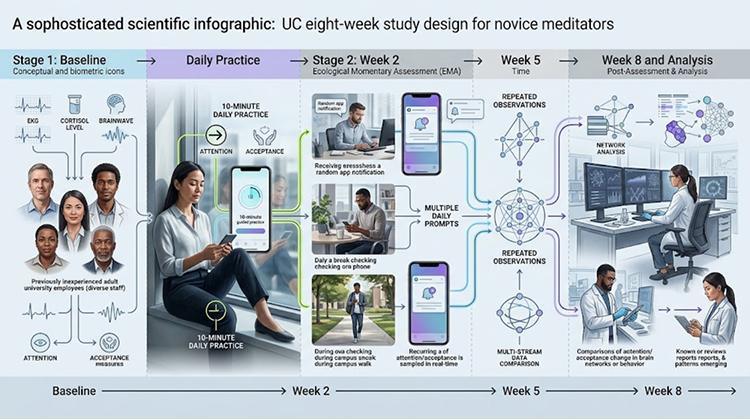
Participants were randomly assigned to either a mindfulness intervention or a waitlist control group using a 2-to-1 allocation. The intervention lasted eight weeks.
Those assigned to the mindfulness group received access to Headspace and were instructed to meditate for 10 minutes per day for eight weeks. They began with the app’s Basics program, which introduced mindfulness practices involving attention and acceptance. After completing the introductory material, participants moved to a Stress program.
The researchers did something particularly useful for studying mindfulness development: they did not rely exclusively on a questionnaire completed at the beginning and end of the study.
Instead, participants completed ecological momentary assessments, allowing researchers to measure attention and acceptance repeatedly during ordinary daily life. Surveys were delivered five times per day during four-day assessment periods at baseline and at Weeks 2, 5, and 8.
| Study Feature | UC Merced Research |
|---|---|
| Location | University of California, Merced |
| Participants | Non-faculty university employees new to meditation |
| Intervention | Headspace mindfulness program |
| Practice target | 10 minutes per day |
| Duration | 8 weeks |
| Assessment points | Baseline, Week 2, Week 5, Week 8 |
| Daily assessment method | Ecological momentary assessment |
| Key skills measured | Attention and acceptance |
| Control | Waitlist group |
The repeated measurements allowed the researchers to see whether changes were already appearing before the end of the eight-week program.
The Learning Curve Was Not Completely Linear
One of the more interesting aspects of the study is that mindfulness development did not simply increase continuously from Week 2 through Week 8.
For attention, the researchers found a significant increase from Week 2 to Week 5. Between Weeks 5 and 8, attention decreased somewhat, although it remained higher than baseline.
Acceptance followed a comparable pattern, with a marginal increase between Weeks 2 and 5 and a decline between Weeks 5 and 8 that still left scores above baseline.
This suggests that developing mindfulness skills may be less like climbing a straight staircase and more like practicing a skill that fluctuates as people gain experience.
Daily circumstances can change. Stress, workload, sleep, motivation, and other factors can influence how someone engages with meditation. A person may also become more familiar with a practice without producing a steadily increasing score every time they are assessed.
The UC Merced findings therefore support the idea that early progress does not necessarily mean uninterrupted progress.
Why Beginners May Respond Differently
The researchers also examined whether characteristics present before the intervention influenced how participants developed mindfulness skills.
One important factor was trait mindfulness, referring to a person’s existing tendency to be attentive and mindful in everyday life.
Participants who started with lower levels of trait mindfulness showed greater increases in attention over the intervention than those who began with higher trait mindfulness. This pattern was not found for acceptance.
The researchers also examined perceived stress at baseline.
Participants who started with lower perceived stress showed greater increases in both attention and acceptance compared with those who began with higher perceived stress.
These findings raise an important issue for digital mindfulness programs: the same intervention may not produce identical learning patterns for everyone.
A person who already tends to notice their thoughts and surroundings may have less room for measurable improvement in certain areas. Someone starting with less developed mindfulness skills may show a larger change because there is more room for development.
The Headspace Format May Have Influenced The Results
The study also offers an interesting clue about how mindfulness programs are structured.
Traditional in-person mindfulness programs may introduce attention and acceptance skills in stages. In contrast, the Headspace Basics material used in this research introduced the two skills together.
That may help explain why both attention and acceptance changed by Week 2.
The researchers noted that the simultaneous presentation of these skills could be an important factor when comparing app-based mindfulness training with traditional instructor-led programs. The findings therefore cannot automatically be generalized to every form of meditation or every mindfulness app.
This is particularly relevant because digital mindfulness has become a significant area of research. Earlier randomized research from the same UC Merced group found that 138 non-faculty university employees assigned to Headspace experienced reductions in subjective stress and repetitive thinking by Week 2, while perceived coping improved by Week 5. Those effects persisted through Week 8.
The newer study adds another piece to that research: it examines the potential skills behind mindfulness practice, rather than focusing only on stress outcomes.
What The Study Does Not Prove
The two-week finding is encouraging, but it needs to be interpreted within the boundaries of the research.
First, participants were instructed to meditate for 10 minutes every day. The study does not establish that two weeks of any amount of meditation will produce the same changes.
Second, the research examined specific measures of attention and acceptance. It did not establish that every person will feel calmer, happier, less anxious, or more focused after two weeks.
Third, the participants were non-faculty university employees in California, so the findings may not apply equally to older adults, adolescents, clinical populations, experienced meditators, or people dealing with serious mental-health conditions.
The researchers also used a waitlist rather than an active comparison intervention. That means the study can show differences between mindfulness training and waiting to receive the intervention, but it cannot fully determine how the program compares with another structured activity that requires the same amount of time and attention.
Broader evidence supports the potential usefulness of mindfulness apps, but the evidence remains mixed depending on the outcome being measured. The National Center for Complementary and Integrative Health notes that research on meditation and mindfulness has investigated stress, anxiety, depression, sleep, pain, and other outcomes, while also emphasizing that study quality and results vary across different practices.
Both Mindfulness Skills Changed By Week Two
The most notable finding was that both attention and acceptance showed significant increases by Week 2 among participants using Headspace.
The researchers initially expected attention to change quickly, while they considered the possibility that acceptance might develop on a different timeline. Instead, both skills increased by the second week.

Attention was significantly higher at Week 2 compared with baseline. It continued increasing between Weeks 2 and 5 before declining somewhat between Weeks 5 and 8, although it remained above the original baseline level.
Acceptance followed a similar overall pattern. It was significantly higher at Week 2 than at baseline, showed a marginal increase from Week 2 to Week 5, and then declined somewhat between Weeks 5 and 8 while remaining above baseline.
By Week 8, both attention and acceptance were significantly higher than they had been at the beginning of the study in the Headspace group. These changes were not observed in the same way among the waitlist controls.
The results therefore do not suggest that participants suddenly became highly skilled meditators after two weeks. Instead, the findings indicate that measurable changes in the skills being trained were already detectable after two weeks of practice.
That is a more precise interpretation of the research and avoids turning a statistical finding into a promise of a particular personal result.
What Two Weeks Could Mean For A New Meditator
The most practical lesson from the UC Merced research is not that everyone should expect a major transformation after 14 days.
Instead, the study suggests that skill development can begin before a mindfulness program is finished.
For a beginner, that may mean noticing a wandering thought more quickly, recognizing that attention has shifted, returning attention to the present experience, or becoming slightly less reactive toward an uncomfortable thought.
Those moments can seem insignificant when they happen during an individual meditation session. From a research perspective, however, repeated changes in these skills can become measurable over time.
The study’s design also reinforces the value of consistency. Participants were not asked to complete occasional long meditation sessions. They were instructed to practice for 10 minutes each day, allowing the intervention to become a repeated activity embedded in ordinary life.
That approach fits with the broader role of mindfulness as a skill rather than a one-time event.
Why Measuring Mindfulness In Daily Life Matters
Another contribution of this research is methodological.
Instead of asking participants to remember how mindful they had been over several weeks, the researchers repeatedly asked about attention and acceptance during everyday life. The ecological momentary assessment design produced measurements across different moments and situations.
That matters because mindfulness is ultimately practiced outside the meditation session.
A person may sit quietly for 10 minutes in the morning and then encounter emails, traffic, workplace disagreements, family responsibilities, and unexpected problems later in the day. The practical question is whether the skills practiced during meditation begin to appear in those ordinary situations.
The UC Merced study cannot answer every part of that question, but its repeated assessment design moves research closer to examining mindfulness as an everyday behavioral skill rather than simply a score recorded before and after an intervention.
A Short Practice Can Still Be A Skill-Building Process
The September 2026 study from UC Merced adds a useful dimension to the growing evidence surrounding digital mindfulness. Earlier research from the same research team showed that stress-related benefits could emerge relatively early in an eight-week Headspace intervention. The new analysis suggests that two of the fundamental skills involved in mindfulness—attention and acceptance—also showed measurable changes by Week 2.
That does not make two weeks a universal benchmark, and it does not mean every beginner will experience the same trajectory.
What the research does show is more specific: among novice meditators participating in this eight-week app-based intervention, changes in key mindfulness skills were detectable early, continued developing through the middle of the program, and remained above baseline at Week 8.
For people beginning a mindfulness practice, that finding shifts attention away from waiting for a dramatic result. The more meaningful signal may be much smaller: noticing sooner, reacting differently, returning attention more easily, and gradually becoming more familiar with the process of observing experience without immediately judging it.
That is precisely the kind of incremental change that can turn a 10-minute daily exercise into a repeatable mindfulness skill.