
Workplace stress has become a major concern for employers, healthcare systems and employees, but one recent study from the University of California, San Francisco suggests that reducing stress may not always require a long meditation session or an in-person wellness program.
A randomized clinical trial involving 1,458 UCSF employees found that participants assigned to a digital mindfulness meditation program experienced reductions in perceived stress, job strain and burnout, along with improvements in mindfulness, job reward, work engagement, depression and anxiety. The benefits were still present four months after the intervention began.
The research, led by Rachel M. Radin, PhD, with UCSF researchers including Elissa S. Epel, PhD, and Aric A. Prather, PhD, was published in JAMA Network Open on January 14, 2025. UCSF published a new report about the findings on September 3, 2026, bringing renewed attention to the question of whether short digital mindfulness sessions can become a practical workplace stress-management tool.
One of the most notable findings involved practice time. Participants who used the meditation program for five to 9.9 minutes per day experienced greater reductions in perceived stress than those practicing less than five minutes daily. The finding does not mean five minutes is a universal prescription, but it does suggest that a relatively small daily commitment may be meaningful when practiced consistently.
Why Workplace Stress Is A Growing Research Concern
Work stress affects more than how someone feels during the workday.
The UCSF researchers point to established connections between occupational stress and poorer emotional and physical well-being, as well as absenteeism and reduced productivity. UCSF’s September 2026 report notes that work-related stressors account for an estimated 8% of U.S. healthcare costs, while 45% of medical providers report high levels of burnout.
The issue is especially relevant in healthcare, where employees may face long hours, emotionally demanding interactions, high responsibility and frequent exposure to difficult situations.
That environment also creates a practical problem for traditional wellness interventions.
An employer might offer an eight-week mindfulness course, but employees still need to find time to attend sessions, travel to a location or coordinate the program with unpredictable work schedules. A self-guided smartphone or web-based intervention removes some of those logistical barriers.
This is where workplace stress management becomes a broader occupational-health question rather than simply an individual wellness issue.
Digital mindfulness can be accessed during a break, before work, after a shift or at home. The question is whether that convenience produces measurable changes rather than simply making meditation easier to access.
The UCSF trial was designed to test exactly that.
How The UCSF Mindfulness Trial Worked
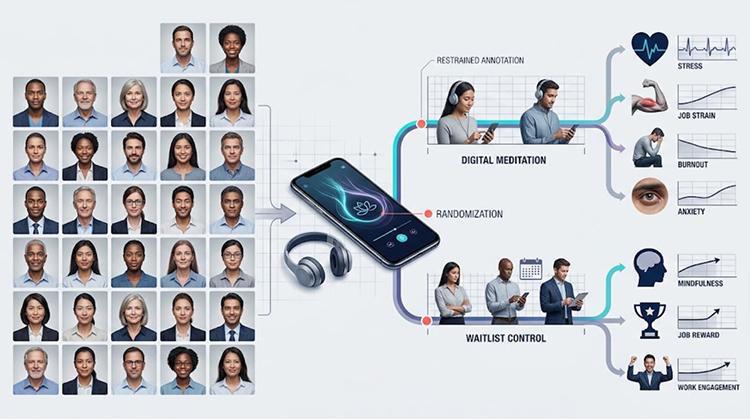
The researchers recruited employees from the UCSF health system who were at least 18 years old and reported mild to moderate stress during the previous month.
Participants also needed regular access to an internet-connected device and could not already have an established sitting meditation practice of at least three sessions per week during the previous three months.
That last requirement was important.
The researchers were primarily interested in people who were not already experienced meditators. This meant that the intervention was closer to a real-world test of whether employees with limited meditation experience could adopt a digital practice and benefit from it.
The trial ultimately included 1,458 employees, making it substantially larger than many behavioral studies of workplace mindfulness.
Participants were randomly assigned either to the digital meditation intervention or to a waiting-list control condition.
| Study Feature | Details |
|---|---|
| Institution | University of California, San Francisco |
| Participants | 1,458 employees |
| Population | Adults working within the UCSF health system |
| Intervention | Digitally delivered mindfulness meditation |
| Control | Waiting-list control |
| Primary stress measure | Perceived Stress Scale |
| Follow-up | 8 weeks and 4 months |
| Publication | JAMA Network Open, January 14, 2025 |
| Current UCSF report | September 3, 2026 |
| Trial | NCT03527303 |
The study evaluated both general psychological stress and work-specific outcomes, allowing researchers to determine whether the intervention affected how participants felt generally as well as how they experienced their jobs.
What The Digital Meditation Program Asked Employees To Do
The intervention used a commercially available digital mindfulness platform rather than requiring employees to attend live meditation classes.
That distinction matters because digital programs can standardize the instructions delivered to participants.
Everyone receiving the intervention had access to the same basic meditation platform rather than relying on different instructors, different workplace settings or different schedules.
The intervention was also intentionally brief enough to fit into everyday life.
Participants could use the program according to their own schedules, allowing the researchers to examine how actual adherence related to outcomes.
The researchers tracked engagement through the meditation platform, providing something that many behavioral studies cannot easily measure: an objective record of how much participants actually used the intervention.
This helped answer a second question beyond whether mindfulness worked.
It allowed the researchers to ask whether more practice was associated with greater benefits.
That distinction became particularly important when the researchers analyzed participants according to daily meditation time.
Five Minutes Became An Important Threshold
The study’s most attention-grabbing finding is connected to a surprisingly small amount of daily practice.
Participants who used the meditation program for five to 9.9 minutes per day experienced a greater reduction in perceived stress than those who used it for less than five minutes per day.

The reported difference in Perceived Stress Scale scores was −6.58 points, with a 95% confidence interval of −7.44 to −5.73.
That result needs careful interpretation.
The study does not establish that exactly five minutes is the minimum amount of meditation required for stress reduction.
It also does not prove that someone meditating for five minutes will experience the same outcome as a participant in the trial.
Instead, the finding comes from an adherence analysis showing that people who used the intervention for at least five minutes daily tended to experience greater reductions in perceived stress.
This is a meaningful distinction because adherence is one of the biggest challenges facing behavioral interventions.
A theoretically effective program is of limited practical value if employees cannot fit it into their lives.
A short digital practice may have an advantage precisely because it requires less time.
Stress Reduction Extended Beyond General Stress
The benefits observed in the trial were broader than perceived stress alone.
At the eight-week assessment, participants assigned to digital meditation showed improvements across the study’s measured outcomes.
Researchers reported reductions in:
- Global perceived stress
- Job strain
- Work burnout
- Depression
- Anxiety
They also found increases in:
- Mindfulness
- Job reward
- Work engagement
The improvements were maintained at the four-month follow-up.
This matters because workplace stress is rarely isolated.
An employee experiencing persistent stress may also experience lower job satisfaction, emotional exhaustion or difficulty engaging with work.
If an intervention affects several related dimensions simultaneously, it could have broader practical relevance than a program that changes only one stress score.
However, the researchers did not claim that mindfulness solves the organizational causes of workplace stress.
That distinction becomes particularly important when digital wellness programs are introduced by employers.
The Four-Month Follow-Up Strengthens The Findings
Short-term changes after a meditation program can be difficult to interpret.
People beginning a new activity may be especially motivated during the first few weeks. The novelty of the intervention can also influence participation and expectations.
The UCSF study therefore included a follow-up four months after randomization.
The improvements observed after eight weeks were maintained at four months, including the reduction in perceived stress and job strain. For perceived stress, the reported effect size at four months was Cohen’s d = 0.71, while the effect size for job strain was d = 0.37.
Those results provide stronger evidence than an assessment performed immediately after the intervention.
They suggest that the benefits were not limited to the final week of the program.
At the same time, four months is still relatively short compared with the length of an employee’s career. The study therefore cannot establish whether the effects would remain after a year or longer.
Long-term research will be necessary to determine whether employees continue practicing and whether sustained mindfulness practice produces lasting occupational or health benefits.
Mindfulness May Explain Part Of The Stress Reduction
The researchers also examined whether increases in mindfulness could help explain the reduction in stress.
Their exploratory analysis found that improvement in the Mindful Attention Awareness Scale accounted for approximately 23% of the effect of digital meditation compared with the waiting-list condition on reductions in perceived stress and job strain at four months.
That finding provides a possible mechanism.
Mindfulness training encourages people to notice thoughts, sensations and emotions without automatically reacting to them. In a workplace environment, that could theoretically create more space between a stressful event and the employee’s response.
For example, an unexpected email, difficult conversation or demanding deadline may still produce an initial stress reaction.
Mindfulness does not necessarily remove the event.
Instead, repeated practice may influence how quickly a person notices the reaction and how they respond to it.
The UCSF study does not prove that this mechanism explains all of the observed improvement. The 23% figure came from an exploratory analysis, so it should not be interpreted as showing that mindfulness accounts for exactly 23% of stress reduction in every employee.
Still, it provides an important clue about how digital meditation could affect workplace stress.
Why Digital Delivery Could Change Workplace Meditation
Traditional workplace mindfulness programs can be difficult to scale.
An organization with thousands of employees would need instructors, meeting spaces, scheduling systems and protected time if it wanted to provide live sessions.
A smartphone-based intervention changes the logistical equation.
Employees can access the program individually without requiring an instructor to be physically present.
That makes the approach particularly attractive to large organizations with distributed workforces or employees working different shifts.
The UCSF researchers specifically highlighted scalability as one potential advantage of self-guided digital mindfulness. Their trial also benefited from relatively low attrition and the ability to measure actual intervention use through the app.
But accessibility should not be confused with universality.
Not every employee will enjoy meditation.
Some may prefer physical activity, therapy, social support or other stress-management strategies.
Others may be dealing with workload problems that cannot be meaningfully addressed through individual coping techniques.
Digital mindfulness can provide one tool, but it cannot substitute for reasonable staffing, manageable workloads, adequate recovery time or organizational changes.
The Study Does Not Mean Five Minutes Can Fix Burnout
This is where the findings require restraint.
Burnout is influenced by more than an individual’s ability to regulate attention.
Workload, staffing, autonomy, leadership, compensation, workplace culture and job security can all affect occupational well-being.
The UCSF researchers themselves state that workplaces should consider system-level changes alongside individual interventions.
That is an important safeguard against turning mindfulness into a responsibility placed entirely on employees.
If a worker is overwhelmed by excessive demands, telling that person to meditate for five minutes may provide a useful coping strategy, but it does not remove the underlying workload.
The study supports mindfulness as one potentially scalable component of workplace wellness.
It does not demonstrate that mindfulness can compensate for an unhealthy work environment.
Who Participated In The Research?
The study’s participants were employees of a large academic medical center, which gives the findings strong relevance to healthcare workplaces but also creates an important limitation.
The population was not a random sample of every type of American worker.
Participants volunteered, had access to web-enabled devices and reported at least mild to moderate stress. Experienced meditators were excluded.
That means the results may not transfer perfectly to people working in manufacturing, construction, transportation, retail, education or other environments.
The digital format may also work differently depending on employees’ schedules and workplace conditions.
A five-minute meditation break may be easy to take in an office but much harder during a busy hospital shift or a job requiring continuous physical attention.
Future studies involving different industries could help determine how broadly the findings apply.
UCSF Researchers Are Continuing To Examine Digital Mindfulness
The current UCSF report is particularly relevant because the research team has been studying digital meditation and workplace stress for several years.
Rachel Radin, Elissa Epel and Aric Prather have previously worked on research examining digital meditation and stress-related outcomes among employees. An earlier randomized trial involving adults with overweight also examined the effects of digital meditation on work stress and health outcomes.
The newer large-scale trial builds on that research by examining a much larger employee population and multiple dimensions of workplace well-being.
The researchers are also interested in what happens beyond stress scores.
The JAMA Network Open paper notes that future research should investigate downstream health outcomes and potential employer health savings, particularly because chronic work stress has been associated with metabolic and other health concerns.
That creates a much larger research question.
If a low-cost digital intervention can consistently reduce stress across large employee populations, could it eventually affect healthcare utilization, absenteeism, employee retention or other organizational outcomes?
The current study does not answer those questions.
It provides a foundation for testing them.
What Employees Can Take From The Five-Minute Finding
The most practical lesson from the UCSF study is not that everyone needs to meditate for exactly five minutes.
It is that consistency and accessibility may matter as much as duration.
A person who cannot commit to a 30-minute meditation session may be more likely to maintain a five- or ten-minute practice.
The UCSF results suggest that participants who engaged with digital meditation for at least five minutes per day tended to experience greater stress reductions than those practicing less.
That creates a realistic entry point for people who are new to mindfulness.
A short practice could be placed before the workday, during a scheduled break or after finishing work.
The purpose would not be to eliminate every stressful thought.
Instead, the goal would be to create a brief period in which attention is deliberately directed away from automatic reactions and back toward present-moment awareness.
For someone new to mindfulness, that may make the practice feel more manageable than committing immediately to a lengthy daily session.
What The UCSF Study Really Tells Us About Workplace Mindfulness
The September 2026 UCSF report has brought renewed attention to a randomized trial involving 1,458 employees, but the underlying research was published in JAMA Network Open in January 2025. That timeline matters because the story is a fresh news report about established research rather than a newly completed 2026 experiment.
The evidence is nevertheless substantial.
Employees assigned to digital mindfulness experienced reductions in perceived stress, job strain and burnout and improvements in mindfulness, job reward, work engagement, depression and anxiety. These improvements remained at the four-month follow-up.
The adherence analysis added another useful finding: people practicing five to 9.9 minutes per day experienced greater reductions in perceived stress than those practicing less than five minutes.
But the study should be interpreted within its limits.
It involved volunteers from one academic medical system, used a waiting-list control rather than an active wellness intervention, and followed participants for only four months.
Most importantly, meditation should not be presented as a substitute for fixing excessive workloads or unhealthy organizational conditions.
The more defensible takeaway is simpler: a brief digital mindfulness routine may provide a practical, scalable way for employees to reduce perceived stress and improve aspects of workplace well-being, especially when the practice is consistent.
Five minutes may be enough to make starting feel realistic. The research does not say that five minutes can solve workplace stress—but it does suggest that a small, repeatable mindfulness habit can be worth studying as part of a larger approach to employee well-being.