
Meditation apps have made guided mindfulness practices available to millions of people, offering structured sessions for stress management, emotional health, sleep, and concentration. Their popularity has also raised an important research question: Do app-based meditation programs produce measurable benefits beyond activities that are already relaxing, such as listening to music?
A randomized controlled trial involving 1,211 adults has put that question under closer examination. Published November 5, 2026, in BMC Psychology, the study compared four app-guided meditation approaches with an active control group that listened to classical music. After four weeks, the researchers found no statistically significant overall advantage for meditation across the study’s preregistered psychological, cognitive, and physiological outcomes after correcting for multiple comparisons. The published research therefore raises questions about how digital meditation programs are evaluated and what users should expect from them.
The findings do not establish that meditation is ineffective. Instead, they suggest that the benefits of short-term app-guided practice may be more difficult to separate from the effects of other structured, engaging activities than some claims about digital wellness products imply. The study also reported substantial participant dropout, making its results important but not definitive.
Inside the 1,211-Person Meditation Study
The research, titled “Digital meditation at scale: a randomized citizen science trial comparing four meditation practices,” was conducted by a team that included Helané Wahbeh, Sitara Taddeo, Erik Brinsmead, Michael Kriegsman, Aravind Ravi, Chris Aimone, and Arnaud Delorme.
Wahbeh and several members of the research team were affiliated with the Institute of Noetic Sciences in Novato, California. Wahbeh also had an affiliation with the Department of Neurology at Oregon Health & Science University in Portland. Delorme was affiliated with the University of California San Diego’s Swartz Center for Computational Neuroscience, among other institutions.
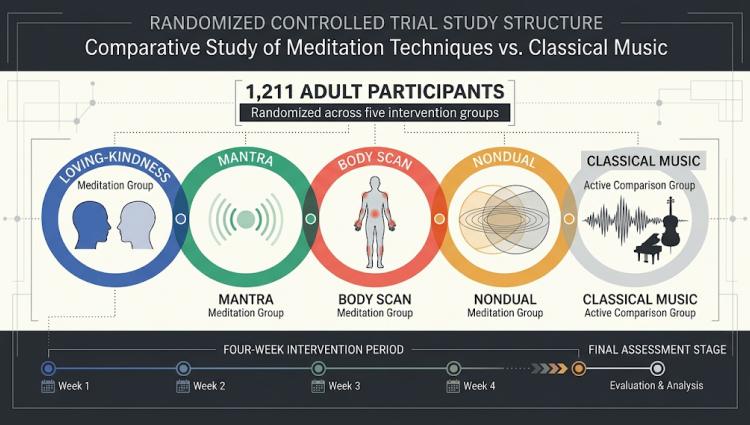
The investigators randomly assigned 1,211 adults to one of five groups. Four groups received app-guided meditation programs, while the fifth listened to classical music as an active comparison condition. The intervention lasted four weeks, with participants assessed before and after the program.
The four meditation approaches represented different contemplative practices:
- Loving-kindness meditation: Participants practiced directing feelings of goodwill, care, and compassion toward themselves and others.
- Mantra meditation: Participants used repeated words or phrases as an anchor for attention.
- Body scan meditation: Participants directed attention through different areas of the body, noticing sensations without immediately reacting to them.
- Nondual meditation: Participants practiced a form of awareness that emphasizes experience without the usual separation between the observer and what is observed.
The classical-music group was particularly important to the study design. Instead of comparing meditation with doing nothing, the researchers used an active control that provided participants with a structured listening activity. This made it possible to examine whether meditation produced additional measurable changes beyond those associated with listening to music.
The study was preregistered on the Open Science Framework on October 24, 2024. It was also registered retrospectively with the International Standard Randomised Controlled Trial Number registry on August 12, 2026, under registration number ISRCTN10867561. The research was funded by the InnerScience Research Fund, which the authors reported had no role in designing, conducting, analyzing, or reporting the study.
What Researchers Measured Beyond Self-Reported Well-Being
The trial examined several dimensions of psychological and physical functioning rather than relying on a single questionnaire about relaxation.
Participants completed self-report assessments covering well-being, mood, self-transcendence, nondual awareness, interoception, and compassion. These measures were intended to capture changes in emotional experience, awareness, and how participants related to themselves and their surroundings.
The researchers also used cognitive tasks. The Stroop test evaluates aspects of attention and the ability to manage conflicting information. The N-back task measures working memory by asking participants to identify whether information matches something presented earlier in a sequence.
Physiological measurements added another layer. Electroencephalography, or EEG, records electrical activity from the brain using sensors placed on the scalp. Heart rate variability, commonly abbreviated HRV, measures changes in the time intervals between consecutive heartbeats. Heartbeat-evoked potentials examine brain responses associated with cardiac signals.
Together, these assessments offered a broader view of whether four weeks of guided meditation produced measurable differences in mental performance, emotional measures, and physiological activity.
The statistical approach also mattered. The investigators used linear mixed models and false-discovery-rate correction. When a study evaluates many outcomes, some apparently significant results can occur by chance. Correcting for multiple comparisons helps reduce the likelihood of treating isolated statistical findings as reliable evidence of an intervention’s effectiveness.
Meditation Did Not Outperform Classical Music Across the Main Outcomes
The central result was that none of the preregistered meditation-versus-control outcomes remained statistically significant after false-discovery-rate correction.
In practical terms, the researchers did not find reliable evidence that the four app-guided meditation programs produced greater overall improvements than the classical-music control across the psychological, cognitive, and physiological measures they had specified in advance.

The findings also did not support the four technique-specific hypotheses. Loving-kindness, mantra, body scan, and nondual meditation did not demonstrate a consistent advantage over one another across the measured outcomes.
This is an important distinction. The results do not show that music and meditation are identical activities, nor do they prove that the practices have no benefits. They indicate that, under the conditions of this four-week experiment, the researchers could not establish a general advantage for app-guided meditation over the active music comparison using the preregistered outcomes.
The study also reported that Bayesian analyses favored the null hypothesis for the temporal EEG measures. This provides another statistical perspective on those particular brain-activity findings, rather than simply relying on a failure to reach conventional statistical significance.
For consumers, the findings offer a reason to be cautious about broad claims that a meditation app will reliably improve multiple aspects of mental or physical health within a short period. The study did not test every app, every meditation program, or every possible duration of practice. Its conclusions apply to the specific interventions, comparison condition, participants, and assessment period examined by the research team.
A Few Differences Emerged Outside the Main Predictions
Although the main comparisons did not establish an overall advantage for meditation, the researchers reported a small number of findings in additional analyses.
Two self-report outcomes showed differences between study groups that survived statistical correction on contrasts that had not been predicted in the original hypotheses. These involved self-compassion isolation and sleep quality, both reported at q = 0.050.
The researchers also found that participants assigned to mantra meditation demonstrated faster working-memory reaction times than those assigned to body scan meditation. This was a specific difference between two meditation groups, rather than evidence that mantra practice was broadly superior to the other techniques or to classical music.
An exploratory analysis examined whether personality characteristics influenced responses. The researchers found that trait neuroticism moderated the relationship between meditation and working-memory reaction time. Participants with higher neuroticism showed a greater benefit in cognitive speed relative to the control group.
This result is potentially relevant because people do not necessarily respond to the same practice in the same way. Personality, prior experience, motivation, and individual circumstances may influence how someone engages with meditation.
However, the neuroticism finding was exploratory and requires replication. It should not be treated as a basis for recommending a particular meditation technique to people with a specific personality profile.
The additional findings also need to be interpreted alongside the main results. Isolated differences do not overturn the overall conclusion that the preregistered meditation-versus-music comparisons did not demonstrate a consistent advantage.
Why the 43% Completion Rate Matters
One of the study’s most important limitations was the proportion of participants who completed the final assessments.
Although 1,211 adults were randomized, endpoint data were available for only 43% of them. This means that fewer than half of the original participants contributed data at the final assessment point.
The authors also reported that missingness was non-random. This matters because people who complete a four-week digital program may differ from those who stop participating. Participants who remain engaged could have different expectations, motivation, schedules, experiences, or responses from those who leave.
If the people who complete a study are systematically different from those who do not, the final results may not represent the full group that originally enrolled.
This issue is especially relevant to digital wellness research. App-based programs depend on continued participation, and daily routines, work demands, family responsibilities, and changing motivation can affect whether users maintain a practice. A program may be easy to access but still difficult to sustain.
The completion rate does not automatically invalidate the trial. Randomization and the researchers’ statistical methods remain important strengths. Nevertheless, substantial non-random missing data limit confidence in how broadly the findings can be applied.
The authors therefore treated the results cautiously and identified the need for further research.
What the Results Mean for Meditation App Users
For people choosing a meditation app, the study suggests looking beyond promotional claims and considering the actual structure of a program.
A guided session can provide a useful framework for setting aside time, directing attention, and practicing a particular technique. Loving-kindness, mantra repetition, and body scanning also involve different approaches, so personal preference may influence which one someone is willing to continue.
However, this trial did not establish that one of these four approaches reliably produces greater overall psychological, cognitive, or physiological benefits than classical music after four weeks.
That does not mean users should abandon meditation. It means that expectations should match the available evidence. A person may find a practice personally meaningful, calming, or useful as part of a daily routine even when a controlled trial does not identify a statistically significant advantage across a broad set of measured outcomes.
People interested in experimenting with different approaches can explore the site’s guides to meditation techniques, including practices that use focused attention, body awareness, and compassion.
It is also worth distinguishing a meditation habit from a clinical treatment. This trial was not designed to establish that an app can replace professional care for depression, anxiety disorders, sleep conditions, or other health concerns. People seeking help for persistent or serious symptoms should consider appropriate support from qualified healthcare professionals.
The Next Challenge for Digital Meditation Research
The 1,211-person trial highlights a central challenge for the growing digital wellness sector: showing that an intervention produces benefits beyond the experience of taking part in a structured activity.
Future research can build on this work by improving participant retention, examining longer practice periods, and testing whether benefits differ according to baseline characteristics or prior meditation experience. Researchers may also need to investigate whether regular practice over several months produces effects that a four-week intervention cannot capture.
Another important question is whether particular outcomes are more responsive to specific techniques. A practice focused on compassion may have different aims from one centered on attention or body awareness. Studies that measure those outcomes with clearly defined hypotheses could help identify where each approach may be most useful.
For now, the findings from Helané Wahbeh, Arnaud Delorme, and their colleagues provide a valuable check on broad claims about app-based meditation. In this randomized trial, four weeks of guided practice did not demonstrate overall superiority to classical music across the main outcomes. The substantial loss of endpoint data also leaves important questions open.
The study does not settle the wider debate about meditation’s value. It does, however, reinforce the need for careful testing, realistic expectations, and evidence that separates the effects of a particular practice from the benefits of simply making time for a restorative activity.