
Researchers at the University of California San Diego have found that combining ketamine-assisted psychotherapy with mindfulness-based addiction treatment may help people with opioid use disorder become more aware of their body’s internal signals and respond to cravings more effectively. The findings, published online November 5, 2026, in the Journal of Psychopharmacology, offer new insight into how mindfulness and ketamine may work together during addiction recovery.
The research was led by Benjamin R. Lewis, MD, of the University of Utah, and Eric L. Garland, PhD, professor of psychiatry at UC San Diego School of Medicine. Their analysis examined data from a randomized clinical trial involving 68 adults with opioid use disorder who were receiving buprenorphine treatment.
Participants received either an eight-week mindfulness-based program called Mindfulness-Oriented Recovery Enhancement (MORE) or the same program combined with two sessions of ketamine-assisted psychotherapy. The researchers found that participants receiving the combined treatment developed greater awareness of bodily sensations, particularly during the period surrounding their first ketamine session.
The analysis also linked improvements in two specific abilities—listening to bodily sensations and using those sensations to regulate distress—with lower opioid cravings three months after treatment.
The results offer a possible explanation for why combining mindfulness with ketamine may support addiction recovery. However, the researchers emphasize that the findings are preliminary and rely substantially on self-reported information.
What The UC San Diego Researchers Discovered
The November 5 publication, titled Ketamine, an interoceptive associative agent? Evidence from ketamine-assisted Mindfulness-Oriented Recovery Enhancement for opioid use disorder, focused on a process known as interoception.
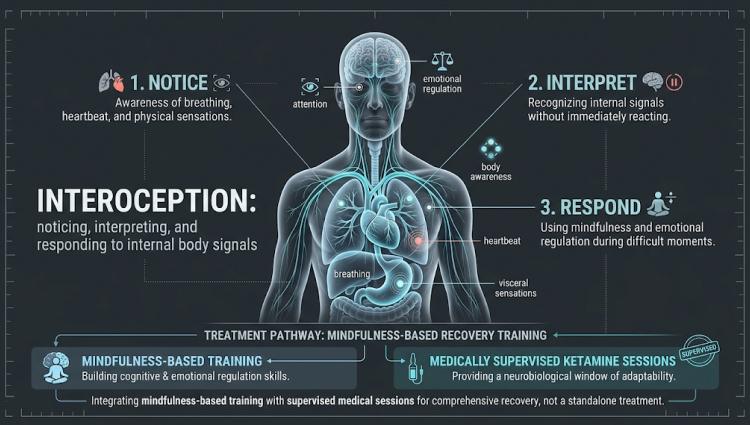
Interoception refers to the ability to notice, interpret, and respond to signals originating inside the body. These signals include changes in breathing, heartbeat, muscle tension, stomach sensations, and other physical experiences.
The ability to recognize these signals can influence emotional regulation and decision-making. For someone experiencing addiction, recognizing the physical sensations associated with a craving may create an opportunity to respond differently instead of automatically following the urge to use a substance.
Eric Garland and his colleagues investigated whether ketamine could strengthen this process when combined with mindfulness training.
The study was a secondary analysis of a randomized clinical trial registered as NCT04892251. Rather than introducing a new treatment experiment, the researchers examined previously collected information to understand whether improvements in body awareness could help explain reductions in opioid cravings.
This distinction matters because the research provides evidence about a possible mechanism behind treatment outcomes, not definitive proof that ketamine directly changes the brain in a way that prevents relapse.
Inside The 68-Participant Clinical Trial
The original trial included 68 adults diagnosed with opioid use disorder who were receiving buprenorphine, a medication used to treat opioid dependence.
Researchers randomly assigned participants to two groups, with 34 individuals in each.
| Treatment group | Intervention |
|---|---|
| MORE group | Eight weeks of Mindfulness-Oriented Recovery Enhancement |
| Combined-treatment group | Eight weeks of MORE plus two ketamine-assisted psychotherapy sessions |
The average participant age was 36.8 years. Approximately 70.6% were male, and 92.6% identified as White. Participants reported an average history of 11.3 years of opioid use.
Researchers initially screened 500 individuals before enrolling the 68 participants who met the study requirements.
The trial was conducted under clinical supervision, and all participants continued receiving buprenorphine. The study therefore examined whether mindfulness and ketamine could provide additional support alongside established medication treatment.
The research team included Eric L. Garland from UC San Diego and Benjamin R. Lewis from the University of Utah. Garland developed the MORE approach, which has been examined in previous clinical studies involving opioid misuse and addiction recovery.
How Mindfulness-Oriented Recovery Enhancement Works
Mindfulness-Oriented Recovery Enhancement is an eight-week therapeutic program developed by Eric Garland. It combines mindfulness meditation with cognitive techniques intended to help participants respond differently to distressing experiences and recognize positive emotions.
The program includes three central components.
Mindfulness: Participants practice observing thoughts, emotions, cravings, and physical sensations without immediately reacting to them. Mindful breathing and body scans help participants recognize the physical experiences associated with stress and substance cravings.
Cognitive reappraisal: This component teaches participants to reconsider negative thoughts and stressful experiences. Rather than automatically accepting an initial interpretation, they practice examining situations from different perspectives.
Savoring: Participants learn to pay closer attention to pleasant experiences and positive sensations. This approach is intended to strengthen responses to natural rewards rather than allowing drug-related experiences to dominate attention.
The intervention consisted of eight weekly group sessions, each lasting two hours. Licensed clinicians facilitated the sessions through a secure video platform, with groups generally containing five to 10 participants.
Participants were also instructed to complete approximately 15 minutes of guided mindfulness, reappraisal, or savoring practice at home each day.
The combined-treatment group followed the same basic program but incorporated two supervised ketamine-assisted psychotherapy sessions.
Why Researchers Focused On Interoception
The central question behind the new analysis was whether people receiving ketamine alongside mindfulness training became better at recognizing and interpreting bodily sensations.
In addiction, cravings can involve more than thoughts about obtaining or using a substance. Physical sensations such as tension, restlessness, discomfort, and changes in breathing can become closely associated with the urge to use.
When these sensations are difficult to recognize or interpret, responding to them may become more challenging.
Interoception provides a framework for examining this relationship. It considers how the brain and body exchange information and how people use that information to regulate their emotions and behavior.
The researchers used two measurement approaches.
The first involved smartphone-based ecological momentary assessments. Participants received prompts three times daily asking how aware they were of sensations inside their bodies at that moment.
The second involved the Multidimensional Assessment of Interoceptive Awareness, or MAIA, a questionnaire measuring different aspects of bodily awareness.
These included noticing sensations, regulating attention, recognizing emotional changes, listening to the body, and using physical awareness to manage distress.
By combining repeated smartphone assessments with questionnaire responses, the team could examine both momentary awareness and broader changes in how participants interpreted bodily signals.
Ketamine Was Associated With Faster Improvements In Body Awareness
One of the most notable findings involved the timing of changes in interoceptive awareness.
Before ketamine administration, the two groups reported nearly identical levels of momentary body awareness. Their average scores were 5.71 in the MORE-only group and 5.89 in the combined-treatment group on a 0–10 scale.

The difference became more pronounced around the first ketamine session.
During the week surrounding the first dose, average body-awareness scores reached 6.93 in the combined-treatment group, compared with 5.57 among participants receiving MORE alone.
The difference between the groups was approximately 1.35 points.
Higher awareness remained evident during the second dosing period, the final mindfulness sessions, and the follow-up period. At the later follow-up, average scores were 7.18 in the combined-treatment group and 5.85 in the MORE-only group.
The researchers’ statistical model also identified a significantly faster increase in body awareness during the first 35 days among participants receiving ketamine alongside mindfulness training.
The effect was statistically significant, with a reported p-value below .001.
These findings suggest that ketamine may have helped participants become more attentive to bodily sensations during the mindfulness program. However, because the measurements relied on participant reports, they do not independently demonstrate changes in brain activity or objective physiological function.
Body Listening And Self-Regulation Were Linked To Lower Cravings
Simply noticing physical sensations may not be enough to change addictive behavior. Researchers therefore examined whether participants could use bodily information to regulate distress and respond more effectively to cravings.
Two MAIA dimensions showed statistically significant improvements in the combined-treatment group.
Self-regulation measures the ability to use awareness of bodily sensations to manage emotional discomfort. For example, someone experiencing tension may recognize changes in breathing and use that awareness to respond more deliberately.
Body listening measures the tendency to consult physical sensations for information when dealing with emotional or stressful situations.
The combined-treatment group showed greater improvements in both areas compared with participants receiving mindfulness training alone.
The researchers then examined whether these improvements were associated with opioid cravings three months after treatment.
Their mediation analysis suggested that the combined improvement in body listening and self-regulation helped explain the relationship between the combined intervention and lower subsequent cravings.
The indirect effect was statistically significant, with a reported p-value of .044 and a 95% bootstrap confidence interval ranging from −25.50 to −0.25.
This result supports interoceptive regulation as a possible mechanism behind the treatment’s effects. However, the researchers described the analysis as preliminary. A separate sensitivity analysis using a broader latent-variable measure produced an indirect effect that did not reach conventional statistical significance.
The findings therefore offer a promising explanation that requires further testing rather than a confirmed account of how ketamine changes addiction-related behavior.
Earlier Results Showed Fewer Drug-Use Episodes
The new publication builds on clinical findings reported earlier in 2026 in Nature Mental Health.
In that randomized trial, participants receiving MORE combined with ketamine reported fewer instances of drug use and lower opioid cravings than those receiving mindfulness treatment alone.
Across the period from the end of treatment through the three-month follow-up, the combined-treatment group experienced 44% fewer instances of drug use.
At the three-month assessment, opioid craving scores were also significantly lower in the combined-treatment group. The reported difference was approximately 26.79 points on a 0–100 visual analog scale.
The November analysis examined whether increased body awareness could help explain those earlier clinical results.
This connection is important because researchers are interested in more than whether a treatment reduces substance use during a specific period. They also want to understand which psychological processes may help people respond differently to cravings after formal treatment ends.
If improved body awareness contributes to better emotional regulation, mindfulness practices could potentially provide skills that participants continue using in everyday recovery.
However, the earlier clinical findings and the November secondary analysis are based on the same underlying trial. They should not be counted as two independent clinical demonstrations of effectiveness.
What The Findings Could Mean For Addiction Recovery
The research highlights a possible connection between mindfulness, body awareness, and the regulation of addictive behavior.
Many mindfulness exercises encourage people to observe physical sensations without immediately trying to suppress or escape them. In recovery, this approach may help individuals recognize the physical components of a craving before responding automatically.
For example, someone experiencing an urge to use opioids might notice muscle tension, changes in breathing, restlessness, or discomfort. Mindfulness training can help the individual observe these sensations, recognize their relationship with emotional experiences, and practice a different response.
The goal is not necessarily to eliminate every craving. Instead, it is to develop greater awareness and the ability to make decisions without automatically following the urge.
The findings also suggest that mindfulness-based treatment may benefit from combining several approaches. Attention training, cognitive reappraisal, positive emotional experiences, and appropriate clinical support may contribute to different aspects of recovery.
For readers interested in the everyday practices behind this research, Spiritual Endeavors also explores mindfulness routines that encourage greater awareness of thoughts, emotions, and physical sensations.
Nevertheless, the clinical program studied by UC San Diego researchers was delivered under professional supervision. It should not be confused with independently practicing meditation or attempting to use ketamine without medical oversight.
Limitations And Questions For Future Research
Although the results are encouraging, several limitations affect how they should be interpreted.
First, the study involved only 68 randomized participants. The secondary analysis had an even smaller sample for some measurements. Post-treatment smartphone assessment data were available for 18 participants in the combined-treatment group and 15 in the MORE-only group.
This limited sample makes it difficult to determine whether the findings will apply to larger and more diverse populations.
Second, participants knew which treatment they received. Because ketamine produces noticeable psychological effects, blinding participants to the intervention was not possible. Expectations about treatment may have influenced some self-reported outcomes.
Third, the researchers relied heavily on questionnaires and smartphone reports. Although these tools provide valuable information about daily experiences, they cannot independently establish changes in the brain’s processing of internal body signals.
The participant population also had limited demographic diversity. More than 92% identified as White, making additional research among more representative populations important.
Finally, the study does not establish that ketamine should replace buprenorphine or other established treatments for opioid use disorder. Participants continued receiving medication throughout the research, and ketamine was administered as an additional intervention under clinical supervision.
Future studies could use larger participant groups, objective physiological measurements, and longer follow-up periods to determine whether improvements in interoception translate into sustained reductions in drug use and relapse.
The research team also wants to investigate whether ketamine creates a temporary period in which people may be more receptive to learning mindfulness and emotional regulation skills.
For now, the November 5 findings provide a new perspective on how body awareness may contribute to addiction recovery. They suggest that combining mindfulness with carefully supervised ketamine-assisted psychotherapy could help some individuals recognize cravings earlier and respond to difficult internal experiences more skillfully.
The central question for future research is whether these changes can produce lasting improvements in recovery while supporting the medication and clinical care that people with opioid use disorder already need.