
A new U.S. study from researchers at the University of California, Berkeley suggests that the challenge with self-compassion practices may not be learning the technique itself, but making it part of everyday behavior. Published September 15, 2026, in Scientific Reports, the randomized controlled trial tested whether adding habit-formation strategies to a very brief self-compassion practice could make people more likely to continue using it over six months. The study included 497 adults recruited across the United States and compared self-compassionate touch alone with the same practice supported by specific habit-building tools.
The researchers found that participants who received the additional habit-formation component reported practicing more frequently and experiencing greater automaticity, meaning the behavior became easier to initiate without deliberate effort. They also reported greater increases in self-compassion and self-compassion automaticity. By six months, the habit-supported group also showed a greater reduction in symptoms of psychopathology, although the researchers did not find a significant difference between groups for perceived stress.
The findings add a different dimension to research on mindfulness and self-compassion. Instead of asking whether a practice works during a guided session, the Berkeley-led research examined what happens after the session ends and whether a small behavioral structure can help people keep practicing.
Why Self-Compassion May Depend On Repetition
Self-compassion is generally described as responding to personal suffering, mistakes, or difficult emotions with kindness rather than harsh self-judgment. Research has linked self-compassion with psychological well-being, while also distinguishing it from simply feeling good about oneself. A major review by University of Texas at Austin researcher Kristin Neff describes self-compassion through elements including self-kindness, common humanity and mindfulness.
The problem examined by the new study is practical. A person may learn a useful exercise during a workshop, online program, therapy session, or meditation class and still fail to use it when daily life becomes busy. The researchers therefore focused on habit formation as a possible bridge between learning a practice and repeatedly using it.
That distinction matters for mindfulness routines. A five-minute or even 20-second exercise has a very different potential impact if it happens once than if it becomes something a person automatically remembers to do during a stressful moment.
The Berkeley researchers described well-being practices as behaviors intended to cultivate enduring well-being through repeated habits of mind. They also pointed to previous evidence showing that practice frequency is associated with the benefits people receive from these interventions.
This places the new findings within a broader question for mindfulness routines: how can a practice become part of ordinary life rather than remain something people intend to do?
The Berkeley Study Included 497 U.S. Adults
The research team included Eli S. Susman, Serena Chen, Dacher Keltner and Allison G. Harvey, all affiliated with the Department of Psychology at the University of California, Berkeley. The study was approved by the university’s ethics committee, preregistered, and registered under ClinicalTrials.gov identifier NCT05866718.

The researchers initially planned to recruit at least 440 adults from across the United States. Ultimately, 497 adults were recruited between June 2023 and February 2024 through social media advertisements. Participants had to be at least 18 years old, live in the United States, speak English, provide informed consent, complete the online assessments, and personally own a smartphone.
The study was delivered entirely online, allowing participants to complete the intervention and follow-up assessments from locations of their choosing. Participants were randomly assigned in a 1:1 design to one of two conditions.
| Study Group | What Participants Received |
|---|---|
| SCT | Self-compassionate touch practice |
| SCT+HABITS | Self-compassionate touch plus habit-formation strategies |
The comparison is important because the researchers did not compare the habit-supported group with a no-treatment or waitlist group. Both groups received the self-compassionate touch intervention. The key question was whether adding habit-building tools produced additional benefits.
The Habit-Building Group Received A Detailed Daily Plan
The difference between the two groups was the additional habit-formation component.
Participants in both groups were asked to select a cue that would come immediately before their daily practice. One example given by the researchers was finishing tooth brushing and then performing the self-compassion exercise.
The habit-supported group went further. Participants received a self-guided online presentation explaining principles of habit formation and were asked to develop a detailed plan covering when, where, and how they would practice. They also selected a cue, identified possible barriers, chose intrinsic rewards, and were instructed to create daily phone reminders.
They were also allowed up to two emergency skip days per week when completing the practice was not possible. After creating their plan, participants were asked to visualize themselves carrying it out.
This is a notable feature of the study because the intervention did not attempt to make self-compassion more complicated. Instead, it added structure around the existing micropractice.
The distinction is subtle but important: the researchers were testing whether changing the behavioral environment surrounding the practice could change long-term adherence.
Researchers Followed Participants For Six Months
The researchers assessed participants at baseline, three months, and six months. The six-month period was selected in part because previous habit research has suggested that new behaviors can require substantially different amounts of time to become established, depending on the behavior and circumstances.
The study focused on two primary behavioral outcomes: practice frequency and practice automaticity.
Practice frequency measured how often participants reported performing the exercise. Practice automaticity measured how much the behavior felt like something they could initiate without consciously remembering or deliberating about it.
The researchers also measured self-compassion, self-compassion automaticity, perceived stress, and symptoms of psychopathology.
This allowed the researchers to distinguish between simply doing an exercise more often and developing a broader tendency to respond to difficult experiences with self-compassion.
Habit Formation Increased Practice Frequency
The strongest behavioral finding was that the SCT+HABITS group reported significantly higher practice frequency than the self-compassion-only group at both three and six months. Practice automaticity was also significantly higher in the habit-supported group at both follow-up points.
The researchers described the standardized effects for the primary outcomes as small to medium. But they also translated the difference into a more concrete measure: the habit-supported intervention was associated with nearly two additional practice sessions per week, equivalent to roughly 50 additional practice episodes over six months.
That distinction helps put the findings into context.
A difference that looks modest when expressed as a standardized statistical effect can accumulate considerably when the behavior requires only seconds to perform. A few additional sessions each week may seem insignificant in isolation, but over half a year the difference becomes dozens of additional opportunities to practice.
The study therefore provides evidence that the habit-building component changed the behavior researchers were specifically trying to change: repeated engagement.
Self-Compassion Also Increased More With Habit Support
The behavioral differences were accompanied by psychological differences.
At both three and six months, participants receiving the habit-supported intervention showed significantly greater increases in self-compassion and self-compassion automaticity compared with participants who received self-compassionate touch alone.
Self-compassion automaticity is particularly interesting because it goes beyond remembering to perform the exercise.
The researchers used measures intended to capture whether compassionate responses toward oneself become more spontaneous in daily life. In practical terms, the question shifts from “Did you remember to perform the exercise?” to something closer to “Did responding to yourself with greater kindness become easier or more automatic?”
That distinction may matter for mindfulness-based routines because many practices are intended to influence how people respond to experiences outside formal practice sessions.
The study does not establish that the intervention permanently changes personality or emotional behavior. It does, however, provide evidence that greater automaticity in the practice was associated with improvements in self-compassion measures over the six-month period.
Stress Did Not Improve More Between Groups
One of the most important details is also one of the easiest to overlook.
The researchers did not find a significant difference between the two groups in perceived stress at either three or six months. That means the study does not support a simple claim that adding habit-building tools to self-compassionate touch directly produced greater stress reduction.
There was a more complicated pattern in the mediation analysis. Improvements in practice automaticity were associated with later changes in several psychological outcomes, and the indirect pathway involving stress was statistically significant even though the overall group difference in stress was not.
The researchers therefore suggest that habit formation may be part of the pathway through which repeated practice influences well-being, while also emphasizing that the evidence does not establish a direct stress-reduction effect from the intervention.
That distinction is especially relevant because self-compassion research has already produced evidence of benefits for stress, anxiety, and depressive symptoms across multiple studies. A 2023 meta-analysis covering 56 randomized controlled trials found small-to-medium effects for several outcomes, while also noting methodological limitations and a high overall risk of bias in the included literature.
The new Berkeley study adds a narrower question: whether making the practice easier to repeat can strengthen some of those outcomes.
The Practice Took 20 Seconds Or Less
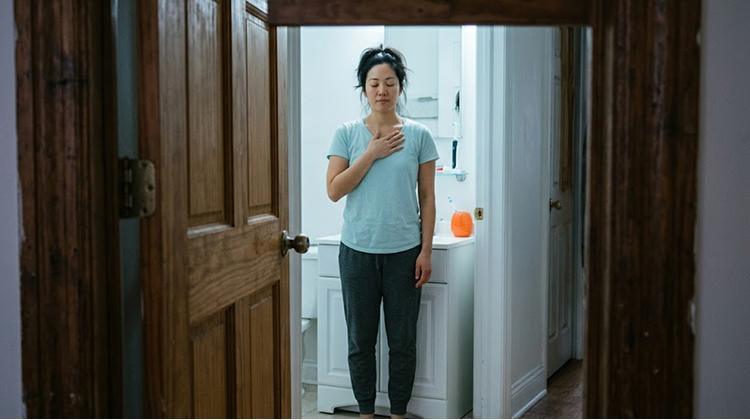
The central intervention was self-compassionate touch, an extremely brief practice that could be performed in 20 seconds or less per day.
Participants first watched an online video that taught them the practice. The exercise involved using self-touch while focusing on feelings of warmth and self-compassionate thoughts. The researchers describe this as a micropractice because it requires very little time compared with conventional mindfulness or self-compassion programs.
This low time requirement was intentional. The researchers noted that many established self-compassion programs require substantial time commitments. For example, Mindful Self-Compassion programs can involve eight sessions lasting two to two-and-a-half hours, plus a half-day retreat and independent practice.
The study therefore tested a different model: instead of asking participants to make a large time commitment, could a tiny practice become useful through repetition?
Previous work from the same research group provides an important comparison. In a 2024 randomized study involving 135 U.S. college students, participants were taught self-compassionate touch and asked to practice for up to 20 seconds per day for one month. The overall intention-to-treat analysis did not find significant differences, but participants who practiced more frequently showed improvements in self-compassion and reductions in stress and psychopathology in additional analyses.
The 2026 study was designed to address that adherence problem directly.
Mental Health Symptoms Changed At Six Months
The habit-supported group also showed a significantly greater reduction in symptoms of psychopathology at the six-month assessment. However, this difference was not significant at three months.
The delayed pattern is noteworthy because it fits the basic logic of the intervention.
If the habit-building tools work partly by increasing repetition, then the psychological consequences may take longer to emerge than the behavioral change itself. The practice automaticity measure changed earlier, while the difference in psychopathology symptoms appeared at the later six-month assessment.
The mediation analysis provided additional support for this possibility. Improvements in practice automaticity from baseline to three months significantly mediated later differences in self-compassion, self-compassion automaticity, and psychopathology symptoms at six months. The researchers estimated that practice automaticity accounted for approximately 40% to 83% of the total group effects for those outcomes.
These are mediation findings, however, and should not be interpreted as proof that automaticity is definitively the causal mechanism. The authors themselves call for additional research to confirm that pathway.
The Study’s U.S. Sample Also Has Limitations
The national recruitment strategy gives the study broader geographic reach than a single-campus trial, but it does not make the sample fully representative of U.S. adults.
Participants were recruited through social media and were required to own a smartphone. The researchers reported that 71% of the sample identified as non-Hispanic White, and their exploratory analysis did not find significant differences in intervention outcomes according to racialized identity. However, the authors specifically state that replication with a larger and more racially diverse sample is needed.
The researchers also relied on self-reported practice frequency rather than continuous real-time measurement. They explain that ecological momentary assessment could provide more detailed behavioral information, but that repeated monitoring can itself influence behavior.
Another limitation is that the intervention was specifically designed for a short, simple practice that could be paired with daily cues. The findings therefore cannot automatically be transferred to longer meditation sessions, complex therapeutic programs, or other wellness behaviors.
The study also does not establish that a smartphone-based approach would work equally well for people who have limited access to smartphones or digital tools.
What The Findings Mean For Mindfulness Routines
The most useful implication may be behavioral rather than clinical.
Many people already know they would benefit from spending more time on meditation, breathing exercises, journaling, stretching, or other forms of self-care. The difficulty is often maintaining the behavior after the initial motivation fades.
The Berkeley study suggests that the design of a routine may matter almost as much as the content of the routine itself. A practice can be short, but it still needs a reliable trigger. The researchers’ approach paired the behavior with a consistent cue, a specific time and location, reminders, plans for obstacles, and an intentional reward structure.
That does not mean everyone needs to follow the exact SCT+HABITS protocol. It does suggest a broader principle worth studying: well-being practices may become easier to sustain when they are attached to behaviors that already happen automatically.
For example, someone could associate a brief breathing exercise with closing a laptop at the end of the workday, or a short mindfulness routine with making morning coffee. The study did not test those specific examples, so they should be viewed as applications of the habit concept rather than outcomes demonstrated by this trial.
A 15-Minute Session Produced A Six-Month Behavioral Difference
Perhaps the most striking feature of the study is the mismatch between the length of the intervention and the duration of the follow-up.
The initial online intervention took approximately 15 minutes. Participants then continued the micropractice independently for six months. The researchers found that the group receiving habit-formation instruction maintained higher reported practice frequency and automaticity throughout that period.
This does not mean a single 15-minute session produces six months of psychological benefits by itself. The participants were instructed to continue practicing throughout the six-month period.
The more precise interpretation is that a brief educational intervention helped participants establish a behavior that they then repeated over time.
That distinction could become increasingly relevant as mindfulness and self-compassion programs move into digital settings. Traditional programs often require scheduled sessions, instructors, and substantial independent practice. A micropractice model attempts to reduce those barriers while using behavioral science to address the problem of adherence.
The new findings suggest that future research may need to pay closer attention to how practices are maintained, rather than measuring only what happens immediately after people learn them.
Why Habit Formation Could Change Self-Compassion Research
The study’s broader contribution is its focus on persistence.
Previous research has shown that self-compassion and mindfulness interventions can be associated with improvements in psychological outcomes, but maintaining regular practice remains a central challenge. The 2024 study involving 135 college students from the same research group illustrated that practice frequency was closely related to outcomes, while the new trial directly tested a strategy for increasing that frequency.
The researchers are therefore moving from a simple question — “Does this practice help?” — toward a more practical one: “What helps people keep doing it?”
That question is particularly relevant for low-burden mindfulness routines. If a practice takes only seconds, the main obstacle may shift away from available time and toward remembering, cueing, repetition, and integration into daily life.
The 2026 study provides evidence that those behavioral components can be deliberately designed and tested.
It also leaves several questions open. Future studies will need to determine whether the same habit-building strategies work for meditation, breathing exercises, longer self-compassion practices, and other forms of psychological training. Researchers will also need to determine whether these behavioral improvements translate into clinically meaningful changes for people experiencing significant mental health difficulties.
For now, the Berkeley trial offers a focused finding: a very brief self-compassion practice was practiced more often and became more automatic when researchers added structured habit-formation tools, with differences persisting through six months. The psychological effects were more selective, with stronger self-compassion outcomes and fewer psychopathology symptoms at six months, but no significant between-group difference in perceived stress.
That makes the study less about finding a shortcut to emotional well-being and more about identifying a practical mechanism that may determine whether a wellness practice actually survives contact with everyday life.
A practice does not have to be long to be repeated. The research question emerging from Berkeley is whether making repetition easier can change what happens over time.