
A large new study suggests that mindfulness-based cancer recovery and Tai Chi/Qigong may help cancer survivors manage several persistent symptoms after treatment, including fatigue and pain, while Tai Chi/Qigong was also associated with improved sleep quality. Published on September 16, 2026, in the Journal of Clinical Oncology, the study analyzed 587 adults with different types and stages of cancer who had completed primary treatment and were experiencing significant distress. Researchers found that both interventions improved fatigue and pain interference compared with waitlist controls, while the Tai Chi/Qigong group also showed a significant improvement in sleep quality.
The study is part of the Mindfulness and Tai Chi for Cancer Health (MATCH) trial, a multisite comparative-effectiveness project that examined whether people could choose between two mind-body programs or be randomly assigned to one. The research included investigators from the University of Calgary, University of Toronto and Mass General Brigham in Boston, including Yan Ma, MD, MPH, and Peter M. Wayne, PhD, who are affiliated with the Osher Center for Integrative Health at Harvard Medical School and Brigham and Women’s Hospital.
The findings are relevant to cancer survivorship because sleep problems, fatigue and pain can continue after active treatment ends and can interact with one another. Rather than treating each symptom as an isolated problem, the MATCH researchers examined them as a connected symptom cluster.
Why Sleep, Fatigue And Pain Matter After Cancer Treatment
Finishing surgery, chemotherapy or radiation does not necessarily mean that all treatment-related symptoms disappear. Cancer survivors can continue experiencing fatigue, disturbed sleep and pain that interfere with daily activities and quality of life.
The National Cancer Institute identifies fatigue as one of the common symptoms affecting people with cancer and notes that mind-body approaches such as yoga, qigong and Tai Chi have been studied as potential approaches for cancer-related fatigue. Tai Chi combines slow movement, breathing and a meditative component, making it different from conventional aerobic exercise. Cancer-related fatigue information from the NCI provides additional context on how these approaches have been investigated.
The MATCH study approached the issue from a broader perspective.
Instead of asking whether mindfulness or Tai Chi improves one specific symptom, researchers examined sleep quality, fatigue and pain interference together. Pain interference is particularly important because it describes how pain affects activities and functioning rather than simply measuring how intense the pain feels.
The study found that changes in these symptoms were significantly correlated. That means improvements in one area tended to be associated with improvements in the others, although the study does not establish that improving one symptom directly caused the others to improve.
The MATCH Study Included 587 Cancer Survivors
The scale of the research distinguishes this study from many earlier mind-body intervention studies.
The MATCH trial enrolled 587 participants, with an average age of 60.7 years. Women represented 75% of the sample, or 440 participants. Breast cancer was the most common diagnosis, accounting for 40.7% of participants, followed by prostate cancer at 11.2% and gastrointestinal cancers at 9.7%.
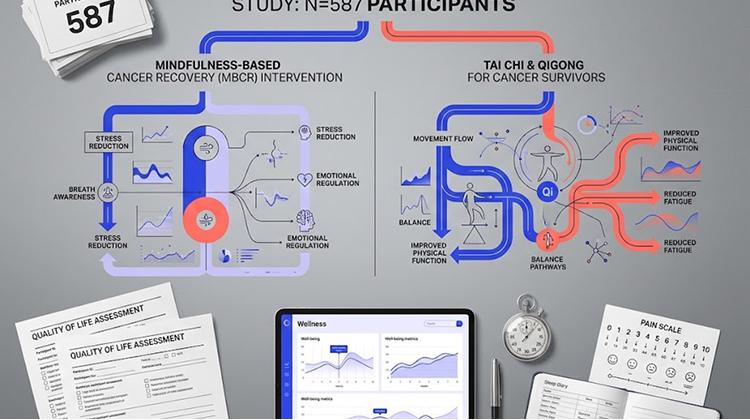
The study deliberately included people with different cancer diagnoses and stages rather than focusing on a single cancer population.
| Study Feature | MATCH Study Details |
|---|---|
| Participants | 587 cancer survivors |
| Average age | 60.7 years |
| Women | 75% |
| Most common cancer | Breast cancer, 40.7% |
| Prostate cancer | 11.2% |
| Gastrointestinal cancers | 9.7% |
| Main interventions | MBCR and Tai Chi/Qigong |
| Comparison | Waitlist controls |
| Primary treatment completed | At least 4 months before enrollment |
| Study sites | Tom Baker Cancer Centre and Princess Margaret Cancer Centre, Canada |
Participants had completed their primary cancer treatment at least four months earlier and needed to report significant distress, defined as a score of at least 4 on the Distress Thermometer. The eligibility criteria included adults with cancer other than brain cancer and allowed a broad range of diagnoses and disease stages.
This selection strategy matters because the researchers specifically wanted participants who were experiencing meaningful distress rather than people who had already returned to low symptom levels.
How Mindfulness-Based Cancer Recovery Was Used
One intervention was Mindfulness-Based Cancer Recovery (MBCR), a structured program developed for people dealing with the psychological and physical challenges associated with cancer.
MBCR uses mindfulness practices to help participants pay attention to thoughts, emotions and bodily sensations while developing ways to respond to difficult experiences.
The study did not test an informal meditation routine that participants created themselves. Instead, participants received a defined intervention delivered as part of a clinical research protocol.
That distinction is important for interpreting the findings.
A study of a structured MBCR program cannot automatically establish that any meditation practice will produce the same outcomes. Different mindfulness programs vary in session length, instructor training, meditation techniques and the amount of home practice required.
For readers interested in developing a meditation practice, the broader lesson is that research findings should be connected to the specific intervention that was actually studied.
Tai Chi And Qigong Provided A Different Type Of Mind-Body Practice
The second intervention was Tai Chi/Qigong (TCQ).
Unlike a seated mindfulness program, Tai Chi and Qigong incorporate slow, coordinated movements with breathing, attention and balance. The combination gives participants both a cognitive and physical component.
The National Cancer Institute describes Tai Chi as a mind-body activity involving deep breathing, exercise and slow movement, with a meditative element connecting physical, mental and emotional states. Previous cancer research has examined Tai Chi for fatigue and other treatment-related symptoms, although long-term effects have remained less certain.
The MATCH study therefore provided an opportunity to compare two different approaches to mind-body care.
MBCR emphasized mindfulness-based practice, while TCQ combined meditative attention with physical movement.
That distinction makes the results useful for researchers interested in whether different mind-body approaches produce similar or different effects on cancer survivorship symptoms.
Participants Could Choose Their Intervention
One of the most unusual features of MATCH was its patient-preference design.
Participants could indicate a preference for MBCR or TCQ. Those without a preference could be randomly assigned to an intervention. Participants were then further randomized to receive an immediate intervention or remain on a waitlist.
This design attempts to address a practical issue in behavioral research: people often have preferences about the activities they are willing to perform.
A person recovering from cancer may prefer meditation because physical movement feels difficult. Another person may prefer Tai Chi because sitting meditation feels uncomfortable or unfamiliar.
The researchers wanted to know whether allowing participants to choose affected the magnitude of the intervention’s effects.
It did not.
The study reported that preference status did not significantly affect the outcomes. Participants who chose an intervention and those who were randomly assigned showed comparable effects.
That finding adds an important dimension to the research because it suggests that the benefits observed in the study were not clearly dependent on participants getting their preferred program.
Tai Chi Improved Sleep Quality
Sleep was one of the clearest areas of difference between the two interventions.
At the post-intervention assessment, participants assigned to Tai Chi/Qigong showed an average 1.9-point improvement in sleep quality compared with waitlist controls.
The difference remained statistically significant after adjustment for age, sex, cancer stage and intervention preference, with P = .004.
The researchers did not report the same statistically significant sleep improvement for MBCR compared with the waitlist group in this particular analysis.
That distinction is important.
The study does not support the simplified statement that “mindfulness and Tai Chi improve sleep equally.” The specific result was that TCQ demonstrated a significant improvement in sleep quality, while the two interventions showed similar effects in the other major symptom areas.
Sleep disturbances are particularly relevant in cancer survivorship because poor sleep can overlap with fatigue, pain and psychological distress.
The findings therefore support continued research into movement-based and mindfulness-based approaches as potential components of survivorship symptom management.
Both Interventions Reduced Fatigue
Fatigue produced a different pattern.
Compared with waitlist controls, both interventions were associated with significant improvements.
Participants in the MBCR group improved by an average of 3.66 points, while participants in the TCQ group improved by 3.42 points. The reported significance levels were P = .036 for MBCR and P = .043 for TCQ.
The difference between the two interventions was not statistically significant.
That means the study did not establish that mindfulness-based recovery was more effective than Tai Chi/Qigong for fatigue, or vice versa.
Instead, both approaches were associated with meaningful improvement compared with the waitlist condition.
This finding is consistent with the idea that cancer-related fatigue can involve multiple dimensions of physical and psychological functioning. A mind-body program may address several aspects of the experience at the same time, although this study cannot determine the exact mechanism responsible for the observed changes.
The National Cancer Institute notes that Tai Chi and other mind-body approaches have been investigated for cancer-related fatigue, with previous studies producing varying findings depending on the cancer population and intervention.
Pain Interference Improved With Both Programs
Pain produced another important result.
Both MBCR and TCQ were associated with more than one point of improvement in pain interference compared with waitlist controls. The reported significance levels were P = .029 for MBCR and P = .002 for TCQ.
However, the findings require an important distinction between pain intensity and pain interference.
Mass General Brigham reported that the interventions produced minimal effects on pain intensity, while pain interference improved over time with both approaches.
Pain interference concerns the degree to which pain disrupts everyday activities and functioning.
That makes the result particularly relevant to survivorship care.
A person may continue experiencing some degree of pain while becoming better able to function around it. A reduction in pain interference therefore represents a different outcome from eliminating pain itself.
The MATCH study’s findings should consequently not be interpreted as evidence that mindfulness or Tai Chi eliminates cancer-related pain.
Sleep, Fatigue And Pain Appeared To Move Together
One of the study’s most interesting findings was the relationship among the three symptoms.
Researchers observed significant correlations between changes in sleep, fatigue and pain interference, with mild-to-moderate associations.
In practical terms, participants who experienced greater improvement in one symptom often tended to experience improvement in another.
This does not prove that one symptom caused another.
For example, the study cannot establish that better sleep directly caused lower fatigue. It also cannot establish that reduced pain interference caused better sleep.
The relationship could reflect shared underlying factors.
Someone who becomes less fatigued may become more physically active during the day and sleep differently at night. Someone experiencing less pain interference may find it easier to maintain daily routines. Better sleep could also affect energy and perceived pain.
The correlations nevertheless support the researchers’ decision to treat these outcomes as a symptom cluster rather than completely separate problems.
The Trial Was Conducted In Canada, With U.S. Research Involvement
Although this study emerged in the context of a U.S.-focused research search, the MATCH trial itself was conducted at Tom Baker Cancer Centre and Princess Margaret Cancer Centre in Canada between 2016 and 2020. Participants were enrolled and treated at those Canadian sites.
The U.S. connection comes through investigators Yan Ma and Peter M. Wayne, who are affiliated with the Osher Center for Integrative Health at Harvard Medical School and Brigham and Women’s Hospital in Boston, Massachusetts. Mass General Brigham also published an institutional report about the findings.
This distinction is worth making because research location affects how a study should be described.
The evidence is from an international research collaboration rather than a study conducted exclusively in the United States.
The Boston involvement nevertheless gives the findings a meaningful U.S. research connection, particularly through Peter Wayne’s role at the Osher Center. The center is a collaboration between Harvard Medical School and Brigham and Women’s Hospital focused on integrative health research and care.
Why Patient Choice Did Not Change The Results
The researchers were also interested in whether people receiving their preferred intervention would experience larger benefits.
The answer was no.
Preference status did not significantly modify the effects of MBCR or TCQ on sleep, fatigue or pain. Participants who selected an intervention did not show a statistically meaningful advantage over participants who were assigned to an intervention.
This finding is relevant because preference-based research is increasingly used in behavioral interventions.
Blinding participants to whether they are meditating, practicing Tai Chi or receiving another behavioral intervention is difficult. Their expectations can potentially influence outcomes.
The MATCH design attempted to account for this issue by allowing some participants to choose while randomly assigning others.
The absence of a meaningful preference effect suggests that the observed symptom changes were not simply explained by people receiving their first-choice intervention.
It does not prove that personal preference is irrelevant in all cancer survivorship programs. A larger study in other populations could produce different results.
What The Study Does Not Prove
The findings are encouraging but should be interpreted within the limits of the research design.
First, the study was conducted among cancer survivors who had completed primary treatment and were experiencing significant distress. The findings therefore should not automatically be applied to people currently undergoing treatment or to cancer survivors without meaningful symptoms.
Second, the interventions were structured programs rather than generic meditation or exercise routines.
Third, the study used waitlist controls. That means the researchers can compare the interventions with receiving the program later, but the design does not completely separate the specific effects of the interventions from factors such as group participation, attention from instructors or expectations about treatment.
Finally, the study does not demonstrate that MBCR or TCQ can treat cancer itself.
The National Cancer Institute distinguishes complementary approaches such as Tai Chi from standard cancer treatment and notes that people may use these practices to cope with symptoms or treatment-related effects. They should not be interpreted as substitutes for evidence-based cancer care.
The Findings Fit Into A Larger Cancer-Survivorship Research Area
The MATCH results are part of a broader effort to investigate nonpharmacological approaches to symptoms that can persist after cancer treatment.
Researchers are studying mindfulness, Tai Chi, Qigong, yoga and other mind-body approaches because symptoms such as fatigue, pain, insomnia and distress can overlap and may be difficult to address with a single intervention.
The new results add useful evidence because of the study’s size and broad eligibility criteria.
With 587 participants, multiple cancer types and a patient-preference design, MATCH provides a larger evidence base than many smaller mind-body studies.
The researchers also deliberately recruited people with significant distress, reducing the likelihood that large numbers of participants would enter the study with very little room for measurable improvement.
Mass General Brigham described the findings as supporting a whole-person approach to cancer survivorship, particularly because improvements in pain interference, fatigue and sleep were interconnected.
What The MATCH Findings Could Mean For Survivorship Care
The most useful takeaway from the study is not that one mind-body practice should replace another.
Instead, the results suggest that different structured approaches may address overlapping survivorship symptoms.
MBCR was associated with improvements in fatigue and pain interference. TCQ was associated with improvements in sleep, fatigue and pain interference. The two interventions did not significantly differ from one another in their effects on the measured outcomes.
That creates room for patient-centered decisions.
A survivor who prefers meditation may have a structured mindfulness option, while someone who wants gentle movement may choose Tai Chi/Qigong. The MATCH findings indicate that participants did not receive a statistically different outcome simply because they selected one intervention over the other.
At the same time, the study does not establish that either approach will work for every survivor.
Cancer type, treatment history, mobility, baseline symptoms, medication use and individual preferences can all affect whether a particular practice is appropriate.
A Larger View Of Sleep, Fatigue And Pain
The September 2026 MATCH findings add another layer to the evidence surrounding mind-body approaches after cancer treatment.
The 587-person study found that Tai Chi/Qigong improved sleep quality compared with waitlist controls, while both Tai Chi/Qigong and Mindfulness-Based Cancer Recovery improved fatigue and pain interference. The researchers also identified relationships among changes in sleep, fatigue and pain interference.
The study’s design is particularly useful because it did not focus on one narrow cancer diagnosis or one isolated symptom. Participants represented multiple cancer types and stages, and the researchers incorporated both random assignment and patient preference.
The results also show why symptom measurement matters.
The interventions had limited effects on pain intensity but meaningful effects on pain interference, suggesting that mind-body programs may influence how survivors function with persistent symptoms even when pain itself does not disappear.
For cancer survivorship research, that distinction can be important. Quality of life is influenced by whether symptoms interfere with sleep, movement, work, relationships and everyday activities—not simply whether a symptom exists.
The MATCH study therefore adds evidence that structured mindfulness and Tai Chi/Qigong programs may have a role in addressing interconnected survivorship symptoms, while leaving important questions about long-term effects, mechanisms and individual differences for future research.