
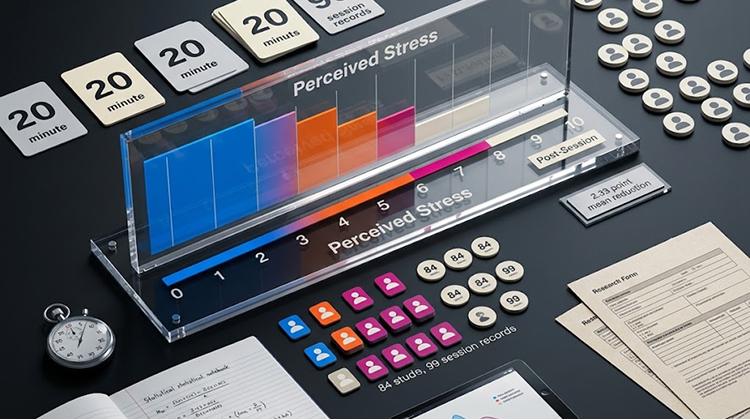
A new U.S. study found that a 20-minute session of Sahaja Yoga Meditation was associated with a substantial immediate reduction in perceived stress among undergraduate nursing students. Across 84 students and 99 meditation sessions, participants reported an average 2.33-point decrease in perceived stress on a 0-to-10 scale, producing a large within-session effect size of d = −1.42. The study was published September 24, 2026, in the Journal of American College Health.
The research was conducted from January through May 2026 among first- and second-semester undergraduate nursing students at a private U.S. health sciences university. Bianca Doczi of the School of Nursing at the Massachusetts College of Pharmacy and Health Sciences in Boston and Anusha Vissapragada of Hult International Business School in Cambridge, Massachusetts, were the study’s authors.
The finding is notable because the intervention was brief enough to fit within an academic schedule. At the same time, the study does not establish that a single meditation session produces lasting changes in stress or resilience. The researchers used a single-group pre-post design, meaning there was no randomized control group against which the meditation sessions could be compared. Controlled trials are therefore needed to determine whether the observed reduction was caused specifically by the meditation intervention.
The Study Focused On Early-Semester Nursing Students
The participants were first- and second-semester undergraduate nursing students, a population facing the transition into demanding professional training. Rather than recruiting experienced nurses or students from multiple academic years, the study focused specifically on students near the beginning of their nursing education.
That distinction matters because academic stress can change substantially as students progress through professional programs. Early-semester students may be adapting simultaneously to demanding coursework, examinations, clinical expectations and the broader transition into health-professional education.

The researchers embedded the meditation sessions within the students’ existing educational environment instead of requiring participants to join a separate long-term meditation program. This made the intervention relatively simple to deliver and allowed the investigators to examine whether a short practice could produce an immediate change in how stressed students felt.
The study also collected data across 99 individual sessions, rather than treating each of the 84 students as having only one observation. This created a larger pool of session-level observations while still requiring careful interpretation because multiple sessions could come from the same participant.
The approach fits a broader interest in brief practices that can be integrated into demanding educational schedules. Rather than requiring students to set aside an hour for a formal class, the researchers examined whether 20 minutes could be incorporated into the normal rhythm of nursing education.
Each Meditation Session Lasted 20 Minutes
The intervention consisted of 20-minute Sahaja Yoga Meditation (SYM) sessions, delivered both in person and virtually. This allowed students to participate through different formats while preserving the same basic time commitment.
Sahaja Yoga Meditation is a specific meditation approach rather than a generic label for sitting quietly. The researchers therefore were testing a defined practice and cannot automatically extend the findings to every form of mindfulness, meditation or relaxation exercise.
The short session length is one of the most practical elements of the study. A 20-minute intervention can potentially fit into a class break, scheduled wellness period or other gap in a student’s day without requiring major changes to an academic program.
For readers interested in developing similar short practices, the study provides a useful example of how brief meditation practices can be examined as an immediate stress-management tool rather than as a long-term lifestyle program.
The research also builds on an established area of interest in nursing education. Nursing students and practicing nurses have been studied in previous mindfulness research because of the high cognitive and emotional demands associated with healthcare training and clinical work. However, the current study is narrower: it asks what happens to perceived stress immediately around a brief meditation session.
Perceived Stress Fell By 2.33 Points
The central finding was a mean reduction of 2.33 points in perceived stress following the 20-minute sessions. Stress was measured using a single-item scale ranging from 0 to 10, making the result relatively easy to interpret at the individual-session level.
The reported effect size was d = −1.42, with p < .001. In statistical terms, that represents a large within-session change in this sample. The researchers also reported that the reduction remained consistent across different nested analytic samples and demographic subgroups.
| Study Measure | Finding |
|---|---|
| Participants | 84 undergraduate nursing students |
| Meditation sessions | 99 |
| Session duration | 20 minutes |
| Stress measure | 0–10 perceived-stress rating |
| Mean stress reduction | 2.33 points |
| Effect size | d = −1.42 |
| Statistical significance | p < .001 |
| Study period | January–May 2026 |
| Publication date | September 24, 2026 |
The magnitude of the immediate change is what makes the result interesting. A participant reporting a stress level of 7 before a session, for example, would theoretically be near 4.7 after an average 2.33-point reduction. That example is only an illustration of the study’s mean change, not a prediction of what an individual student would experience.
The measurement itself is also important. The study captured perceived acute stress, not a laboratory measurement of cortisol, heart-rate variability or another physiological marker. A reduction in a person’s self-reported stress is meaningful, but it represents a different type of evidence from a measurable physiological change.
The Study Did Not Find A Significant Change In Resilience
The stress result was accompanied by a different finding for resilience. Researchers measured trait resilience using the Brief Resilience Scale, but the analysis did not show a significant change following the intervention. The reported effect size was d = +0.12, with p = .281.
This contrast is one of the most informative parts of the study.
Stress and resilience are related but distinct concepts. A short meditation session may potentially change how stressed someone feels at a particular moment without changing the broader psychological characteristics associated with resilience.
The data therefore do not support the idea that a 20-minute meditation session suddenly makes a nursing student more resilient. Instead, the strongest evidence from this study concerns an immediate shift in perceived stress.
That distinction prevents the findings from being overstated. If the researchers had found both a sharp stress reduction and a significant resilience improvement, it would have suggested a broader effect. Instead, the results point toward a more limited short-term response.
The authors explicitly identified this distinction in their interpretation, noting that brief embedded meditation was associated with substantial within-session reductions in acute perceived stress while trait resilience remained unchanged.
In-Person And Virtual Sessions Were Both Used
Another practical feature was the delivery format. The meditation sessions were provided both in person and virtually, giving students more than one way to participate.
That flexibility has relevance for universities because student schedules are rarely uniform. Some students may be on campus, while others may have clinical responsibilities, commuting requirements or other commitments that make a particular physical location difficult to access.
A virtual format also changes the resources needed to deliver an intervention. A university does not necessarily need a dedicated meditation room for every session if students can participate through an online format.
However, the current study does not establish that virtual meditation is equally effective as in-person meditation. The researchers reported that both delivery formats were used, but the study’s primary finding was the overall association between the meditation sessions and reduced perceived stress rather than a definitive head-to-head comparison of delivery methods.
That means universities should not interpret the study as evidence that moving a meditation program online will automatically produce the same outcome.
Ninety-Nine Sessions Provided Repeated Observations
The study’s 99 sessions across 84 participants are important because the researchers were able to examine the intervention repeatedly rather than relying exclusively on a single pre-session and post-session measurement for every participant.
At the same time, repeated observations introduce analytical considerations. Multiple measurements from the same person are not necessarily equivalent to measurements from completely independent participants. The researchers therefore examined the robustness of their findings across nested samples and reported consistent stress reductions.
The study’s sample size is also best described in two ways: 84 unique students and 99 meditation sessions. Referring simply to 99 participants would incorrectly inflate the number of people studied.
That distinction becomes particularly important when comparing this research with randomized clinical trials that recruit hundreds or thousands of independent participants.
The study is better viewed as an examination of repeated real-world meditation sessions among a defined student population rather than as a large randomized efficacy trial.
The Research Design Limits Causal Conclusions
The most important limitation is the single-group pre-post design.
There was no randomized control group receiving another activity, no waitlist group and no comparison intervention. Students’ stress was measured before and after meditation, and the researchers observed a large decline after the sessions.
That design can identify an association between the session and the change, but it cannot establish that meditation itself caused the entire reduction.
Several alternative explanations remain possible. Students may naturally feel less stressed after taking a 20-minute break. Simply stepping away from coursework could change their immediate stress rating. Expectations about meditation could also influence self-reported responses. The setting, interaction with instructors or researchers, and repeated participation could contribute as well.
A randomized controlled trial would provide a stronger test by assigning participants to meditation or another condition and comparing how their stress changes.
The researchers themselves state that controlled trials are needed to establish causal efficacy.
This limitation does not make the observed reduction irrelevant. It defines what the study can legitimately tell us: students reported substantially lower acute stress following these brief sessions, but the study cannot determine how much of that change was specifically attributable to Sahaja Yoga Meditation.
The Findings Apply To Acute Stress, Not Long-Term Burnout
The study also should not be interpreted as evidence that 20 minutes of meditation prevents nursing-student burnout.
Burnout develops through longer-term interactions among workload, academic demands, recovery, social support, institutional conditions and other factors. A single-session stress rating captures a much narrower moment.
The research period ran from January through May 2026, but the published results concern the immediate relationship between meditation sessions and perceived stress rather than evidence that students became less burned out over an academic year.
This difference between acute stress and long-term well-being is particularly important for health-professional education. A student can experience a temporary reduction in stress after meditation while continuing to face the same examination schedule, clinical workload or financial pressures afterward.
For that reason, meditation can be studied as one potential component of a broader student wellness strategy without treating it as a substitute for changes to academic workload, support systems or other sources of stress.
Why The 20-Minute Format Matters
The practical question raised by the study is not simply whether meditation can make students feel less stressed. It is whether a short, repeatable intervention can fit inside demanding educational environments.
Twenty minutes is long enough to represent a meaningful pause but short enough to be scheduled during many academic days. The researchers’ use of both in-person and virtual delivery further demonstrates how the intervention could be incorporated into different educational settings.
Previous research has also examined brief mindfulness sessions among nursing populations. For example, an earlier pilot investigated 20-minute Mindful Moment sessions delivered in person and online, combining meditation with yoga and self-reflection. That earlier work focused on feasibility, burnout and perceived stress rather than the same Sahaja Yoga intervention tested in the 2026 study.
The newer study adds a more specific data point: 84 nursing students, 99 sessions and a 2.33-point average immediate reduction in perceived stress.
That does not establish a universal 20-minute prescription. It does show that the format can be studied in a real educational setting and that the immediate self-reported response was substantial within this sample.
What The Nursing Student Study Actually Shows
The September 24, 2026 study by Bianca Doczi and Anusha Vissapragada provides evidence that 20-minute Sahaja Yoga Meditation sessions were followed by substantial reductions in perceived stress among first- and second-semester undergraduate nursing students. The study covered January through May 2026 and included 84 participants across 99 sessions.
The average perceived-stress reduction was 2.33 points on a 0-to-10 scale, with a large within-session effect size of d = −1.42 and p < .001. Results were reported as consistent across nested samples and demographic subgroups.
The other major finding was more restrained: trait resilience did not significantly change, with d = +0.12 and p = .281. That distinction suggests the strongest signal from the research is an immediate perceived-stress response rather than evidence of a broader transformation in resilience.
For nursing education, the study provides a useful starting point for larger investigations. A randomized controlled design could determine whether the stress reduction exceeds the effect of simply taking a quiet 20-minute break, while longer follow-up could examine whether repeated meditation affects resilience, academic stress, burnout or other outcomes over time.
For now, the evidence is specific but limited: a brief meditation session was followed by a measurable short-term decrease in perceived stress among the nursing students studied, while resilience remained statistically unchanged. That is a meaningful research signal, but it is not yet evidence that a single 20-minute session can produce lasting changes in student mental health.