
Breathing is usually treated as an automatic background process, but new research from Northwestern University suggests that the precise phase of a breath may influence how quickly people respond to an unexpected visual event. In a study of 35 healthy adults ages 18 to 33, researchers found that responses during exhalation were faster than responses during inhalation by an average of 41 milliseconds. Responses during brief pauses between breaths were also faster than those during inhalation, by about 21 milliseconds.
The study, led by neuroscientist Erika M. Yamazaki, PhD, with Ken A. Paller, PhD, senior author and James Padilla Professor of Psychology at Northwestern University, was published in iScience in September 2026. Its title is “Response speed is modulated by respiratory phase.” The research provides experimental evidence that respiratory timing is associated with moment-to-moment variation in sustained-attention performance.
The finding does not mean that exhaling generally makes people smarter or that someone can automatically improve athletic or driving performance simply by breathing out at the right moment. The experiment measured one specific form of visual reaction speed under controlled laboratory conditions.
Its importance is more fundamental: the researchers demonstrated that respiration and cognitive-motor performance fluctuate together on a timescale of milliseconds.
The Northwestern Study Examined All Phases Of Breathing
Previous research has already suggested that respiration and brain activity are closely connected. What makes the Northwestern experiment distinctive is that researchers examined response speed across the entire respiratory cycle, including inhalation, exhalation and the brief pauses between breaths.
The researchers used a Psychomotor Vigilance Task, commonly known as the PVT. It is a sustained-attention test in which participants monitor a screen and respond as quickly as possible when a visual signal appears.
For this experiment, participants watched a display containing a red square. When the square changed to yellow, they were instructed to press the space bar as quickly as possible.
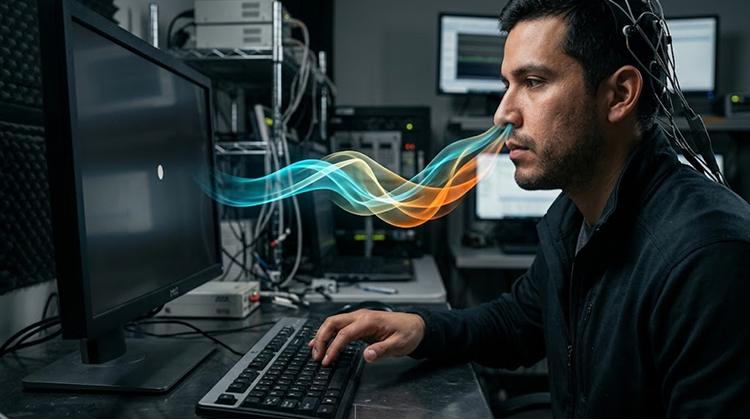
At the same time, a simple airflow-measuring device positioned beneath the participants’ nostrils continuously recorded their breathing.
This allowed the researchers to determine exactly where a participant was within the breathing cycle at the moment a visual stimulus appeared and when the participant responded.
That level of timing is important. A conventional reaction-time test might tell researchers that someone responded in a certain number of milliseconds. The Northwestern experiment added another variable: what was happening in the person’s respiratory cycle at that exact moment?
For people interested in breathwork practices, the study provides a useful reminder that breathing is connected to more than oxygen exchange and relaxation. Researchers are increasingly examining respiration as a rhythmic physiological signal that interacts with attention, perception and brain activity.
35 Adults Completed The Reaction-Time Experiment
The study involved 35 adults between 18 and 33 years old. Participants completed the psychomotor vigilance task while their respiration was continuously monitored.
Each participant completed the experiment twice.
One assessment took place before a sleep period, while the second occurred after either a daytime nap or approximately eight hours of overnight sleep in the laboratory. This design allowed the researchers to collect measurements both before and after a period of sleep rather than relying on a single testing session.
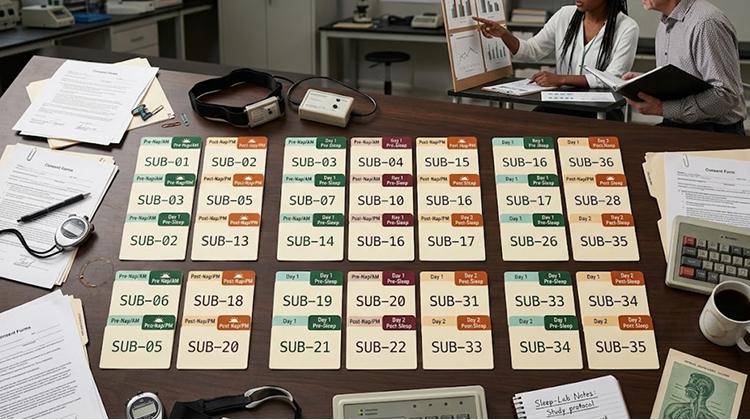
The experiment was therefore not a breathwork intervention in which participants were taught to breathe differently.
Instead, researchers observed naturally occurring respiratory cycles while participants performed a standardized cognitive task.
That distinction matters because the results show an association between naturally occurring respiratory phase and response speed. They do not demonstrate that participants could consciously manipulate their reaction times simply by changing their breathing.
The participants were also relatively young and healthy, so the findings cannot automatically be extended to older adults, people with respiratory conditions or people with neurological disorders.
Responses Were 41 Milliseconds Faster During Exhalation
The central finding was a measurable difference in reaction speed.
Participants responded to visual stimuli an average of 41 milliseconds faster during exhalation than during inhalation. Responses during pauses between breaths were approximately 21 milliseconds faster than during inhalation.
The researchers also analyzed the respiratory cycle in finer detail rather than treating inhalation and exhalation as two simple categories.
That analysis showed that response speed varied systematically throughout the cycle, with the slowest responses occurring around the peak of inhalation. The difference between the fastest and slowest portions of the respiratory cycle was approximately 40 milliseconds.
| Respiratory Phase | Response-Speed Finding |
|---|---|
| Exhalation | Approximately 41 ms faster than inhalation |
| Breath pause | Approximately 21 ms faster than inhalation |
| Peak inhalation | Slowest response period in fine-grained analysis |
Forty-one milliseconds is a very small interval in ordinary daily life. Yet reaction-time researchers routinely measure performance in milliseconds because small differences can reveal changes in the relationship between physiological processes and cognitive performance.
The finding therefore should not be interpreted as saying that a person consciously “thinks faster” during every exhalation. It indicates that, under this specific sustained-attention task, the timing of responses varied systematically with the respiratory cycle.
The Test Measured Sustained Attention And Motor Response
The Psychomotor Vigilance Task is particularly useful for this kind of experiment because it produces a simple, measurable behavioral response.
Participants do not need to solve a complicated problem or interpret a long sentence. They simply have to detect the visual change and press a button.
That simplicity allows researchers to focus on the timing of the response.
The task measures psychomotor vigilance, which involves maintaining attention over time and responding quickly when a target appears. In the Northwestern experiment, the researchers could compare each response with the airflow measurement recorded at the same moment.
This makes the study different from research asking whether breathing improves memory, creativity or complex decision-making.
The experiment was deliberately narrow.
It asked whether the respiratory cycle corresponds with variation in the speed of responding to an external visual event.
That narrow question is one reason the findings are useful. A measurable relationship can be identified without requiring researchers to make broader claims about every aspect of cognition.
The Researchers Do Not Yet Know Exactly Why This Happens
The physiological mechanism behind the finding remains uncertain.
Senior author Ken Paller said researchers do not yet know exactly how respiration and response systems are connected. One possibility they identified is neurophysiological efficiency, based partly on previous evidence that brain oscillations can synchronize with respiratory rhythms.
The idea is that breathing may provide a rhythmic signal that interacts with neural activity.
The brain is not operating independently from the rest of the body. Respiratory activity generates continuous sensory and physiological information, while breathing rhythms can coincide with changes in neural excitability and oscillatory activity.
The Northwestern results add a behavioral measurement to that broader line of research.
Previous studies have investigated relationships between respiration and brain activity, sensory processing and memory. The new experiment asks whether those respiratory fluctuations can also be detected in something as concrete as the speed of a button press.
The researchers’ explanation remains a hypothesis, however.
The study demonstrates the respiratory-phase relationship with reaction speed but does not establish the precise neural pathway responsible for the effect.
Inhalation May Not Be Worse For Every Cognitive Task
The results should also not be simplified into the claim that exhalation is universally the “best” breathing phase for cognition.
Different cognitive tasks can place different demands on the brain.
Research discussed alongside the Northwestern findings indicates that some previous experiments have observed stronger performance during inhalation for tasks involving processes such as emotion recognition, visuospatial processing or memory. This suggests that the relationship between respiration and cognition may depend on what the brain is being asked to do.
That possibility changes the interpretation of the new finding.
The study did not discover a universal respiratory phase that makes the brain function better.
Instead, it identified a relationship between respiratory timing and one particular class of performance: rapid responses during a sustained-attention task.
This distinction is especially relevant for people who use breathing exercises as part of a stress management routine. Slower breathing, longer exhalations and other breathing techniques may have goals related to relaxation or autonomic regulation, but this Northwestern study was not designed to determine whether those techniques improve reaction speed.
The Findings Do Not Prove That You Should Time Your Reactions To Exhalation
The 41-millisecond difference naturally raises an intriguing practical question: could someone deliberately exhale before a starting signal, sudden visual event or other rapid-response situation?
The current study cannot answer that.
Participants were not instructed to predict an upcoming stimulus and deliberately coordinate their breathing with it. Researchers observed the respiratory phase that happened naturally when the visual stimulus appeared.
That means the experiment does not establish that consciously timing an exhalation will produce the same reaction-time advantage.
It also did not test athletes starting races, drivers responding to road hazards or emergency workers responding to unpredictable events.
The examples of swimmers, runners and drivers are useful for explaining why milliseconds matter, but they should not be confused with experimental evidence from this study.
A laboratory reaction-time task is substantially different from a real-world emergency.
This distinction is important because the study’s strongest contribution is scientific rather than instructional: it demonstrates that the timing of respiration is associated with measurable variation in response speed.
Sleep Adds Another Dimension To The Northwestern Research
The researchers’ use of testing before and after sleep also connects the experiment with a broader interest in respiration, sleep and next-day cognitive performance.
Paller’s laboratory is involved in related NIH-funded research led by Yamazaki examining sleep apnea. Obstructive sleep apnea involves repeated breathing disruptions during sleep and can interfere with sleep quality and daytime functioning.
The connection is scientifically interesting because breathing does not stop being physiologically relevant when people fall asleep.
During sleep, respiratory patterns continue to interact with brain activity, while abnormal breathing patterns can disrupt sleep architecture and potentially affect next-day performance.
The Northwestern team describes this broader direction as part of research into noninvasive “sleep engineering” strategies, although that concept remains an area of investigation rather than an established treatment resulting from the new reaction-time study.
The current experiment therefore sits within a larger research program examining how respiration and brain function interact across different states.
The Difference Is Small But Scientifically Measurable
Forty-one milliseconds is roughly one twenty-fifth of a second.
That is too short for most people to consciously perceive as a separate event, but it is large enough to detect in carefully controlled reaction-time experiments.
The researchers emphasized that fractions of a second can matter in situations involving rapid responses. Yet the scientific importance of the finding does not depend on proving that it will change the outcome of a sporting event or prevent an accident.
The more fundamental question is whether a basic bodily rhythm contributes to the moment-to-moment variability observed in human performance.
The Northwestern data suggest that it does.
The study provides evidence that reaction speed is not completely independent of the physiological state occurring at the moment a stimulus arrives.
That adds another layer to the growing body of research on brain-body interactions, in which cognitive performance is examined alongside signals originating from the heart, lungs and other bodily systems.
What The Northwestern Study Actually Shows
The September 2026 research provides a precise finding but also leaves several important questions unanswered.
The strongest evidence from the experiment can be summarized in several points:
- 35 adults ages 18–33 completed a sustained-attention reaction-time task while researchers continuously monitored respiration.
- Responses were approximately 41 milliseconds faster during exhalation than inhalation.
- Responses during pauses between breaths were approximately 21 milliseconds faster than during inhalation.
- Fine-grained analysis found the slowest responses around the peak of inhalation.
- Participants completed testing both before and after a sleep period.
- The researchers do not yet know the precise neurophysiological mechanism producing the respiratory-phase effect.
The next step is to determine whether the effect can be replicated in larger and more diverse populations and whether it appears across different types of cognitive tasks.
Researchers could also investigate whether deliberately manipulating breathing changes the effect, rather than simply observing naturally occurring respiratory phases.
That would be a fundamentally different experiment.
For now, the Northwestern findings provide evidence for a subtle but measurable connection between when we breathe and how quickly we respond. They do not establish that exhalation improves cognition generally, nor do they provide a practical breathing technique for maximizing reaction speed.
What they do show is that respiration can be incorporated into the measurement of human performance at a level of precision that reaches down to individual phases of a single breath.