
Stress is usually something people try to avoid. Chronic pressure from work, financial concerns, caregiving responsibilities, and difficult personal circumstances can affect emotional well-being and physical health. But researchers at the University of California, San Francisco (UCSF) are investigating a different possibility: Could carefully controlled, short periods of physical or psychological stress help the body become more resilient to future challenges?
The research centers on a biological concept known as hormesis. In this process, a limited exposure to a stressor may activate adaptive responses that help an organism tolerate later challenges. Exercise provides a familiar example: physical exertion temporarily challenges the body, while repeated training can improve cardiovascular and muscular capacity.
UCSF researchers want to determine whether certain breathing practices, meditation, and brief physical activity can produce comparable adaptations in systems involved in emotional regulation and health.
The university’s Stress and Resilience Study, known as STARS, is led by psychiatrist and researcher Elissa Epel, PhD, and Wendy Berry Mendes, PhD, with contributions from researchers including Aric Prather, Stefanie Mayer, and Ashley Mason. Their work examines how daily practices might influence stress responses, mood, and physical health.
The question is scientifically interesting, but the distinction between a promising research hypothesis and a demonstrated health benefit remains essential. Existing human evidence offers encouraging findings, although it does not yet establish that short bursts of stress can reliably reverse biological aging or prevent future disease.
Why Researchers Are Reconsidering the Relationship Between Stress and Resilience
Stress is a normal biological response that prepares the body to react to demands or potential threats. The autonomic nervous system helps regulate this response by coordinating changes in heart rate, breathing, blood pressure, and other functions.
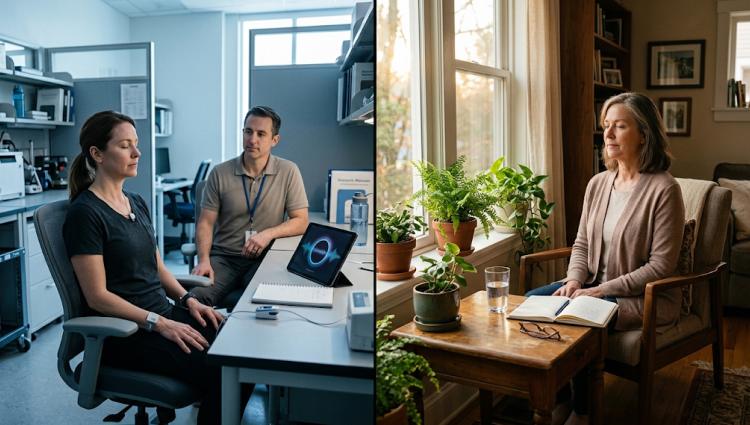
Short-term stress can be useful when it helps someone respond to a temporary challenge. The difficulty arises when stress becomes persistent and recovery periods are insufficient.
Long-lasting psychological stress has been associated with depression, cardiovascular problems, metabolic changes, inflammation, and markers of accelerated cellular aging. Researchers studying these relationships have also examined telomeres, protective structures at the ends of chromosomes that tend to shorten as cells divide.
Epel’s research at UCSF focuses on how psychological and behavioral factors interact with biological aging. Her work considers whether changes in daily habits and stress regulation could influence processes associated with long-term health.
The hormesis hypothesis offers another way to approach the problem. Rather than focusing exclusively on reducing every stress response, researchers are investigating whether manageable challenges followed by recovery could help the body adapt.
This does not mean that chronic stress is beneficial or that people should deliberately expose themselves to overwhelming situations. The proposed approach involves controlled interventions, carefully monitored responses, and sufficient recovery.
The UCSF Stress and Resilience Study Examines Three Types of Daily Practice
UCSF’s STARS program investigates whether regular habits involving breathing, physical activity, and meditation can change how people respond to later stressors.
The research program examines several dimensions of health, including mood and physiological regulation. Its investigators include Epel and Mendes as principal investigators, with Aric Prather, Stefanie Mayer, and Ashley Mason among the co-investigators. Elena Fromer serves as project director, according to the university’s research-center listing.
The interventions described by UCSF include three broad approaches.
Meditation and attention training provide a way to practice observing thoughts, sensations, and emotional reactions. Rather than immediately responding to every uncomfortable feeling, participants practice directing attention and developing awareness of their internal experience.
Brief aerobic exercise creates a temporary physical challenge. Exercise increases cardiovascular demand and activates several physiological systems, but regular training can improve the body’s ability to manage physical exertion.
Breathing techniques can create different physiological responses depending on their pace and structure. Slow breathing generally emphasizes a lower-arousal pattern, while some more intensive protocols use faster breathing and periods of breath retention.
The research interest is not simply whether participants feel calmer immediately after completing an exercise. Investigators want to determine whether repeated practice changes their responses when they encounter subsequent stressful situations.
That distinction is important. An intervention could produce temporary relaxation without necessarily changing how someone responds to stress several days or weeks later.
The STARS program therefore connects mindfulness and breathing research with broader questions about autonomic regulation, immune activity, metabolism, and emotional health. UCSF’s research-center overview describes the program and its investigators.
What the 84-Woman Randomized Trial Found
One of the most relevant published human studies connected to this research team examined whether a high-arousal breathing and cold-exposure intervention could improve mental health among women experiencing elevated stress and depressive symptoms.
The paper, titled A Randomized Controlled Clinical Trial of a Wim Hof Method Intervention in Women With High Depressive Symptoms, was published in Comprehensive Psychoneuroendocrinology in November 2024.
The research involved 84 medically healthy midlife women between 30 and 60 years old. Participants were randomly assigned to one of two groups.
- Wim Hof Method group: 41 participants practiced a breathing technique intended to produce intermittent hypoxia, combined with cold showers.
- Active comparison group: 43 participants practiced slow-paced breathing and took warm showers.
Both groups received daily audio instructions lasting approximately 15 minutes over a three-week intervention. The research was conducted during the COVID-19 pandemic, between 2020 and 2021.
Researchers assessed depressive symptoms, anxiety, and perceived stress before and after the intervention, with an additional follow-up assessment three months later. Participants also completed daily diaries about stress-related rumination and emotional experiences.
The investigators included Robin Blades, Wendy Berry Mendes, Brian P. Don, Stefanie E. Mayer, Rebecca Dileo, Julia O’Bryan, Elena Fromer, Joanna Y. Guan, Sylvia S. Cheng, Ashley E. Mason, Aric A. Prather, and Elissa S. Epel.
The results offered an important finding: Both groups experienced improvements in several mental-health measures.
Among participants who completed the intervention, depressive symptoms declined by approximately 24%, anxiety symptoms by 27%, and perceived stress by 20%. Improvements were also reported at the three-month follow-up. Among respondents completing that follow-up, 46% reported mild or no depressive symptoms.
However, the more intensive Wim Hof intervention did not outperform slow breathing and warm showers on the primary measures of depression, anxiety, and perceived stress.
This finding matters because it challenges the assumption that a more intense physiological challenge necessarily produces greater psychological benefits.
The researchers did identify a difference in daily stress rumination. Participants in the Wim Hof group showed a greater reduction in reported rumination following stressful daily events than those in the comparison group. This was a more specific result that the authors said required replication in larger and more diverse samples.
Both groups also showed lower peak cortisol reactivity during a laboratory stress test after the intervention. Cortisol is a hormone involved in the body’s response to stress, and its levels can be measured in saliva.
The study therefore provides evidence that different structured practices may be associated with improvements in stress-related outcomes, but it does not establish that high-intensity breathing is generally more effective than slower breathing.
The full peer-reviewed study provides the methods, statistical analyses, and limitations.
Why Hormesis Is Not the Same as Chronic Stress
The biological concept behind this research deserves closer examination.
Hormesis describes a response in which a limited exposure to a stressor activates adaptive mechanisms. Depending on the biological system, these mechanisms may improve the ability to respond to subsequent challenges.
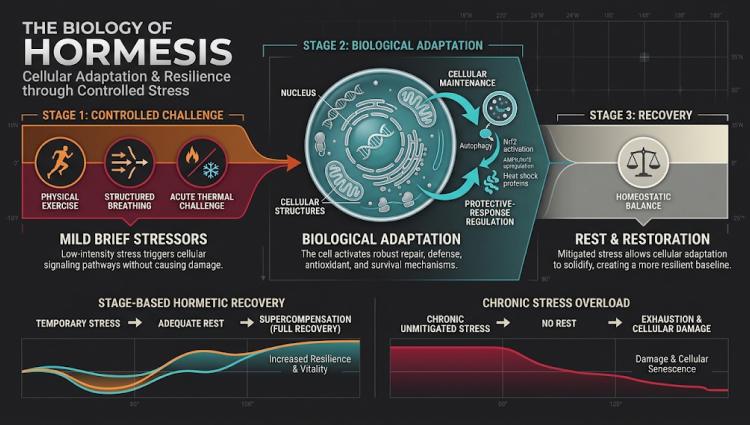
Researchers have studied this process in cells and animal models. Findings from those experiments have helped generate questions about whether similar adaptations can occur in humans.
In the context of the UCSF research, investigators are interested in whether controlled breathing, exercise, and other short-term challenges might stimulate biological responses involved in cellular maintenance and stress regulation.
One proposed mechanism involves cellular cleanup processes that remove damaged or unnecessary components. These processes are part of normal cellular maintenance and are relevant to research on aging and metabolism.
However, evidence from cells and animals cannot automatically be applied to human health. A biological mechanism observed in a laboratory model does not prove that a particular breathing routine will slow aging, prevent cardiovascular disease, or reduce the risk of depression.
The 2024 randomized trial adds human evidence about psychological outcomes and cortisol responses, but it did not demonstrate that participants experienced slower cellular aging.
For that reason, the most accurate interpretation is that hormesis provides a research framework for testing controlled stress interventions, rather than an established explanation for the long-term health effects of these practices.
What Happens to the Body During a Stress Response?
Understanding the autonomic nervous system helps explain why researchers are measuring more than participants’ reported moods.
The autonomic nervous system regulates many processes that operate without conscious control. It includes sympathetic and parasympathetic pathways, which contribute to the body’s responses to demands and recovery.
During an acute challenge, sympathetic activity can increase heart rate and prepare the body for action. After the challenge passes, regulatory processes help restore physiological balance.
The parasympathetic system contributes to functions associated with recovery, including aspects of heart-rate regulation and digestion.
Heart-rate variability, or HRV, is one measure researchers use to examine changes in the timing between consecutive heartbeats. It can provide information about autonomic regulation, although it is influenced by multiple factors and should not be treated as a standalone measurement of resilience.
Other measures, including cortisol, inflammatory markers, and metabolic indicators, can help researchers examine how different systems respond to repeated interventions.
The STARS research program is particularly interested in whether daily habits influence responses to later challenges rather than producing only an immediate change after a session.
That approach could eventually help identify which practices are most appropriate for different people and which physiological outcomes respond to repeated training.
The Limitations That Researchers Still Need to Address
The available evidence does not support recommending intense breathing exercises or cold exposure as universal stress-management treatments.
The 2024 trial had several limitations. Its sample consisted of 84 women, so the findings cannot automatically be generalized to men, younger populations, or people with different medical conditions.
The intervention also took place during the COVID-19 pandemic, a period when many people experienced unusual social and psychological pressures. This context may have influenced participants’ experiences and responses.
Six participants, representing 7% of the randomized sample, dropped out during the intervention. All six belonged to the Wim Hof group. The researchers also noted that the active comparison group considered its intervention more credible and expected greater mental-wellbeing benefits.
The three-month follow-up included a smaller group of participants who met the study’s adherence criteria. This limits the strength of conclusions about how long improvements might persist.
Another important limitation is the absence of a no-treatment control group. Because both groups received structured daily activities, the researchers could not determine how much of the improvement resulted from the interventions themselves rather than other influences, including changes over time.
The study also did not establish that either intervention changed cellular aging or prevented future physical illness.
Future studies will need larger samples, more diverse participants, stronger long-term follow-up, and objective physiological measurements during everyday practice.
Can People Use These Findings to Improve Their Daily Stress Management?
The practical message is not that people should seek out intense stress. Instead, the research highlights the value of examining how different practices influence the relationship between challenge, recovery, and emotional regulation.
Gentle meditation, regular physical activity, and comfortable paced breathing are distinct approaches that can be incorporated into daily routines according to personal needs and circumstances.
For people interested in beginning with mindfulness, a brief body-awareness exercise or a few minutes of quiet attention may provide a manageable starting point. Readers can explore additional approaches through the site’s stress management resources.
More intensive breathing methods deserve additional caution. Rapid breathing and breath retention can cause dizziness or fainting, and deliberate hyperventilation should never be practiced in water or while driving. People with relevant medical conditions should consult a qualified healthcare professional before attempting such techniques. The fact that a method is being studied does not make it appropriate for unsupervised use.
The same distinction applies to cold exposure. A practice used in a research protocol is not automatically suitable for everyone, and individual health circumstances matter.
The Future of Research Into Short-Term Stress and Long-Term Resilience
UCSF’s Stress and Resilience Study represents an effort to examine a question that extends beyond conventional relaxation research: Can the body learn to respond more effectively to future challenges through carefully structured daily practices?
The combination of meditation, breathing, and physical activity gives investigators several ways to explore this possibility. It also allows researchers to compare different levels and types of physiological activation.
The existing 84-participant randomized trial provides an early human example. Both the Wim Hof Method and the slower-breathing comparison were associated with reductions in depression, anxiety, and perceived stress, while the more intensive intervention showed an additional signal involving daily rumination.
Those findings are promising, but they do not prove that short bursts of stress produce lasting biological resilience. The research program’s broader questions about cellular aging, immune function, and long-term adaptation still require rigorous human evidence.
For now, the most useful takeaway is that stress management may involve more than eliminating uncomfortable experiences. Researchers are examining whether the way people respond to manageable challenges, practice recovery, and build consistent daily habits can influence their capacity to handle future stress.
The answer will depend on larger studies and measurable outcomes, not simply on how intense or popular a wellness technique becomes.