
Researchers at the University of Southern California are launching a new clinical trial examining whether eight weeks of mindfulness training can help people with depression sustain the potential benefits of psilocybin therapy. Announced by USC on October 7, 2026, the study will enroll 80 adults in Los Angeles and compare supervised psilocybin therapy alone with psilocybin combined with a structured mindfulness program.
The project is being led by researchers from the Keck School of Medicine of USC and the USC Dornsife College of Letters, Arts and Sciences. Rael Cahn, MD, PhD, clinical associate professor of psychiatry and the behavioral sciences and director of the USC Center for Mindfulness Science, leads the study. Assal Habibi, PhD, associate professor of psychology at the USC Dornsife Brain and Creativity Institute, and Shri Narayanan, PhD, a USC University Professor and engineering researcher, are also principal investigators.
The research has received an award of up to $4 million from the Advanced Research Projects Agency for Health, or ARPA-H, through its EVIDENT initiative. The project is based in Los Angeles and combines clinical assessments with brain imaging, biological samples and digital measurements to examine what happens during and after psychedelic-assisted treatment.
For Spiritual Endeavors readers interested in meditation techniques, the study is especially significant because mindfulness is being tested as a structured component of a medical research protocol rather than simply as a general wellness practice.
Why USC Is Combining Psilocybin And Mindfulness
Psilocybin and mindfulness meditation operate through very different routes, but researchers at USC are interested in whether the two approaches can complement one another.
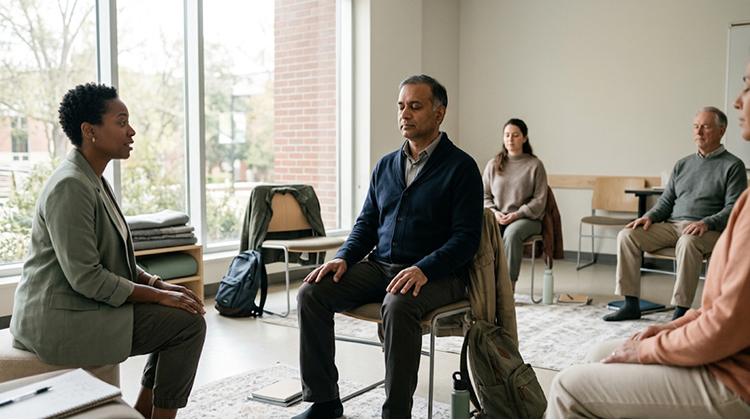
Psilocybin is a psychedelic compound found in certain mushroom species. During a supervised session, it can produce substantial changes in perception, mood, cognition and a person’s sense of self. Researchers studying psychedelic-assisted therapy have been examining whether these experiences, when delivered within controlled clinical settings, can produce meaningful changes in mental health.
Mindfulness training takes a different approach. Rather than producing an acute altered state, mindfulness involves repeatedly practicing attention and awareness, including noticing thoughts, emotions and bodily sensations without automatically reacting to them.
USC researchers believe the combination may address two different stages of the therapeutic process. Psilocybin may produce an intense period in which people experience new perspectives or changes in habitual patterns of thought. Mindfulness may then provide a repeated practice for working with those experiences after the psychedelic session has ended.
Cahn described the concept as a process in which psychedelics may “ignite” changes in the brain and behavior, followed by the need for tools that help people maintain a mindset of exploration and discovery. The trial is therefore testing whether meditation can help extend or deepen changes associated with psychedelic therapy rather than treating mindfulness as a replacement for clinical care.
This distinction matters. The study is designed to answer a research question, not establish that meditation or psilocybin is an effective treatment for depression.
The 80-Person Depression Trial
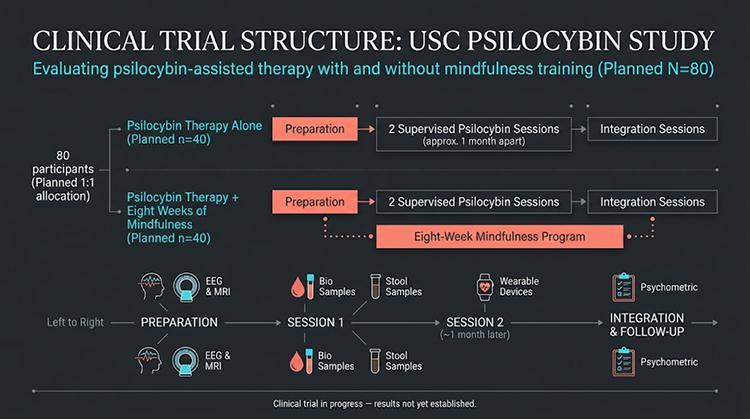
The new study will recruit 80 adults living in Los Angeles who have depression and no previous experience with psychedelics or meditation. Half of the participants will receive supervised psilocybin therapy alone, while the other half will receive psilocybin therapy alongside the eight-week mindfulness program.
Each participant will undergo two psilocybin sessions separated by approximately one month. Before the first session, participants will complete six hours of preparatory psychotherapy. The protocol also includes three integration sessions between the two psychedelic sessions and another three following treatment.
During the psilocybin sessions, therapists are expected to provide a supportive and attentive presence rather than directing the participant through a conventional psychotherapy session. This creates a controlled environment in which researchers can observe the psychedelic experience while maintaining clinical support.
Participants assigned to the mindfulness group will complete an eight-week program incorporating mindful awareness, loving-kindness and compassion practices. Daily meditation at home is also part of the intervention.
The first psilocybin session is scheduled to occur between weeks two and three of the mindfulness program. That timing allows participants to begin developing meditation skills before their first psychedelic experience, while the remaining weeks provide an opportunity to continue practicing afterward.
The design gives researchers a direct comparison between psilocybin alone and psilocybin combined with structured mindfulness training. That comparison is central to determining whether meditation contributes something beyond the psychedelic treatment itself.
USC Will Track More Than Depression Symptoms
One of the distinctive features of the USC project is the amount of biological and neurological information researchers plan to collect.
Participants will undergo EEG recordings and MRI brain imaging, alongside psychological and cognitive assessments. Researchers will also collect saliva, blood and stool samples and use wearable devices to gather additional information throughout the study.
The approach reflects the broader goals of the ARPA-H EVIDENT program, which is supporting research that combines detailed clinical information with digital, biological and neurological measurements.
Rather than asking only whether a participant feels better, researchers can examine multiple biological and behavioral signals associated with changes during the study. ARPA-H says the EVIDENT-MAP project will add new at-home and in-clinic measurements while expanding the research to people with more severe depression. Data collected through the award will be deidentified and stored in the EVIDENT Data Repository.
This multimodal approach could eventually help researchers identify which characteristics are associated with better or worse responses to treatment. It could also provide clues about whether changes associated with psychedelic therapy remain visible after the acute experience has ended.
For mindfulness research, that longer-term question is particularly relevant. Meditation requires repeated practice, and the USC researchers are testing whether that practice can become part of the process through which psychedelic experiences are integrated into everyday life.
The Study Builds On Earlier USC Research
The October 2026 announcement is not the beginning of USC’s interest in combining psychedelics and mindfulness.
The university previously launched a registered study known as Mindfulness-Assisted Psychedelic Therapy, or MAPT. That earlier project examined psilocybin combined with eight weeks of mindfulness training in healthy adults. The protocol randomized participants to either psilocybin with weekly mindfulness classes or psilocybin alone and included psychological assessments, cognitive testing, EEG and, when possible, functional MRI.
USC says that earlier work had tested 24 people without mental health conditions and produced encouraging early observations. The new EVIDENT-MAP project moves the research into a population with depression, where the potential clinical implications are greater but so are the demands for careful safety and efficacy evaluation.
ARPA-H describes the new project as an expansion of an ongoing clinical trial comparing psilocybin alone with psilocybin combined with mindfulness training. Its award listing identifies Rael Cahn and Shri Narayanan as principal investigators and lists the University of Southern California as the prime awardee in Los Angeles.
That progression—from healthy participants to people experiencing depression—is an important part of the research story. Early feasibility work can provide information about how an intervention is delivered, while later studies can examine whether the approach has meaningful effects in a population experiencing a specific mental health condition.
Why Depression Is A Major Focus Of Current Research
Depression remains a substantial public health concern in the United States.
The National Institute of Mental Health reports that an estimated 21.0 million U.S. adults experienced at least one major depressive episode in 2021, representing 8.3% of adults. Approximately 14.5 million adults experienced an episode associated with severe impairment.
These figures help explain why researchers continue to investigate new approaches to depression, particularly treatments that may work through mechanisms different from conventional medications and psychotherapy.
The psychedelic research field has also received increasing attention from federal agencies. In 2026, the FDA announced that it was prioritizing development of certain therapies for serious mental illness and identified psilocybin programs among the research efforts receiving national priority vouchers. The agency emphasized that promising treatments still need rigorous clinical evidence.
That last point is critical for interpreting the USC announcement. Psilocybin remains a research intervention in this context. The USC trial does not establish that psilocybin or mindfulness is an approved treatment for depression, and the study has been launched precisely because researchers need more evidence.
The Role Of Music In The Psychedelic Experience
The USC researchers are also paying close attention to the environment in which psilocybin sessions occur.
Assal Habibi has worked with clinicians and music therapists to create a specialized, lyric-free playlist for the sessions. The music is timed to correspond with different stages of the psychedelic experience, including a highly emotional piece during the period of peak intensity.
Music is being treated as part of the research environment rather than as background entertainment.
After treatment, participants will undergo MRI scanning while listening to the same music. Researchers will examine whether the brain responds to those musical cues in ways that could be associated with the therapeutic experience.
The longer-term idea is particularly interesting: if certain musical cues become associated with beneficial psychological states, researchers want to know whether those responses might eventually be useful without administering psilocybin.
That remains a research question. The study is not testing music as a standalone depression treatment.
Mindfulness May Provide A Longer-Term Practice
One of the central questions behind the USC trial is what happens after a psychedelic session ends.
A psilocybin session is relatively brief compared with an eight-week meditation program. That difference gives researchers a way to examine whether a repeated behavioral practice can influence the longer-term trajectory following an acute psychedelic experience.
Participants in the mindfulness group will practice mindful awareness, loving-kindness and compassion during the eight-week intervention. Daily home meditation is intended to make mindfulness a repeated activity rather than an isolated session.
This creates an interesting research model. The psychedelic experience may represent a concentrated intervention, while meditation supplies repeated opportunities to revisit attention, emotional responses and patterns of thinking.
Whether that combination produces better outcomes than psilocybin alone is exactly what the randomized comparison is intended to investigate.
For people interested in meditation outside clinical research, the distinction is also useful. The study is examining a highly structured program delivered alongside psychedelic therapy. It should not be interpreted as evidence that ordinary meditation practice produces the same effects as psilocybin.
What Researchers Will Need To Learn
The new USC trial is promising because it asks a specific question with a controlled comparison, but it will still have limitations.
An 80-person study can provide valuable evidence, but it is too small to answer every question about psychedelic-assisted therapy. Researchers will need to examine whether any differences between the two groups are statistically meaningful, clinically meaningful and sustained over time.
The study also involves a highly structured environment. Participants receive preparation, supervised psychedelic sessions, integration meetings, mindfulness training and extensive assessments. Results from this type of research setting cannot automatically be generalized to unsupervised psychedelic use or casual meditation practice.
The biological measurements add another layer of complexity. EEG, MRI, blood, saliva, stool and wearable-device data can generate large quantities of information, but researchers still have to determine which changes are meaningful and which are simply associated with the intervention without explaining why someone improves.
That is why the trial’s future findings will matter more than the announcement itself.
At present, there are no final results from the new 80-person depression study. USC is announcing the launch of the research and the structure of the investigation, not reporting that the combined treatment has been proven effective.
A New Test Of How Meditation Could Fit Into Mental Health Care
The USC project represents a different way of thinking about the relationship between meditation and emerging psychiatric treatments.
Instead of studying mindfulness as an isolated relaxation technique, researchers are testing whether an eight-week meditation program can become part of a broader therapeutic process. The comparison with psilocybin alone gives the researchers a way to investigate whether mindfulness contributes measurable benefits after the psychedelic intervention.
The project also reflects a larger movement toward collecting detailed information about mental health treatments. Brain recordings, biological samples, wearable devices and repeated psychological assessments may help researchers identify patterns that are invisible when studies rely only on symptom questionnaires.
For now, the most important finding is that the question is being tested in a formal clinical research setting.
The 80 participants in Los Angeles will provide researchers with data that may help determine whether mindfulness can extend or strengthen changes associated with psilocybin therapy for depression. If the combined approach produces better sustained outcomes than psilocybin alone, it could provide a foundation for larger trials. If the groups show little difference, that result would also be valuable because it would challenge the assumption that meditation necessarily adds therapeutic benefit to psychedelic treatment.
Either outcome would move the research forward.
The USC study therefore offers a useful example of where modern mindfulness research is heading: toward controlled experiments that examine meditation alongside other interventions, while measuring psychological, behavioral, neurological and biological changes over time. For Spiritual Endeavors, it is a reminder that meditation research increasingly extends beyond traditional wellness settings and into carefully monitored clinical science.