
Researchers affiliated with the University of Florida and Florida State University are examining whether a structured breathing practice combined with mindfulness and relaxation could become a useful option for adults living with chronic low back pain. A pilot study published September 22, 2026, in Pain Medicine reported that an eight-week intervention was feasible for most participants who enrolled, received favorable acceptability ratings, and was associated with improvements in self-reported pain.
The intervention, called Guided Respiration Mindfulness Therapy (GRMT), combines conscious connected breathing, mindful attention to bodily sensations and deliberate relaxation. Rather than focusing on breathing alone, the method asks participants to notice physical sensations as they arise, allow thoughts to pass without following them, and release unnecessary tension.
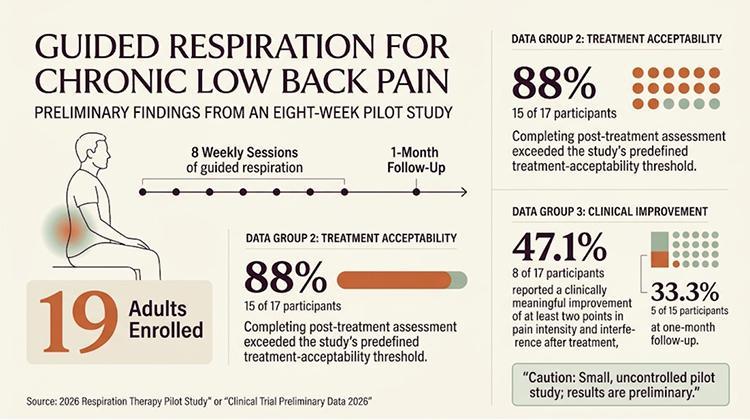
The study included 19 adults with chronic low back pain, making it an early-stage investigation rather than a definitive clinical trial. Researchers reported that 17 participants completed post-intervention assessments and 15 returned for a one-month follow-up. Although several participants reported meaningful improvements in pain, the study did not include a control group, so it cannot establish that breathwork caused those changes.
The findings nevertheless offer a useful starting point for researchers exploring how breathing practices and mindfulness might fit into broader approaches to persistent pain.
Why Researchers Are Investigating Breathwork For Chronic Pain
Chronic low back pain can affect mobility, sleep, concentration, work and everyday activities. For many people, the effects extend beyond the physical sensation itself, influencing mood, stress levels and confidence in movement.
Pain is a complex experience involving interactions among sensory processing, emotions, attention, behavior and the body’s responses to stress. This has encouraged researchers to investigate nonpharmacological approaches that address more than the physical symptoms alone.
Breathwork is one area of interest because breathing is closely connected with autonomic nervous system activity and emotional regulation. People can change their breathing patterns voluntarily, and structured breathing exercises are being studied for their potential role in managing stress and discomfort.
The September study examined a more comprehensive approach. GRMT combines respiratory regulation with mindfulness and relaxation, allowing researchers to explore whether these elements can be delivered together in a structured intervention for people with chronic low back pain.
The research team included Steven D. Pratscher, affiliated with The Ohio State University and the University of Florida; Lloyd Lalande, who developed GRMT; Mark A. Lumley of Wayne State University; Irene M. Estores, Kimberly T. Sibille and Roger B. Fillingim of the University of Florida; and Adam W. Hanley of Florida State University.
Their paper, Guided Respiration Mindfulness Therapy for Chronic Low Back Pain: A Single-arm Pilot Study of an 8-week Integrative Breathwork Intervention, appeared online in Pain Medicine on September 22, 2026.
How The Eight-Week GRMT Program Worked
The researchers delivered the intervention individually, in person, through eight weekly sessions. Each session lasted approximately 60 minutes and was conducted by one of four trained facilitators.

The method included three main components: respiratory regulation, mindfulness and relaxation.
During respiratory regulation, participants practiced deep, conscious, connected breathing into the chest. The technique involved moving from inhalation to exhalation without a deliberate pause, while allowing the exhale to remain relaxed.
The mindfulness component asked participants to focus on the dominant physical sensation they experienced from moment to moment. Instead of immediately reacting to discomfort or becoming absorbed in related thoughts, they were guided to observe the sensation and practice acceptance.
The relaxation component involved releasing physical tension and remaining still. During the final five minutes of each session, participants returned to their normal breathing pattern before discussing the experience with the facilitator.
Unlike programs that assign daily homework, this pilot did not require participants to practice the intervention between sessions. That made it possible to examine whether a weekly, facilitator-led format could be delivered and maintained by adults dealing with persistent pain.
The study was registered as ClinicalTrials.gov NCT06546956 and approved by the University of Florida’s institutional review board.
What The Researchers Found In The 19 Participants
The primary purpose of this pilot was to evaluate feasibility and acceptability, while also estimating whether participants’ pain outcomes changed during the intervention.
The researchers found that the program met its predefined feasibility targets. Of the 19 participants who enrolled, 17 completed the post-intervention assessment, representing 89.5% retention. Fifteen participants completed the one-month follow-up, equivalent to 78.9% of the original sample.
Attendance was also encouraging. Sixteen participants, or 84.2%, attended at least five of the eight sessions.
Participants generally rated the intervention positively. Among the 17 people who completed the post-intervention assessment, 15—approximately 88%—exceeded the study’s predefined threshold for treatment acceptability. Across 124 sessions, more than 90% of participant ratings described the experience as positive, likable and satisfying. All participants’ session ratings indicated satisfaction with the facilitator.
The researchers also reported improvements in self-reported pain intensity and interference, which measures how much pain disrupts daily activities.
| Study measure | Reported finding |
|---|---|
| Participants enrolled | 19 |
| Completed post-intervention assessment | 17 (89.5%) |
| Completed one-month follow-up | 15 (78.9%) |
| Attended at least five sessions | 16 (84.2%) |
| Exceeded the predefined acceptability threshold | 15 of 17 (88%) |
| Participants reporting clinically meaningful pain improvement after treatment | 8 of 17 (47.1%) |
| Participants reporting clinically meaningful pain improvement at follow-up | 5 of 15 (33.3%) |
These figures show why the researchers considered the approach suitable for further testing. They also show the limits of the evidence: the number of participants was small, and the pain improvements were measured without a comparison group.
How Pain Changed After The Breathwork Sessions
The researchers used the Pain, Enjoyment, and General Activity scale, known as PEG-3, to assess pain intensity and interference. The measure helps capture both how severe pain feels and how much it affects ordinary life.
Eight of the 17 participants assessed after the intervention achieved an improvement of at least two points on the PEG-3 scale, the threshold selected by the researchers to represent a clinically meaningful change. At the one-month follow-up, five of the 15 participants assessed met that threshold.
These results suggest that a subset of participants experienced improvements that may have mattered in daily life. The study also reported favorable changes across several secondary outcomes, including sleep disturbance, fatigue and physical functioning.
However, participants did not respond uniformly across every measure. Assessments involving movement-evoked pain and quantitative sensory testing produced more variable results than some of the self-reported outcomes.
The distinction is important. A participant may report feeling better overall without showing the same degree of change on every physical test. Researchers need larger studies to determine whether the observed improvements reflect a specific effect of GRMT, natural variation in symptoms, expectations, other influences or a combination of these factors.
The study was not powered to determine treatment effectiveness. Its results are best understood as preliminary evidence that the approach can be delivered and may warrant more rigorous evaluation.
Why Breathing, Mindfulness And Relaxation Are Being Studied Together
GRMT combines three practices that researchers often examine separately.
Conscious breathing gives participants a structured focus for attention. Mindfulness encourages them to observe physical sensations without automatically becoming caught up in thoughts about them. Relaxation adds an opportunity to reduce unnecessary muscular tension.
Together, these elements may help participants respond differently to discomfort. For example, a person who experiences pain during a routine movement may also notice worry, frustration or tension. A mindfulness-based approach encourages awareness of these responses without assuming that every sensation signals further injury.
That does not mean pain is imaginary or that people can overcome chronic pain simply by changing their attitude. Chronic pain can have many biological and medical causes, and breathwork should not replace appropriate assessment or treatment.
The scientific question is whether the combined intervention can produce reliable improvements in pain, function or related symptoms beyond what participants might experience without it.
Researchers also need to determine whether the breathing component adds measurable value beyond mindfulness or relaxation alone. Because GRMT combines all three elements, the current study cannot identify which component, if any, contributed most to the observed changes.
Readers interested in related practices can explore breathwork techniques for an overview of breathing-based approaches and how they differ.
What The Pilot Study Cannot Prove
The most important limitation is the absence of a control group. Every participant enrolled in the study received GRMT, so there was no comparison group receiving usual care, an alternative intervention or no additional treatment.
Without that comparison, researchers cannot separate the possible effects of the intervention from other explanations for the improvements. Chronic pain symptoms can fluctuate naturally, and expectations, attention from a facilitator, changes in daily behavior or concurrent care may also influence reported outcomes.
The sample size of 19 is another limitation. A small pilot can provide useful information about recruitment, attendance, participant satisfaction and the practical delivery of a treatment. It cannot reliably determine how well the intervention works across the wider population of people with chronic low back pain.
The results also cannot establish whether GRMT is more effective than other approaches, such as established psychological therapies, physical rehabilitation or other mindfulness-based programs.
The authors reported no serious adverse events or safety concerns in this small study. That is encouraging, but it does not establish that every form of intensive breathwork is suitable for everyone. People with chronic pain or significant medical conditions should discuss new therapeutic breathing programs with an appropriate healthcare professional.
What Comes Next For Integrative Breathwork Research
The researchers concluded that the feasibility and acceptability findings support moving toward a pilot randomized controlled trial, followed by a larger efficacy study if warranted.
Future trials can compare GRMT with an appropriate control condition, recruit more participants and assess whether changes in pain persist over time. Researchers can also investigate which participants are most likely to benefit, how much practice is needed and whether individual or group delivery produces different outcomes.
A controlled study could also measure changes in daily functioning, sleep, fatigue and movement-related pain alongside participants’ overall pain ratings. These measures would help establish whether any benefits extend beyond subjective impressions immediately after a session.
The work is part of a broader effort to evaluate breathing-based interventions with the same scientific care applied to other clinical approaches. A method can be easy to deliver and well received without necessarily proving effective, which is why feasibility studies are an important first step rather than the final word.
For Spiritual Endeavors readers, the central takeaway is that researchers are testing breathwork as a structured practice that combines conscious breathing, mindful awareness and relaxation. In this small 2026 pilot, most participants stayed with the program and rated it positively, while a subset reported meaningful improvements in pain.
Those findings make GRMT a promising subject for further research, but they do not yet establish it as an effective treatment for chronic low back pain. Larger controlled studies will be needed to determine whether the early results can be reproduced and whether the approach offers benefits beyond existing care.