
A large randomized clinical trial involving 1,458 employees at the University of California, San Francisco (UCSF) found that an eight-week digital mindfulness program was associated with lower perceived stress, less job strain and burnout, and improvements in mindfulness and work engagement. The findings are receiving renewed attention after UCSF highlighted the research in a September 28, 2026 report on workplace digital mindfulness.
The underlying study, however, is not new research from 2026. Rachel M. Radin, PhD, Julie Vacarro, MA, Elena Fromer, BA, and colleagues published the randomized clinical trial in JAMA Network Open on January 14, 2025. The research was conducted among employees of a large academic medical center who reported mild to moderate stress and generally had little or no previous meditation experience.
That distinction matters because the September 2026 UCSF report is a new institutional discussion of previously published findings, rather than evidence from a newly completed trial. Still, the study offers useful data about a practical question in workplace wellness: can a short, self-guided meditation program delivered digitally produce measurable changes in stress and work-related well-being?
The UCSF Trial Included 1,458 Employees
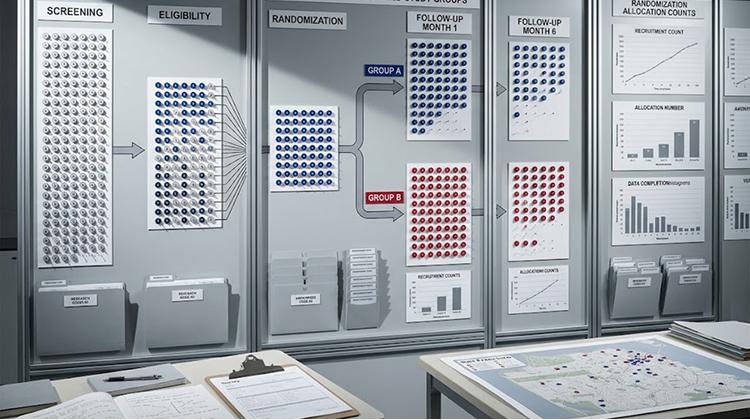
The trial recruited employees throughout the UCSF health system between May 16, 2018, and September 28, 2019. Researchers screened 3,382 people, identified 2,611 as eligible, and ultimately randomized 1,465 participants. Seven were withdrawn after being randomized in error, leaving 1,458 participants for the reported analysis.
The final group had an average age of 35.54 years. Women represented 80.8% of participants, while 17.9% identified as men. The most common occupational groups were academic research staff, medical staff and administrative staff. Participants had a mean baseline Perceived Stress Scale score of 21.42 out of 40, indicating moderate perceived stress under the study’s criteria.
Previous meditation experience was also limited. About 89.4% of participants reported meditating less than once a month or never. This makes the study particularly relevant to workplace populations that may be interested in mindfulness but do not already have an established meditation routine.
The researchers were based primarily in the UCSF Department of Psychiatry and Behavioral Sciences, with Rachel Radin serving as first author and Aric A. Prather, PhD, and Elissa S. Epel, PhD, among the senior researchers involved. The research team also included investigators affiliated with the University of Connecticut, UC Davis, UC Irvine, UC Riverside, UCLA and UC Merced.
Participants Were Randomized To Digital Meditation Or A Waitlist
The study used a randomized design, with participants assigned in approximately equal numbers to either a digital meditation intervention or a waiting-list control group. Of the 1,458 analyzed participants, 728 were assigned to digital meditation and 730 to the waiting list.
The intervention was deliberately brief. Participants were instructed to complete 10 minutes of meditation per day for eight weeks using a commercially available digital meditation platform. The control group was asked to continue its normal activities without adding meditation during the study period.
This approach differs from structured programs that require participants to attend regular classes, travel to a clinical site or meet with an instructor. Digital delivery allowed employees to access the meditation program through a web-connected device on their own schedules.
The researchers assessed participants at baseline and again after eight weeks. Some outcomes were measured again at four months, allowing the team to examine whether changes observed immediately after the intervention persisted beyond the active eight-week period.
For people interested in establishing a short daily practice, this type of intervention also illustrates why mindfulness routines can be structured around relatively small periods of practice rather than requiring lengthy meditation sessions.
Job Strain And Burnout Also Improved
Stress was only one part of the investigation. The researchers also examined work-specific outcomes, including job strain, burnout and work engagement. They reported significant improvements across the secondary outcomes in the digital meditation group compared with the waiting-list group.
Job strain was measured using an effort-reward framework, which considers the relationship between demands placed on workers and the rewards associated with their work. At eight weeks, the effect size for job strain was Cohen’s d = 0.34, with a 95% confidence interval of 0.23 to 0.46. At four months, the effect remained statistically significant with Cohen’s d = 0.37.
The researchers also reported reductions in work burnout and improvements in work engagement, alongside increases in subjective mindfulness. Depression and anxiety symptoms were among the additional psychological outcomes that improved following the intervention.
These results suggest that the potential value of digital mindfulness was broader than a change in one stress questionnaire. The intervention was associated with differences across several measures connected to how participants experienced both their general lives and their work.
However, these measurements remain largely psychological and self-reported. The trial should therefore be interpreted as evidence about perceived stress, work experience and related psychological outcomes rather than proof that digital meditation eliminates occupational stress or prevents burnout at an organizational level.
More Meditation Was Associated With Greater Stress Reduction
An especially interesting part of the research examined how much participants actually used the meditation intervention.
The study divided participants in the meditation group according to average daily practice. Those using the program for less than five minutes per day, five to 9.9 minutes per day, or 10 minutes or more per day were compared in exploratory analyses.
The researchers found evidence of a dose-response relationship for perceived stress. Participants who averaged between five and 9.9 minutes per day showed a greater reduction in stress than those averaging less than five minutes. The reported difference in mean PSS scores between those groups was approximately −6.58 points, with a 95% confidence interval of −7.44 to −5.73.
This does not establish that exactly five minutes is a threshold at which mindfulness begins working. Participants were not randomly assigned to different amounts of meditation, so adherence levels could also reflect differences in motivation, schedule, stress or other characteristics.
Still, the finding provides an important practical signal: engagement mattered. The UCSF researchers reported that greater adherence was associated with greater reductions in perceived stress, reinforcing the idea that access to an app alone is different from actually using it consistently.
Perceived Stress Fell More In The Meditation Group
The primary outcome was change in perceived stress, measured with the Perceived Stress Scale (PSS). At eight weeks, the digital meditation group showed a substantially larger reduction than the waiting-list group.
The mean PSS change was approximately −5.84 points in the digital meditation group compared with −1.45 points in the waiting-list group, producing an adjusted between-group difference of about −4.39 points. The reported standardized effect size for the primary outcome was Cohen’s d = 0.85, with a 95% confidence interval of 0.73 to 0.96.
These numbers are important because the comparison was not simply between people who meditate and people who do not meditate based on personal preference. Participants were randomized to the intervention or waitlist condition, which provides stronger evidence for an intervention effect than a purely observational comparison.
The study also examined whether the effects lasted. At four months, the stress reduction remained statistically significant, with a reported effect size of Cohen’s d = 0.71 for perceived stress.
That persistence does not mean every participant continued meditating at the same level or that the program permanently changed stress. Rather, it indicates that the group-level differences measured after the intervention were still present at the later assessment.
The Study Was Conducted At A Major Academic Medical Center
The setting is another important part of the research. Participants were employees within the UCSF health system, rather than a nationally representative sample of American workers.
The occupational mix included academic research personnel, medical staff and administrative employees. That gives the study relevance to workplaces where employees may experience demanding schedules, high responsibility and exposure to stressful environments, but it also limits how broadly the results can be generalized.
The study was also designed around employees who already reported mild to moderate stress. People with very low stress levels were therefore not the primary population being tested, while regular meditators were excluded. The findings should be understood within that population rather than applied automatically to every worker.
The trial also had attrition. Overall, 237 participants, or 16.23%, did not complete all relevant study assessments, with attrition somewhat higher in the meditation group than in the waiting-list group.
These factors do not invalidate the results, but they are relevant when interpreting workplace mindfulness research.
Digital Delivery Changes How Workplace Meditation Can Be Used
One reason UCSF researchers continue to discuss this trial is the scalability of digital meditation. Traditional workplace mindfulness programs may require instructors, meeting space and scheduled sessions. A smartphone or web-based program can remove many of those logistical requirements.
The UCSF research team described digital mindfulness as a potentially low-cost, low-burden approach that could be delivered at scale. The study’s design supports that practical argument because participants were able to complete the intervention without attending recurring in-person meditation classes.
At the same time, digital access does not solve every workplace stress problem.
A meditation application cannot change understaffing, excessive workloads, unpredictable schedules, inadequate management or other organizational sources of stress. The researchers themselves noted the need for future work examining mechanisms of benefit and ways to improve adherence.
That distinction is particularly relevant for employers. A digital mindfulness program can be viewed as one possible employee wellness resource, but the evidence does not establish that it should replace organizational approaches to working conditions.
UCSF Continues To Study Digital Meditation
The 2026 UCSF report also fits within a broader research program at the university examining digital mindfulness and health. UCSF’s Aging, Metabolism and Emotion Center describes the Stress Free UC project as a large randomized study spanning five University of California campuses, including UCSF, UC Irvine, UCLA, UC Merced and UC Riverside.
UCSF also lists ongoing digital meditation research involving older adults. One trial is examining whether personalized digital meditation can improve attention and well-being, while another investigates digital meditation in older adults with mild cognitive impairment and its potential effects on cognition, sleep and stress.
This broader research activity shows that digital meditation is being studied as more than a workplace wellness product. Researchers are testing whether app-delivered practices can be adapted to different populations and outcomes, including stress, cognition, sleep and emotional well-being.
For workplace research specifically, the 1,458-person trial remains notable because of its randomized design and the range of outcomes measured.
What The UCSF Study Actually Shows
The strongest finding from the UCSF research is specific: among employees with mild to moderate stress, an eight-week digital mindfulness program involving 10 minutes of daily meditation was associated with greater reductions in perceived stress than a waiting-list control. The intervention group also showed improvements in job strain, burnout, work engagement, mindfulness, depression and anxiety measures, with several benefits remaining evident at four months.
The study does not show that meditation eliminates workplace stress, guarantees better job performance or produces the same effects for every employee. It also does not establish that five or 10 minutes is the ideal amount of daily meditation because the adherence analysis was observational within the intervention group.
The September 28, 2026 UCSF report therefore adds current attention to an already published body of evidence rather than introducing a new 2026 clinical trial. The underlying randomized research, published in January 2025, provides the measurable results: 1,458 employees, eight weeks of digital meditation, a 4.39-point adjusted difference in PSS change at eight weeks, and sustained group differences at four months.
For workplace mindfulness, the significance lies in the combination of scale, digital delivery and measurable changes in perceived stress and work-related well-being. It provides a concrete example of how a brief daily meditation practice can be tested within a real academic medical-center workforce, while also showing why adherence and workplace conditions remain important parts of the larger picture.