
Meditation research has increasingly moved beyond the question of whether meditation works and toward a more specific question: which practice may work best for a particular person? A large randomized controlled trial involving 5,049 adults from the United States and United Kingdom provides new evidence that individual characteristics may help predict how people respond to different brief meditation practices.
The study, published in Behaviour Research and Therapy in October 2026, compared three short practices—mindfulness, self-compassion and gratitude—with an internet-as-usual control condition. Participants practiced for only five or 10 minutes, allowing researchers to examine whether very brief interventions could influence subjective well-being while also testing whether pre-intervention characteristics could help identify differences in individual response.
The findings are promising but more limited than the idea of an algorithm simply telling someone which meditation to use. The researchers found a modest improvement in negative affect from brief meditation, while their data-driven analysis showed that pre-intervention characteristics could predict some differences in response. However, the study did not directly test whether assigning people to a personalized meditation program produces better outcomes than assigning everyone the same practice. That distinction is central to interpreting the research.
The Study Included 5,049 Adults From The U.S. And U.K.
The trial was led by Otto Simonsson and included researchers affiliated with institutions including the University of Wisconsin-Madison, Harvard Medical School, McLean Hospital, Northeastern University, Karolinska Institutet, Stockholm School of Economics and Trier University. The U.S. research involvement included the University of Wisconsin-Madison’s Center for Healthy Minds and other American institutions.
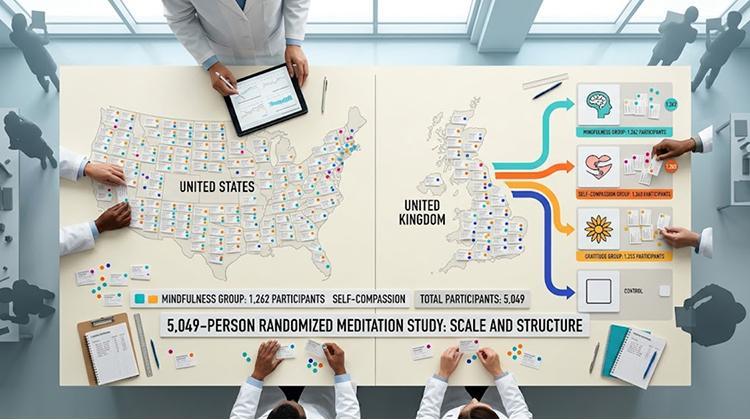
The sample included 5,049 adults from the United States and United Kingdom, with the researchers describing the samples as representative of the adult populations in those countries with respect to age, sex and ethnicity. The study was preregistered and randomized, giving it a substantially stronger design than small convenience-sample experiments that have characterized some earlier meditation research.
The research was registered as the Short Practices Well-being Study and was designed to examine whether short practices could influence well-being. Participants were adults aged 18 or older residing in the United States or United Kingdom. The study was completed after enrolling its target sample of 5,049 participants.
The scale matters because individual differences can be difficult to study reliably in small meditation experiments. A large sample gives researchers more observations with which to examine whether characteristics measured before an intervention are associated with different responses afterward.
For readers interested in the broader scientific evidence surrounding meditation, the National Center for Complementary and Integrative Health provides an overview of current research in its meditation and mindfulness evidence. NCCIH notes that meditation research covers a wide range of practices and outcomes, which makes differences between specific techniques an important area for continued study.
Three Different Meditation Practices Were Compared
Rather than treating meditation as one uniform intervention, the researchers separated three approaches: mindfulness, self-compassion and gratitude.
The mindfulness condition focused attention on present-moment experience. Self-compassion practice directed attention toward a kinder and more supportive response to one’s own difficulties. Gratitude practice emphasized appreciation and recognition of positive aspects of life.
Each intervention was brief, lasting five or 10 minutes. Participants were compared with an internet-as-usual control condition rather than simply being compared with people who received no activity at all. This distinction is useful because the control condition represents what participants might otherwise have been doing online during the same general period.
The study therefore tested two related questions. First, does a short meditation practice produce a measurable change in subjective well-being compared with ordinary internet use? Second, can characteristics measured before the intervention help predict whether an individual responds differently to mindfulness, self-compassion or gratitude?
That second question is where the research becomes more unusual.
Traditional meditation research often reports an average treatment effect. For example, researchers might compare the average change in stress between a meditation group and a control group. A personalized approach asks a different question: does the size or direction of that effect depend on who the participant is?
Brief Meditation Produced A Modest Change In Negative Affect
The strongest overall finding concerned negative affect, which refers broadly to unpleasant emotional states.
The researchers reported that brief meditation practices modestly reduced negative affect relative to the control condition. In a description of the study’s results, Christian A. Webb, one of the researchers, reported effect sizes of approximately d = −0.30 for meditation and d = −0.20 for the control condition, indicating that the meditation advantage was relatively modest rather than dramatic.
The researchers did not find a significant overall group difference for positive affect. This is an important distinction because a reduction in unpleasant emotional states is not the same thing as producing a large increase in happiness or positive emotion.
The study also reported that shorter interventions were associated with larger increases in positive affect than longer interventions. This does not mean that five-minute meditation is universally better than 10-minute meditation. Instead, it shows that intervention duration may interact with the specific outcome being measured.
This pattern reinforces a broader point about meditation research: the results depend heavily on what researchers measure. Stress, anxiety, positive affect, negative affect, attention, sleep and physiological measures are different outcomes, and an intervention can produce a measurable change in one without producing the same change in another.
The Personalization Analysis Used Pre-Intervention Characteristics
The most innovative component of the study involved a data-driven prediction model.
Researchers examined characteristics available before participants began their assigned practice and used them to estimate whether individuals might respond differently to mindfulness, self-compassion or gratitude meditation.
The analysis identified people for whom the model-indicated practice was associated with greater reductions in negative affect. The overall advantage for model-indicated practice was approximately d = 0.16, while the estimated difference increased to approximately d = 0.43 among participants with the largest predicted benefit.
These figures should not be interpreted as evidence that an existing algorithm can reliably prescribe the ideal meditation for every person. The researchers did something different: they used characteristics collected before the intervention to model differences in response within a randomized trial.
That is an important scientific step, but it remains a step toward personalized meditation rather than a finished personalization system.
The next experiment would need to take people entering a new trial, use their baseline characteristics to assign them to a specific meditation practice, and then compare those participants with people assigned to practices without personalization. The current researchers specifically identify this type of prospective algorithm-guided randomized trial as the next stage needed to directly test whether personalized recommendations improve well-being.

For people building a regular practice, the practical implication is therefore more modest: different forms of meditation may affect people differently, but current evidence does not establish a universally reliable formula for selecting one practice over another.
Mindfulness, Self-Compassion And Gratitude Serve Different Functions
The three practices also represent different psychological targets.
Mindfulness generally trains attention and awareness of present-moment experience. Self-compassion focuses more directly on how a person responds to personal difficulty, mistakes or suffering. Gratitude shifts attention toward appreciation and positive aspects of experience.
Because these practices have different instructions and psychological emphases, treating them as interchangeable could hide meaningful differences between participants.
Someone experiencing repetitive negative thinking might find a present-moment mindfulness exercise useful, while another person struggling with harsh self-judgment might respond differently to self-compassion practice. A third person may respond more strongly to an exercise that directs attention toward gratitude.
The current study does not establish those individual recommendations as clinical rules. What it does show is that baseline characteristics contain some information about subsequent response. That finding supports further research into whether meditation can eventually be matched to individual needs rather than offered as a single standardized intervention.
This is consistent with the broader scientific position that meditation encompasses many different approaches rather than one standardized treatment. NCCIH notes that mindfulness and meditation studies vary substantially in their techniques, populations and outcomes, making it difficult to generalize results from one form of meditation to all others.
The Study Also Provides Important Information About Short Practice Sessions
The five- and 10-minute formats are significant because they test an accessible form of meditation rather than requiring lengthy sessions.
Many people who are interested in meditation struggle with consistency because longer sessions can be difficult to fit into a daily schedule. A study based on five- or 10-minute practices therefore asks a practical question: can a very small amount of structured practice produce a measurable psychological effect?
In this trial, the answer was yes, but modestly for negative affect.
That wording matters. The findings do not show that five minutes of meditation produces major changes in mental health, nor do they demonstrate that a short practice can replace established treatments for a mental health condition.
Instead, the results suggest that brief digital meditation exercises can generate measurable changes in a specific aspect of subjective well-being. The size of those changes and the variability between individuals provide the more interesting scientific questions.
This also makes the study relevant to people establishing a meditation basics routine. A short session may be a realistic entry point, but the appropriate practice should still depend on personal preference, goals and circumstances rather than an assumption that one technique is universally superior.
The Researchers Did Not Test A Personalized Recommendation System
One of the easiest ways to overstate this research would be to describe it as proof that artificial intelligence can now prescribe the perfect meditation.
That is not what happened.
The researchers used a data-driven approach to identify patterns in individual responses after participants had been assigned to different conditions. They then examined whether pre-intervention characteristics could predict which practice might produce a better response.
The study’s authors explicitly call for future research that directly tests algorithm-guided intervention assignment. That means the next study would need to use personalization prospectively, before the intervention begins, rather than using the data afterward to determine which practice appears to have been a better match.
This difference between prediction and prospective testing is essential. A model can identify patterns in existing data without necessarily producing better decisions when deployed on new people.
The current study therefore provides evidence for the possibility of personalized meditation, not proof that personalized meditation is already more effective than standard recommendations.
Safety Was Also Examined In The Same 5,049-Person Research Program
A separate analysis published September 14, 2026 in JMIR Mental Health examined adverse experiences using the same 5,049-person randomized study population. That analysis found that 4.1% of participants reported a distressing experience during the intervention, while 7.1% experienced an increase in negative affect from before to after the intervention.
The meditation groups were no more likely than the internet-as-usual group to report a distressing experience overall. The odds ratio was 1.05, with a 95% confidence interval of 0.76 to 1.47 and a P value of .76. Participants assigned to meditation were also less likely to experience clinically relevant increases in negative affect, with an odds ratio of 0.63 and P < .001.
However, the analysis identified one difference between the two short durations. Participants assigned to 10-minute practices were more likely to report a distressing experience than those assigned to five-minute practices, with an odds ratio of 1.42, a 95% confidence interval of 1.07 to 1.89 and P = .02.
The researchers also found that pre-intervention characteristics showed acceptable predictive ability for distressing experiences, with an area under the curve of 0.73. Prediction of increased negative affect was somewhat weaker, with an area under the curve of 0.67.
NCCIH similarly notes that meditation is generally considered to have few risks, while acknowledging that some people report negative experiences. Its evidence review emphasizes that safety research remains an important part of evaluating meditation practices.
What The Findings Mean For Personalized Meditation
The study changes the conversation around brief meditation in a useful way.
The central result is not that one of the three practices—mindfulness, self-compassion or gratitude—is universally the best. Instead, the research suggests that individual differences may help explain why the same practice produces different responses in different people.
That is potentially important for the future of digital meditation. A standardized app might currently offer the same sequence to thousands of users. A personalized system could eventually consider characteristics such as baseline emotional state and other measurable factors before recommending a particular type of practice.
But that future model still needs to be tested.
The 5,049-person trial provides strong evidence that individual response patterns exist and that some of those patterns can be predicted from pre-intervention characteristics. It does not yet establish that personalized recommendations will produce larger or more durable improvements than conventional meditation instruction.
That distinction keeps the findings in perspective while still recognizing why the study is important.
Why This Trial Matters For The Future Of Meditation Research
Meditation research has traditionally focused on average effects. Large randomized trials can now begin addressing a more complicated question: what happens when the average effect hides substantial differences between individuals?
The U.S.-UK study provides a large dataset for investigating that problem. It combined randomized assignment, brief standardized interventions and data-driven prediction in a sample of 5,049 adults.
Its findings point toward a future in which meditation research may pay greater attention to individual response rather than asking only whether meditation works across an entire population.
The next stage will require prospective testing. Researchers will need to determine whether an algorithm can correctly select a meditation practice for a new participant and whether that selection produces better outcomes than standard, non-personalized assignment.
Until those trials are completed, the most defensible takeaway is straightforward: brief mindfulness, self-compassion and gratitude practices can produce modest changes in negative affect, and early evidence suggests that personal characteristics may help predict which practice works better for some individuals.
That is a meaningful development in meditation research because it shifts attention from finding one universally effective practice toward investigating how different practices may fit different people.