
Let’s be honest. Our minds often feel like a browser with too many tabs open. And half of them are stuck.
Nadi Shodhana, or Alternate Nostril Breathing, is an old yogic trick. It’s not just magic. It’s a real way to reset your system through breathing.
Imagine it as a meeting where your brain’s two sides talk it out. The logical left and the creative right usually fight like political rivals. But this method helps them agree.
It clears mental fog quickly and efficiently. It brings calm that lasts longer than any meditation app’s promise. You’ll feel your nerves calm down and your focus get sharper.
This is about finding an inner balance. It’s like having your life together, but in a good way.
Contraindications and Prep
Nadi shodhana is like a diplomatic meeting for your nervous system. It needs the right conditions to work. You wouldn’t hold peace talks in a war zone, and you shouldn’t do this breathwork if your nose is blocked.
Who’s not invited to this party?
- Respiratory infections: If you’re fighting a cold or flu, your body is already busy. Trying to control your breath is like trying to have a meeting in a snowed-in airport—wait until it’s better.
- Severely blocked nostrils: This practice needs you to breathe through both nostrils. If one is blocked, it’s like trying to talk on a broken phone line.
Once you’re cleared, the prep is simple. You just need a quiet spot for 12 to 15 minutes. In today’s world, finding quiet time is a bold move.
Choosing where to sit is important. You can sit on the floor or in a chair. Just make sure you sit up straight with your feet on the ground.
The most important tool you’ll need is the “silent” switch on your phone. This practice is about focusing your mind, not multitasking.
By following these rules, you’re not limiting the practice. You’re setting up the perfect conditions for nadi shodhana to work its magic. The prep is the first, and most important, step.
Detailed Technique with Hand Positions
Think of your right hand as the conductor of your brain’s orchestra. It’s ready to lead a symphony of breath between your left and right brain hemispheres. This setup is called Vishnu Mudra, your control panel for the whole process.
Place your left hand, palm-up, in your lap. It’s ready to help, even if it’s not doing much. Your right hand is the main conductor.
Start by placing your right palm close to your nose. Use your thumb to gently block your right nostril. Your pinky seals your left nostril. The other fingers? They’re curled or stretched, forming a special shape.
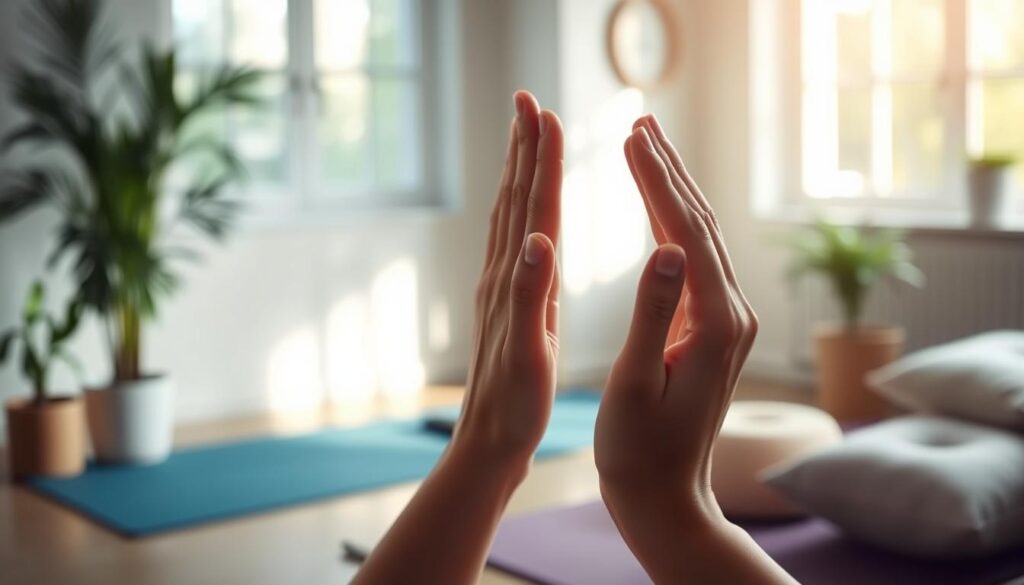
Why do we do this? Your thumb controls your right nostril, linked to your left brain. This side is all about logic and lists. Your pinky controls your left nostril, connected to your right brain. This side is for emotions and creativity. A wrong grip can ruin the whole thing. You need to apply gentle pressure.
To understand this better, here’s a simple breakdown:
| Finger/Hand | Physical Action | Symbolic Role |
|---|---|---|
| Right Thumb | Gently closes right nostril on exhale/inhale cycles. | Mutes the analytical left brain, allowing its circuits to cool. |
| Right Pinky | Gently closes left nostril on exhale/inhale cycles. | Dims the emotional right brain, quieting its static. |
| Right Index, Middle, Ring | Extended upward or curled inward. | Acts as a stabilizer; the “antenna” for focus or a gesture of inward collection. |
| Left Hand (in lap) | Rests palm-up, passive. | Represents receptivity and grounding, the calm counterweight to the active right hand. |
Look at the beautiful balance? One hand is active, the other is calm. This shows the balance you’re trying to find inside. The shape of your fingers is not just for looks. It helps your body feel what’s happening.
Before you start breathing, get your hand position right. Your thumb and pinky are more than just blocks. They’re diplomats trying to make peace between your brain’s sides. Master this, and you’re halfway to finding harmony.
Pacing Options and Ratios
The pacing ratios are like the harmony that makes simple notes profound. Anyone can learn to switch nostrils. But the real magic happens when you start controlling the tempo.
Start without counting. Just follow the flow: inhale left, switch, exhale right, inhale right, switch, exhale left. It’s like finding the beat to a new song. This practice gets your neural pathways talking.
To truly change your state, you need structure. You need ratios. Let’s look at the classic pattern. Inhale for five counts, hold for five, exhale for five. This 1:1:1 ratio is basic biohacking.
The equal parts balance the autonomic nervous system. The inhale and exhale are given equal weight. The hold is a pause for integration. It’s like finding center.
This is where you become a composer. The table below is your mixing board. Each ratio pattern is designed to achieve a specific state of equilibrium.
| Ratio Pattern | Intended Effect | Sample Count (Inhale:Hold:Exhale) |
|---|---|---|
| Equal Ratio (1:1:1) | For overall balance & nervous system symmetry | 5:5:5 |
| Extended Exhale (e.g., 1:1:2) | For calming anxiety, inducing relaxation | 4:4:8 |
| Extended Inhale (e.g., 2:1:1) | For energizing, increasing alertness | 6:3:3 |
| Extended Hold (e.g., 1:4:2) | For advanced focus & mental clarity | 4:16:8 |
Feeling wired? Try a longer exhale. Inhale for four, hold for four, exhale for six or eight. This extends your vagus nerve, calming your fight-or-flight response.
Need a boost? Focus on the inhale. A pattern like 6:3:3 is like a caffeine boost without the jitters.
Playing with these ratios is like DJing for your inner state. You’re not just breathing; you’re remixing your physiology. The ratios let you fine-tune your internal balance until the mix feels just right.
Forget rigid rules. The count of “5, 4, 3, 2” is just a suggestion. Listen to your body and adjust the pace. This way, you’re not just balancing your breath. You’re mastering your own balance.
Combining with Seated Meditation
You wouldn’t start a symphony with the cymbals crashing; starting silent meditation without preparation is chaotic. Your mind is like an orchestra that needs tuning. Nadi shodhana is like the essential prelude.
After five to ten minutes of this breathwork, your mind quiets down. The constant chatter in your head is silenced. The left and right brain hemispheres find peace, like tuning an old radio.

This calm is your golden window. The frantic energy is spent. Now, you can move smoothly into seated meditation.
It’s like moving from a choppy lake to a glassy pond. The breathing technique creates calm. Meditation lets you enjoy the view. Why fight the current when you can be the calm water?
So, you’ve done the work. The channels are clear. Sit in that silence. Observe the space between your thoughts.
As one resource on making mindfulness accessible notes, simple practices are profound. Stay in the silence as long as you can. This is the reward—a direct line to cultivating a joyous mind without struggle.
Measuring Calm (HRV/Baseline Mood)
“Feeling balanced” sounds nice, but in today’s world, shouldn’t inner peace have a dashboard? Feeling calmer is a very personal thing. It’s like describing a wine as “oaky” versus knowing its pH level.
Thankfully, the harmony and emotional stability from alternate nostril breathing have proof. We’re not just talking about good vibes; we have real data. The key evidence is in your autonomic nervous system.
This system controls your heart rate, digestion, and stress response. When it’s stressed, it’s all over the place. But when it’s calm, it adapts well.
The best way to measure this? Heart Rate Variability (HRV).
A healthy heart doesn’t beat like a metronome. The small changes in time between beats are very important. A higher HRV means a more flexible, calm nervous system. It shows your body can handle stress.
So, how do you turn feelings into facts? You run an experiment on yourself.
First, find your baseline. Use a fitness tracker or HRV app for a week. Just live your usual life. Record the numbers.
Then, add daily Nadi Shodhana practice. Keep it up for another week or two. Watch your HRV number go up, showing your nervous system is getting stronger.
Also, keep a simple mood log. Before and after practice, rate your calmness from 1-10. The change is your personal peace gain.
| Tracking Method | What It Measures | Tool Needed | Key Insight Provided |
|---|---|---|---|
| Subjective (Mood Log) | Immediate perceptual shift, emotional state | Pen & paper, notes app | Direct feedback on the practice’s calming effect on your conscious mind. |
| Objective (HRV Trend) | Autonomic nervous system resilience | HRV-capable fitness tracker (e.g., Whoop, Apple Watch, Oura Ring) | Physiological proof of improved stress adaptation and balance. |
| Combined Analysis | Mind-Body congruence | Both tools + a spreadsheet | Correlates the felt sense of calm with the biological metric of balance, quantifying left/right brain operational harmony. |
When your mood scores and HRV chart both improve, you’ve done more than just feel good. You’ve collected real evidence. The data shows you’re not just feeling balanced. You can see it in your own biometrics.
FAQs and Cultural Respect
Let’s talk about the elephant in the *shala*. You might call it alternate nostril breathing. Its real names are Nadi Shodhana (channel cleansing) or Anulom Vilom. That “anavalom” spelling you see? It’s just a typo, not a different method.
This isn’t just a quick fix. It’s a key part of Pranayama from the Yogic tradition. View it as a classic text, not just a tool for stress relief. Show respect for its roots.
FAQ time. The best time to practice is in the morning. It helps set your day’s rhythm. Daily practice is best for balance. But practicing three times a week also works.
What if one nostril is always blocked? You can’t get balance if one way is blocked. Try a neti pot first. It’s like the warm-up for the main event.
The goal is to practice with both curiosity and respect. That’s the real balance you seek.