
A new UCLA study is challenging the assumption that school wellness programs necessarily have their biggest effects among students with the fewest challenges. Researchers found that teenage girls who had experienced the highest levels of childhood adversity showed the largest improvement in social connectedness after participating in a program combining structured breathing techniques with social-emotional learning.
The study, published August 10, 2026, in the Journal of Research on Adolescence, followed 174 female adolescents ages 14 to 18 at two Southern California high schools. The program, known as SKY Schools, combined social-emotional learning with SKY Breathing, a structured breathing practice based on Sudarshan Kriya Yoga.
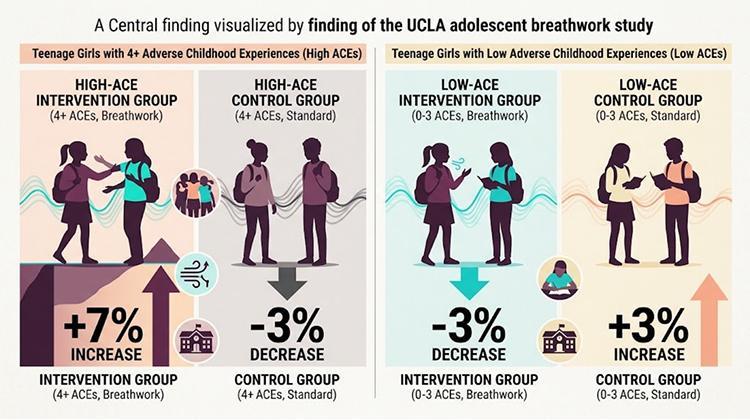
Among participants who reported four or more adverse childhood experiences (ACEs), social connectedness increased by 7% following the intervention. By comparison, the low-ACE intervention group declined by 3%, while the high-ACE and low-ACE control groups showed changes of -3% and +3%, respectively. The difference was statistically significant at p < .01.
The finding does not mean breathwork reverses childhood trauma, nor does it establish that breathing exercises alone caused the improvement. The intervention included several components, and the study involved female students at only two schools. But the results raise an important question for schools: Could simple practices that help adolescents regulate their stress also make it easier for them to feel connected to the people around them?
Why Social Connectedness Matters During Adolescence
Adolescence is a period when relationships with peers become increasingly important. Feeling accepted, supported and connected to a school community can influence how young people experience stress, belonging and emotional difficulties.
That makes the UCLA finding more significant than a simple measurement of whether students enjoyed a wellness class.
Social connectedness refers to a person’s perceived sense of closeness and belonging with other people and groups. When that perception improves, an adolescent may feel more supported by classmates, teachers, friends or the broader school environment.
Previous research has associated social disconnection and loneliness with poorer mental-health outcomes in young people. A large NIH-supported study, for example, found that supportive relationships with family and friends were associated with better mental health among adolescents during the COVID-19 pandemic.
The UCLA researchers focused on a population for whom this issue may be especially important: girls who had experienced multiple adverse childhood experiences.
The Centers for Disease Control and Prevention defines ACEs as potentially traumatic experiences occurring before age 18, including abuse, neglect, household instability and exposure to violence. The CDC notes that ACEs can have long-term effects on health, well-being and life opportunities.
This gives the UCLA study a broader context. The researchers were not simply testing whether teenagers could become calmer after learning to breathe differently. They were examining whether a school-based mind-body program could influence how connected vulnerable students felt to other people.
What The UCLA Researchers Studied
The study was conducted by researchers affiliated with UCLA’s Semel Institute for Neuroscience and Human Behavior, including senior author Dara Ghahremani, a research professor at the institute.
The co-lead authors were Nathan Chabin, now a postbaccalaureate fellow at the National Center for Complementary and Integrative Health, and Justine Chen, who conducted the research as a postgraduate research assistant at UCLA. Other researchers included Matthew Abikenari, Maxim Dembow, Prabha Siddarth, Vickie Mays, Denise Chavira and Susan Ramsundarsingh.
The researchers recruited 174 female students between 14 and 18 years old from two Southern California high schools. More than 93% of the students were Latinx, making the population particularly relevant to questions about culturally appropriate and accessible school wellness programs.
The researchers divided students according to their reported number of ACEs.
| Study Group | ACE Exposure | Social Connectedness Change |
|---|---|---|
| High-ACE intervention | 4 or more ACEs | +7% |
| Low-ACE intervention | Fewer than 4 ACEs | -3% |
| High-ACE control | 4 or more ACEs | -3% |
| Low-ACE control | Fewer than 4 ACEs | +3% |
The most striking number is the 7% improvement among high-ACE participants receiving the intervention.
Rather than seeing weaker results among the students facing the greatest challenges, the researchers observed their strongest improvement in the social-connectedness measure.
The Program Combined Breathwork With Social-Emotional Learning
It is important to understand what participants actually received.
The UCLA study did not test a breathing exercise in isolation.
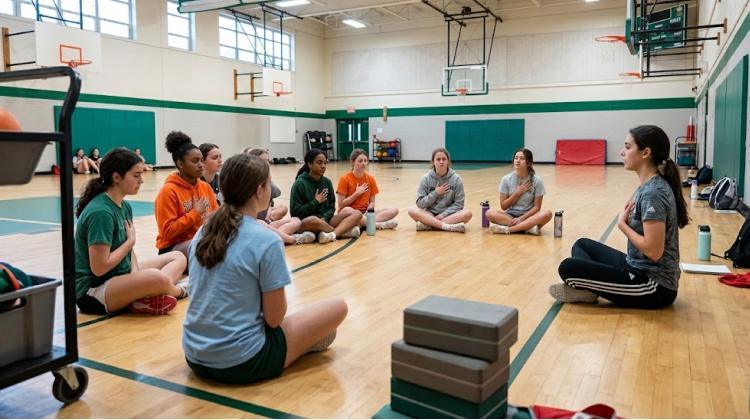
Students first completed a four-week SKY Schools curriculum combining social-emotional learning with SKY Breathing. After that curriculum, they practiced the breathing techniques during physical education classes every school day for another eight weeks.
The breathing schedule was relatively practical for a school setting. Students completed approximately five minutes of shorter breathing techniques on four days each week, followed by a 25-minute SKY Breathing session on the fifth day.
Across the eight-week practice period, the students completed 40 breathing sessions.
That structure is worth emphasizing because it shows why the intervention could potentially fit into a school schedule.
The researchers were not asking students to spend hours meditating every day.
Instead, breathing practice was incorporated into an existing physical education environment.
The SKY Schools curriculum also included stretching, games involving physical activity, self-regulation training, leadership skills and conflict-management education.
That makes the intervention closer to a school-based biopsychosocial program than a conventional meditation class.
For readers interested in breathwork techniques, the distinction is useful: the study supports interest in a broader program that includes breathing, emotional skills and physical activity, rather than proving that any individual breathing technique will produce the same result.
Why The High-ACE Group Stood Out
The most surprising result was the response among girls who reported four or more ACEs.
The CDC’s current data show how common childhood adversity can be among U.S. adolescents. In national 2023 Youth Risk Behavior Survey data, 76.1% of high school students reported at least one ACE, while 18.5% reported four or more. Emotional abuse was the most commonly reported experience at 61.5%, followed by physical abuse at 31.8% and living in a household affected by poor mental health at 28.4%.
These numbers help explain why the UCLA researchers focused on cumulative adversity rather than a single traumatic experience.
ACEs can accumulate.
The CDC notes that prolonged stress associated with adversity can affect children’s development, attention, decision-making and learning, while also influencing the body’s stress-response systems.
Social relationships can become part of this picture.
When a young person has experienced instability, conflict, violence or other adverse experiences, feeling safe and connected at school may be more difficult. A program that teaches students to regulate their own physiological responses while also teaching communication and emotional skills could theoretically address several parts of that challenge at once.
The UCLA results offer preliminary evidence consistent with that possibility.
They do not prove the mechanism.
What SKY Breathing Actually Adds
SKY Breathing is based on Sudarshan Kriya Yoga, a breathing practice that uses specific rhythms and patterns of respiration.
The UCLA researchers describe the practice as a form of autonomic regulation, meaning that it is intended to influence processes associated with the autonomic nervous system.
That is relevant because stress regulation is not exclusively psychological.
Breathing changes can alter respiratory patterns and influence physiological arousal. When combined with social-emotional learning, students may gain both a physiological strategy and a set of cognitive or interpersonal skills for responding to difficult situations.
The researchers’ interpretation is that better self-regulation could make social interaction easier.
As Ghahremani explained, when students can regulate their stress more effectively, they may also find it easier to connect with people around them.
That proposed pathway is plausible, but it remains a hypothesis rather than a demonstrated causal chain.
The study measured social connectedness, not a direct physiological pathway showing that a particular change in the autonomic nervous system caused the 7% improvement.
The Study Used A Wait-List Comparison
Another strength of the research was its use of a comparison school.
The two Southern California high schools were randomly assigned so that one received the SKY Schools program during the study while the other served as a wait-list control and received the program afterward.
Students in the control school continued their normal physical education curriculum during the comparison period.
The researchers administered the Social Connectedness Scale before and after the intervention and again after the eight-week period of daily breathing practice.
This design gives the findings more weight than a simple before-and-after study in which every student receives the intervention.
However, the design does not eliminate every possible explanation.
Students knew whether they were participating in the program. Teachers and researchers also knew the school assignment. The intervention contained several elements, making it impossible to determine whether breathing, social-emotional learning, physical activity, group participation or the combination produced the observed effect.
Why The 7% Increase Matters — And What It Does Not Mean
The 7% increase is the headline figure, but it needs to be interpreted carefully.
It does not mean that every girl with four or more ACEs will experience a 7% improvement in social connection after practicing breathwork.
The number describes the change observed in this particular study population and intervention.
It also does not mean that breathwork eliminates loneliness or protects adolescents from depression, anxiety or other mental-health conditions.
The study measured social connectedness.
That is important in its own right, but it is not equivalent to a clinical diagnosis or treatment outcome.
The researchers argue that social isolation is relevant because it is associated with a range of mental-health challenges. Their findings suggest that school programs aimed at improving self-regulation and social skills may deserve further investigation, particularly for students who have experienced substantial adversity.
That is a much more defensible interpretation than claiming that breathwork “heals trauma.”
Childhood Adversity Is A Major Public Health Issue
The UCLA findings also fit into a larger U.S. public-health conversation about childhood adversity.
The CDC reports that ACEs are common and that their consequences can extend into adulthood. In its 2026 overview, the agency notes that three in four high school students have experienced at least one ACE, while one in five has experienced four or more.
The effects are not limited to emotional well-being.
The CDC links ACE exposure with increased risks involving mental health, substance use, chronic disease and other health outcomes. Prolonged toxic stress can also affect the body’s stress-response systems.
This is why prevention and early support matter.
Schools cannot eliminate every source of adversity. They can, however, provide environments where students have access to supportive adults, social-emotional education and practical strategies for managing difficult emotional states.
The CDC specifically identifies safe, stable and nurturing relationships as important protective factors for children and adolescents.
The UCLA study fits naturally into that framework because its outcome was not simply relaxation.
It was connection.
Could Breathwork Help Students Feel Less Isolated?
This is perhaps the most interesting question raised by the study.
Breathing exercises are usually discussed in terms of stress, anxiety or physiological relaxation. The UCLA findings point toward another possibility: breathwork may indirectly influence social behavior by helping some students regulate their internal responses to stress.
Imagine a teenager who enters a stressful classroom interaction already feeling physiologically overwhelmed.
A technique that helps that student pause, regulate breathing and reduce immediate arousal could theoretically create more room for communication and emotional control.
But that process requires more than breathing.
The SKY Schools curriculum also taught self-regulation, leadership and conflict management, while incorporating physical activity and social-emotional learning.
The program therefore provided students with multiple tools for handling interpersonal situations.
That combination may be one reason the intervention produced a social outcome.
The Research Has Important Limitations
The results are encouraging, but several limitations should prevent overstatement.
First, the study involved 174 female students at only two Southern California high schools. The population was also predominantly Latinx, with more than 93% of participants identifying as Latinx.
That specificity is valuable because research involving underrepresented communities is important, but it also means the findings should not automatically be generalized to boys, younger children, adults or students in other regions.
Second, the intervention combined multiple components.
Researchers cannot isolate the contribution of SKY Breathing from social-emotional learning, stretching, games, physical activity or the group experience.
Third, the primary outcome was self-reported social connectedness.
Self-report measures are useful for understanding subjective experiences, but future studies could strengthen the evidence by adding behavioral, physiological and longer-term measures.
Finally, the study does not establish that the intervention changes the underlying effects of childhood trauma.
It shows an improvement in a specific social outcome among a particular group of adolescents.
That distinction matters, especially when discussing young people who have experienced significant adversity.
What Researchers Could Study Next
The next stage should involve larger and more diverse school populations.
Researchers could compare breathwork alone with social-emotional learning alone, the combined intervention and standard physical education. That would help identify whether the breathing component contributes independently to the outcome.
Longer follow-up would also be valuable.
The UCLA study followed students through the intervention and an additional eight weeks of daily breathing practice. Future studies could determine whether increased social connectedness remains after students stop structured practice.
Researchers could also investigate whether changes in social connectedness are accompanied by changes in stress physiology, sleep, anxiety symptoms, school attendance or academic engagement.
Those measures would help determine whether the observed social benefit is an isolated effect or part of a larger pattern.
The question is especially relevant because schools need interventions that are affordable and practical.
A program that can be integrated into physical education classes and delivered in short sessions may be easier to implement than interventions requiring dedicated clinical appointments.
Why This UCLA Finding Is Different From Typical Breathwork Research
Much of the public conversation around breathwork focuses on whether a technique can make someone feel calmer within minutes.
The UCLA study asks a more ambitious question.
Can repeated breathing practice, combined with social-emotional education, change how vulnerable teenagers experience their relationships with other people?
The answer from this study is promising but preliminary.
The high-ACE group recorded a 7% increase in social connectedness, significantly outperforming the comparison groups. The strongest response occurred among the students who had experienced four or more adverse childhood experiences.
That pattern is what makes the research worth watching.
Instead of finding that students with greater adversity benefited less from a school wellness intervention, the researchers found evidence of the opposite.
For schools searching for practical ways to support students who face higher levels of stress, the finding provides a reason to investigate breath-based programs more seriously.
It also points toward a broader definition of mindfulness and wellness.
The potential benefit may not come from sitting quietly with closed eyes.
It may come from giving young people a repeatable way to regulate their responses, understand their emotions and participate more confidently in relationships.
That possibility needs larger controlled studies before it can become a firm recommendation.
For now, the UCLA study provides an unusually specific finding: among 174 adolescent girls in two Southern California high schools, those with the greatest exposure to childhood adversity experienced the largest improvement in perceived social connectedness after a school program combining social-emotional learning and structured breathing.
That is not evidence that breathwork can undo childhood adversity.
It is evidence that a relatively short, school-based mind-body program may have its most noticeable social effects among some of the students who face the greatest barriers to feeling connected.
And that makes the next question less about whether teenagers should simply “breathe more” and more about how schools can build accessible, evidence-based systems that combine physiological regulation, emotional skills and meaningful human connection.