
Meditation is often presented as a practice of sitting quietly, following the breath, and returning attention to the present moment. For people living with trauma-related symptoms, however, focusing on internal sensations can be difficult. Breathing, a heartbeat, or tension in the chest may feel uncomfortable or overwhelming rather than calming.
Researchers at Emory University School of Medicine are investigating whether a small change to mindfulness practice could make body awareness more accessible: gentle vibrations delivered near the breastbone while a person meditates.
A study published online May 16, 2026, in Neuropsychopharmacology examined this approach in 116 adults with trauma exposure and elevated dissociative symptoms. Participants who received chest vibration alongside mindfulness meditation showed greater improvements in self-reported body awareness and changes in brain white matter measurements associated with sensory processing. The findings offer a promising direction for trauma-informed meditation, although they do not establish chest vibration as a treatment for post-traumatic stress disorder (PTSD).
The research, led by Alexa Kondas, Timothy J. McDermott, and senior author Negar Fani at Emory, adds to efforts to understand how physical sensory cues may support psychological interventions. The original Emory University report describes the work as an interim analysis of an ongoing clinical trial, with longer-term follow-up still needed.
Why Trauma Can Make Body Awareness Difficult
Trauma can affect how people experience their bodies, emotions, and surroundings. Some individuals with PTSD experience dissociation, a group of symptoms that can include feeling detached from the body, experiencing the environment as unreal, or having difficulty connecting with present-moment sensations.

These experiences vary considerably. Dissociation is not the same as ordinary distraction during meditation, and not everyone who has experienced trauma develops dissociative symptoms.
One concept relevant to the Emory research is interoception, the ability to detect and interpret signals originating inside the body. These signals include breathing rhythms, heartbeat, digestive activity, muscle tension, and other physical sensations.
Interoception helps people recognize what is happening internally. Those signals can contribute to emotional awareness and the ability to respond to changing physical states. Yet paying attention to the body does not feel equally comfortable for everyone. A person who associates bodily sensations with danger may find a conventional body scan or breath-focused meditation difficult to tolerate.
Mindfulness practices often invite participants to notice sensations without immediately judging or reacting to them. For some people, this can provide a useful way to develop awareness. For others, directing attention inward may intensify discomfort or disconnection, particularly when the practice is not adapted to their needs.
The Emory researchers investigated whether a physical sensory cue could provide a more concrete point of attention. Rather than relying entirely on the participant’s ability to notice breathing or other internal sensations, the approach introduces a gentle vibration that can be felt through the chest.
This does not mean that meditation is inherently unsuitable for trauma survivors. It means that the experience of meditation can vary, and the way an exercise is delivered may matter. Trauma-informed practice places particular emphasis on choice, pacing, personal safety, and the ability to stop or modify an exercise when needed.
How Emory’s Chest-Vibration Meditation Study Worked
The study, titled Good vibrations: Sternal vibration enhances white matter density and interoceptive awareness, was published in Neuropsychopharmacology and involved researchers from Emory University, the University of Pittsburgh, and collaborating institutions.
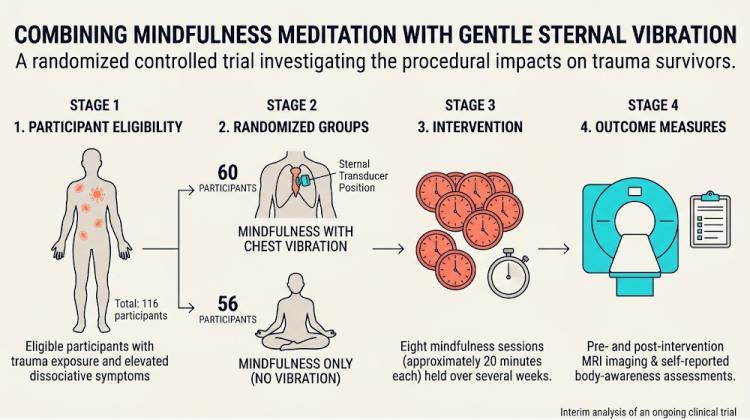
The research team analyzed 116 trauma-exposed adults with elevated dissociative symptoms. Of those participants, 60 received mindfulness meditation with sternal vibration, while 56 completed mindfulness meditation without the added vibration.
Sternal vibration refers to vibration applied near the sternum, the flat bone at the center of the chest. Researchers used a small transducer worn in that area to deliver the sensory cue. Depending on the setting, the vibration was synchronized with exhalation or delivered in steady pulses.
Participants completed eight mindfulness meditation sessions, each lasting approximately 20 minutes. The researchers collected magnetic resonance imaging (MRI) scans before and after the intervention and assessed self-reported body awareness during the sessions.
The study was not simply a test of whether meditation made participants feel calmer immediately after sitting quietly. The researchers also examined whether the addition of vibration was associated with measurable changes in the microstructure of white matter pathways.
White matter consists largely of nerve fibers that connect different parts of the brain and nervous system. These pathways help transmit information between regions involved in movement, sensation, and other functions. The research team used neurite orientation dispersion and density imaging, a specialized MRI method, to examine characteristics of these neural structures.
The study received support through National Institutes of Health funding, including a $3.6 million grant from the National Center for Complementary and Integrative Health supporting the broader research program.
The published report, available through PubMed, provides the sample sizes, study methods, and statistical results. These details matter because the findings describe a specific group of trauma-exposed adults with elevated dissociation, rather than all people who meditate or everyone living with PTSD.
What the Researchers Found About Body Awareness
The researchers found that participants receiving chest vibration experienced a greater improvement in self-reported body awareness than participants who completed mindfulness meditation without vibration.
The difference between the groups was statistically significant, with a reported p-value of 0.032. The researchers also observed changes in neurite density index, a measure derived from MRI data that provides information about white matter microstructure.
The most notable findings involved the corticospinal tract and the left cerebral peduncle, structures associated with pathways carrying information between the brain and the body. The analysis found increased neurite density index in a region of the left cerebral peduncle, with additional tractography analyses identifying changes in the left and right corticospinal tracts.
| Study measure | Reported finding |
|---|---|
| Total participants | 116 adults with trauma exposure and elevated dissociation |
| Meditation with vibration | 60 participants |
| Meditation without vibration | 56 participants |
| Intervention | Eight mindfulness sessions of approximately 20 minutes each |
| Body awareness | Greater improvement in the vibration group |
| Brain imaging | Increased neurite density index in specified white matter pathways in the vibration group |
The study also found an association between increased neurite density in the cerebral peduncle and reduced self-reported body dissociation among participants who received vibration. That association was not observed in the group practicing meditation without vibration.
These results are scientifically interesting because the physical and self-reported changes appeared together in the vibration group. However, the imaging measure is not a direct count of newly formed nerve fibers, and it does not prove that the device created new neural connections in the way that phrase might suggest in everyday language.
The findings also require careful interpretation. Both groups practiced mindfulness, and the study did not demonstrate that chest vibration eliminated dissociation or consistently reduced all PTSD symptoms. The clearest group-specific effects involved body awareness and particular MRI measurements.
For a closer look at the reported statistics, readers can consult the peer-reviewed research paper.
Why A Physical Sensory Cue May Matter During Meditation
Mindfulness meditation generally asks practitioners to notice an experience, such as breathing, and gently return attention to it when the mind wanders. This can be straightforward for some people but challenging for those who experience disconnection from bodily sensations.
A vibration delivered through the chest introduces a distinct tactile signal. Instead of depending exclusively on the ability to notice the natural movement of breathing, a participant can also feel a consistent physical cue.
The researchers suggest that this cue may help participants engage with bodily signals that otherwise feel difficult to access. When vibration is synchronized with exhalation, it may also provide an external reference for the rhythm of breathing. Steady pulses offer a different sensory pattern that does not depend on matching every breath.
This approach relates to a broader area of research examining how sensory feedback and attention interact. Physical sensations can influence what a person notices, while repeated experiences may be associated with changes in how the nervous system processes information.
Still, the precise biological mechanism behind the MRI findings remains uncertain. The study identifies changes in white matter microstructure associated with the intervention, but it does not establish every step linking chest vibration to those changes or explain why some participants may respond more strongly than others.
The findings also should not be interpreted as proof that more sensory stimulation is always better. Some trauma survivors may prefer an external focus, such as sounds in the room or the feeling of their feet on the floor. Others may find chest sensations uncomfortable. A useful mindfulness practice is one that respects those differences rather than assuming that every participant should follow the same method.
What This Research Means For Trauma-Informed Mindfulness
The Emory findings may help researchers develop meditation practices that give participants more options for directing attention. For people who struggle with conventional breath-focused exercises, an external sensory cue could eventually become one element of a more flexible approach.
Trauma-informed mindfulness emphasizes predictability, consent, and the ability to choose where attention rests. A participant might focus on a sound, an object in the room, contact between the feet and the floor, or a physical sensation that feels manageable. The appropriate choice depends on the person and the setting.
This flexibility is especially relevant when a meditation exercise involves attention to the chest or breathing. Such sensations can be uncomfortable for some individuals, and no one should be pressured to continue an exercise that increases distress.
People interested in developing a more adaptable practice can explore breathwork techniques and learn how different approaches direct attention to breathing and physical sensations. The goal is not to force a particular experience but to identify a practice that can be approached safely and consistently.
The current study does not establish a home-use protocol for chest vibration. Participants took part in a structured research intervention, and the device, session format, and assessments were part of that study. Commercial vibration devices or self-directed experiments should not be assumed to reproduce the findings.
For people with PTSD or significant dissociative symptoms, mindfulness may be best explored with a qualified mental health professional who understands trauma. Meditation can complement appropriate care, but it should not replace evidence-based PTSD treatment or be treated as a guaranteed solution.
The Study’s Limitations And The Questions Still Open
One of the most important details is that the research represents an interim analysis of an ongoing clinical trial. The researchers planned to follow participants for six months after the intervention to investigate whether the observed brain and clinical changes persist.
That follow-up matters because a change measured immediately after eight sessions does not establish a lasting benefit. Researchers also need to examine whether the MRI findings predict meaningful improvements in daily functioning, whether participants experience sustained reductions in distress, and which individuals are most likely to benefit.
The sample was relatively specific: 116 trauma-exposed adults with elevated dissociative symptoms. The findings cannot automatically be generalized to people without trauma histories, individuals with different psychiatric conditions, or all patients diagnosed with PTSD.
Another limitation is that body awareness was assessed through self-report. Such measures are valuable for understanding personal experience, but they are different from independently measured changes in symptoms or functioning. The brain imaging findings add another source of evidence, yet they do not establish that the observed changes will translate into a clinically significant improvement for every participant.
Future research will need to clarify how vibration timing, session duration, treatment context, and individual sensory preferences influence outcomes. It will also be important to compare the approach with other forms of grounding and trauma-informed mindfulness, rather than assuming that a specialized device is necessary for body awareness to improve.
The study’s results are best viewed as an early step toward understanding how physical sensory feedback might support mindfulness for some trauma survivors. They offer a measurable research direction, not a finished treatment recommendation.
A New Research Direction For Meditation And Body Awareness
The Emory University study adds a distinctive finding to the science of mindfulness: in a group of 116 trauma-exposed adults with elevated dissociation, adding gentle vibration near the breastbone was associated with greater gains in self-reported body awareness and changes in specific white matter measurements compared with meditation alone.
The findings point to the potential value of adapting meditation to the needs of people who find internal sensations difficult to approach. They also highlight why future research must look beyond immediate feelings of calm and examine how sensory cues relate to brain structure, personal experience, and longer-term clinical outcomes.
The next phase of the research will help determine whether these changes endure and whether the technique can play a useful role alongside established care. Until those questions are answered, chest-vibration meditation remains an investigational approach with promising early findings—not a proven standalone treatment for trauma or PTSD.
For mindfulness researchers and clinicians, the central question is now whether a simple, carefully controlled sensory cue can help more people engage with their bodies in ways that feel manageable, meaningful, and sustainable.