
Researchers at the University of Southern California are launching a new clinical trial that will test whether mindfulness training can strengthen and extend the potential effects of psilocybin therapy for people with depression. The study, announced by USC on October 7, 2026, will recruit 80 adults living in Los Angeles and compare psilocybin therapy alone with psilocybin therapy combined with an eight-week mindfulness program.
The project, called Evaluation of Integrated Digital, Biomarker and Neurophysiological Tracking in Mindfulness-Assisted Psilocybin Therapy, or EVIDENT-MAP, has received an award of up to $4 million from the Advanced Research Projects Agency for Health, known as ARPA-H. The agency’s award listing identifies USC as the prime awardee and Rael Cahn, M.D., Ph.D., and Shrikanth “Shri” Narayanan, Ph.D., as principal investigators.
The study brings together two areas that have increasingly attracted scientific interest: psychedelic-assisted therapy and structured mindfulness practice. Rather than asking whether psilocybin alone can change depressive symptoms, the USC team is examining whether meditation and related practices can help participants process and maintain changes that may occur after psychedelic treatment.
The USC Trial Will Include 80 Adults With Depression
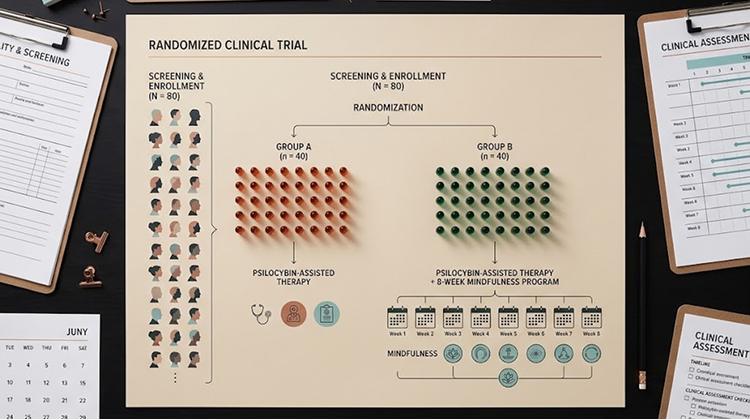
The new study will recruit 80 adults in Los Angeles who have depression and who do not have previous experience with psychedelics or meditation. Participants will be divided between two treatment approaches.
One group will receive supervised psilocybin therapy without the mindfulness component. The other will receive the same psychedelic therapy together with an eight-week mindfulness program. This comparison gives researchers a way to examine whether the additional training produces differences beyond those associated with psilocybin therapy itself.
The project builds on an earlier USC investigation involving healthy adults. That earlier trial examined whether an eight-week mindfulness program could augment psilocybin-assisted therapy and included approximately 72 participants when the study was initially announced in June. USC said the research team had subsequently tested psilocybin and mindfulness training in 24 people without mental health conditions and observed encouraging early experiences. Those observations are preliminary and are separate from the new depression-focused study.
The distinction matters because the new 80-person study is intended to examine the approach in people actually living with depression. Results from the earlier healthy-volunteer work cannot establish whether the combined treatment will reduce depressive symptoms.
Mindfulness Is Being Tested As Part Of The Treatment Process
The mindfulness component is central to the scientific question. Participants assigned to the combined-treatment group will complete an eight-week program intended to develop mindful awareness, loving-kindness and compassion, including meditation practice at home.
The first psilocybin session is scheduled to occur between the second and third weeks of the mindfulness program. That timing allows participants to begin developing meditation skills before their first psychedelic session rather than introducing mindfulness afterward.
The researchers are interested in whether those skills could help participants work with changes in perspective that may occur during psychedelic therapy. Rael Cahn, who directs the USC Center for Mindfulness Science, has described the central question as whether mindfulness can deepen and prolong potential benefits rather than simply producing a short-term effect.
This approach also gives the study relevance to stress management because the intervention is examining psychological skills that may influence how participants respond to difficult thoughts, emotions and self-narratives.
The trial is therefore different from a conventional meditation study. Participants are not simply being asked whether they feel calmer after sitting quietly for several minutes. Researchers are testing a structured sequence in which mindfulness training is combined with supervised psychedelic treatment and follow-up assessments.
The Researchers Will Track The Brain, Body And Behavior
EVIDENT-MAP is also unusually data-intensive for a meditation-related clinical study. Researchers plan to collect information across several biological and behavioral systems.
Participants will undergo EEG and MRI brain recordings, while researchers will also collect saliva, blood and stool samples. Psychological and cognitive assessments will be combined with information from wearable devices.
This multimodal design gives the research team several ways to examine changes associated with treatment.
A questionnaire may indicate that a participant’s depressive symptoms have changed. A cognitive assessment may show a shift in attention or emotional processing. Brain imaging may provide another measurement of neural activity, while biological samples and wearable data could reveal changes in physiological systems.
ARPA-H says the EVIDENT-MAP project will also expand the measurement framework to examine early affective and cognitive markers associated with depression and suicide risk. De-identified information generated through the project will be placed in the ARPA-H EVIDENT Data Repository.
The goal is therefore broader than determining whether participants report feeling better. Researchers are building a large collection of measurements that may help identify how psychological and biological changes occur during treatment.
Each Participant Will Receive Two Psilocybin Sessions
The treatment schedule includes two psilocybin sessions approximately one month apart.
Before the first session, participants will receive six hours of preparatory psychotherapy. The preparation is intended to establish the therapeutic setting and help participants approach the psychedelic sessions with an appropriate framework.
After the first session, participants will have three integration sessions before the second psychedelic treatment. Three additional integration sessions will take place after treatment is completed.
The therapeutic role is also different from highly directive psychotherapy. During the psilocybin sessions, USC researchers say therapists will primarily provide a supportive and attentive presence rather than continuously directing the participant’s experience.
That structure reflects an important feature of psychedelic research: the experience itself can vary substantially between individuals, making preparation, environment and post-session integration important parts of the research protocol.

Earlier research has already produced evidence that psilocybin may reduce depressive symptoms in carefully selected clinical populations. For example, a randomized clinical trial published in JAMA Psychiatry included 24 adults with major depressive disorder and found substantial reductions in depression scores after psilocybin-assisted treatment. However, that study did not test the specific mindfulness-plus-psilocybin approach now being examined by USC.
Music Will Also Be Part Of The Therapeutic Setting
The physical and sensory environment is another unusual component of the USC study.
Assal Habibi, Ph.D., an associate professor at USC’s Brain and Creativity Institute, worked with clinicians and music therapists to create a lyric-free playlist for the psychedelic sessions. The music spans several traditions and is timed around the expected progression of the psilocybin experience.
The researchers plan to revisit the role of the music after treatment. Participants will undergo MRI scanning while listening to the same music used during their psychedelic sessions.
That allows the team to explore whether brain responses to the music could reveal signals associated with the therapeutic experience. Researchers are also interested in a longer-term possibility: whether some of the effects associated with the carefully structured musical environment could eventually be studied without psychedelic drugs.
This part of the project adds another layer to the mindfulness question. The intervention is being treated as an entire therapeutic environment involving preparation, meditation, music, supervised psychedelic sessions and integration.
Psilocybin Research Has Moved Further Into Clinical Trials
The USC announcement arrives during a period of increased federal interest in psychedelic research.
The FDA granted breakthrough therapy designation to psilocybin-assisted psychotherapy for treatment-resistant depression in 2018 and for major depressive disorder in 2019. Those designations did not mean psilocybin had been approved as a treatment. They were intended to facilitate development and review of therapies showing preliminary clinical promise. The National Center for Complementary and Integrative Health continues to describe psilocybin as an area of active research rather than an established treatment for depression.
Federal research activity has also expanded in 2026. ARPA-H’s EVIDENT initiative is supporting multiple projects focused on behavioral health, psychedelic therapies, biological measurements and digital health data. The agency announced in April that the broader initiative would collectively support research teams with up to $139.4 million.
USC’s EVIDENT-MAP award is listed by ARPA-H as an award of up to $4 million, with a May 14, 2026 start date and Los Angeles as the project location.
The timing reflects a shift from asking whether psychedelic experiences might have therapeutic potential to investigating exactly who benefits, under what conditions, and why those benefits may persist or fade.
The Study Is Testing A Hypothesis, Not Confirming A Treatment
The most important point for readers is that the USC trial has not yet demonstrated that combining psilocybin with mindfulness treats depression.
Researchers have a hypothesis that mindfulness training could help participants maintain or integrate changes associated with psychedelic therapy. The 80-person trial is designed to test that hypothesis.
The study also has several features that limit how broadly its eventual results may apply. Participants will be adults living in Los Angeles who meet the study’s eligibility requirements and have no previous experience with psychedelics or meditation. The intervention occurs in a highly supervised research environment with psychotherapy, medical monitoring, brain imaging and extensive assessments.
That is very different from taking psilocybin outside a clinical setting or beginning meditation independently.
It also means that any future results will need to be interpreted in the context of the exact treatment protocol. A positive finding would not automatically show that every form of meditation improves psychedelic therapy, nor would it establish that psilocybin is appropriate for everyone with depression.
The Eight-Week Mindfulness Component Could Answer A Different Question
Much of the public discussion surrounding psychedelic therapy focuses on the psychedelic experience itself. USC’s approach shifts attention to what happens before, between and after those experiences.
The eight-week mindfulness program creates an opportunity to examine whether repeated contemplative practice can influence the longer trajectory of treatment.
The researchers are particularly interested in mindful awareness, loving-kindness and compassion. These practices may give participants a framework for observing thoughts and emotions without immediately reacting to them. In the context of psychedelic therapy, the research team wants to determine whether those skills can help participants work with insights or shifts in perspective after the acute effects have ended.
That question is scientifically different from asking whether meditation reduces stress in healthy adults.
It also gives the project significance for mindfulness research because the intervention places meditation inside a much larger therapeutic sequence. The study can potentially reveal whether the value of mindfulness depends partly on when it is introduced and what therapeutic process surrounds it.
What The USC Study Could Tell Researchers
EVIDENT-MAP is designed to provide more than a simple comparison of two treatment groups. By combining psychological assessments, cognitive testing, brain imaging, biological samples and wearable data, the researchers hope to identify patterns associated with changes in depression.
The project also fits into a broader effort to make behavioral-health research more measurable. ARPA-H’s EVIDENT program is collecting de-identified information across participating projects so researchers can investigate biological, psychological and digital signals together.
If the combined-treatment group eventually shows better outcomes than the psilocybin-only group, researchers would still need additional studies to determine which part of the mindfulness program contributed to the difference. Future research could examine meditation frequency, specific practices, therapeutic integration or other aspects of the eight-week program.
If the two groups perform similarly, that would also be informative. It could suggest that the additional mindfulness training does not add measurable benefits under this particular protocol, or that different forms or durations of contemplative practice need to be tested.
For now, the USC study represents a research question rather than a treatment recommendation. Its value will come from determining whether an eight-week mindfulness program can make a measurable difference after carefully supervised psychedelic therapy—and from identifying the biological and psychological patterns that accompany whatever changes the researchers observe.