
Chronic low back pain may involve more than the brain’s response to a physical sensation. New research from the University of California, San Diego suggests that when movement triggers a flare in people with chronic low back pain, brain networks associated with self-related thoughts become unusually active.
The study, published October 5, 2026, in the British Journal of Anaesthesia, examined 114 people with chronic low back pain using functional magnetic resonance imaging. Researchers found that a movement designed to provoke a pain flare increased activity in parts of the brain’s Default Mode Network (DMN), sometimes called the brain’s “self network.” The findings provide new evidence that chronic pain can become closely connected with how people process themselves, their experiences and their expectations.
For Spiritual Endeavors readers, the research is particularly relevant because the UC San Diego team is also investigating whether mindfulness meditation can influence self-referential brain processes involved in chronic pain. That does not mean meditation has been proven to treat the condition based on this study. Instead, the findings help explain why researchers are interested in approaches that change how people relate to painful sensations.
The UC San Diego Study Focused On Movement-Triggered Pain
The research team included Morgan Gianola, Jon Dean, Conan Chen, Daniel Barrows, Gabriel Riegner, Thomas Liu and Fadel Zeidan of UC San Diego School of Medicine. Zeidan is a professor in the Department of Anesthesiology and directs the Pain Health and Mindfulness Laboratory at UC San Diego.
Rather than simply asking participants to report their usual pain, the researchers wanted to examine what happens in the brain during a movement-evoked flare. Chronic low back pain can become more intense during movements such as lifting, bending or extending the leg, making movement-triggered pain an important feature to investigate.
The 114 participants completed a standardized leg raise test while researchers measured cerebral blood flow using arterial spin labeling functional MRI. Participants also rated pain intensity and unpleasantness using an 11-point scale, while the researchers examined relationships between the brain responses and chronic pain severity.
The leg raise test increased reported pain intensity by 23% and unpleasantness by 26%, with both changes statistically significant at P<0.001. The researchers then compared the movement-related response with the brain’s response to a painful heat stimulus applied to the calf.
This comparison was important because experimental acute pain normally produces a different pattern of activity in the Default Mode Network.
Why The Default Mode Network Matters
The Default Mode Network is a collection of interconnected brain regions involved in internally directed mental activity. It has been associated with self-referential thinking, autobiographical memories, internal reflection and thoughts about one’s identity.
The network includes areas such as the medial prefrontal cortex and posterior cingulate cortex. These regions are generally more active when attention is directed inward rather than toward an external task.
The UC San Diego findings are unusual because acute experimental pain has typically been associated with reduced DMN activity. In the chronic low back pain participants, however, movement-triggered pain produced increased blood flow in key DMN regions.
The study found increased activity in the medial prefrontal cortex and posterior cingulate cortex, alongside activity in pain-processing areas including the thalamus, the portion of the primary motor cortex representing the back, and the parietal operculum.
This pattern suggests that movement-triggered chronic pain may involve simultaneous processing of the physical sensation and internally focused information.
That distinction matters. The study does not demonstrate that the pain is imaginary or purely psychological. Instead, it shows that the brain’s systems involved in sensation and self-related processing are interacting during a chronic pain flare.
More Severe Pain Was Associated With Stronger Brain Connectivity
The researchers also examined resting-state functional connectivity, looking at how activity in the Default Mode Network was related to activity elsewhere in the brain.

Participants with greater chronic pain severity showed stronger connectivity between the DMN and the primary somatosensory cortex representing the back. The somatosensory cortex is involved in processing information about bodily sensations, including where sensations occur and how they are experienced.
This finding provides another piece of the neurological picture.
A painful sensation originates from the body, but the experience of chronic pain involves much more than the initial signal. The brain continuously interprets sensory information in relation to previous experiences, expectations, attention and other internal processes.
In this study, greater chronic pain severity was associated with stronger communication between a network involved in self-related processing and an area representing physical sensation from the back. The researchers described this as maladaptive coupling between self-referential and somatosensory networks.
That does not establish that stronger connectivity causes chronic pain. Because this was an observational brain-imaging study, the researchers cannot determine whether the altered network relationship produces the pain, develops as a consequence of long-term pain, or reflects a combination of factors.
The Brain Responded Differently To Acute Heat Pain
One of the most interesting parts of the research was the contrast between the movement-triggered chronic pain flare and the acute heat stimulus.
When participants experienced painful heat applied to the calf, the Default Mode Network showed the deactivation typically associated with experimental pain. During the movement-triggered chronic low back pain flare, however, key DMN regions became more active.
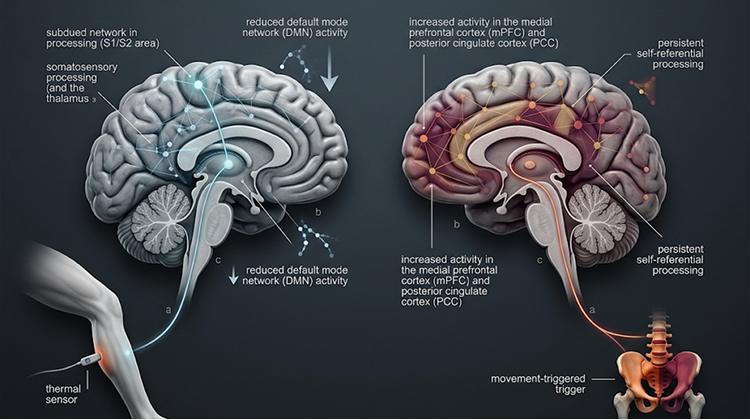
This difference may help researchers distinguish between the neurological characteristics of acute pain and chronic pain.
Fadel Zeidan explained that the chronic pain flare appeared to involve a stronger connection between the physical experience and the person’s internal sense of self. UC San Diego researchers propose that this may help explain why chronic pain can affect anticipation, movement, emotional responses and everyday activities in ways that extend beyond the immediate sensation.
For someone living with chronic pain, the experience may therefore involve several layers at once: the physical sensation, concern about triggering another flare, memories of previous episodes and changes in how the person views normal activities.
This is one reason the research has relevance for mindfulness routines, which emphasize observing physical sensations and thoughts without automatically treating them as a definition of the self.
What The Findings Could Mean For Mindfulness
The connection between the study and mindfulness comes largely from the work already being conducted by Zeidan’s research group.
Mindfulness meditation is often studied as a way of changing attention, emotional responses and the relationship people have with unpleasant experiences. Rather than attempting to force a sensation away, mindfulness practice generally encourages people to observe sensations, thoughts and emotions with less judgment.
That approach is particularly interesting in light of the UC San Diego findings because the study identifies self-referential brain processing as part of the response to movement-triggered chronic low back pain.
The researchers are conducting additional neuroimaging-based clinical studies to investigate whether approaches such as mindfulness meditation can alter brain processes associated with chronic pain.
One current UC San Diego-linked study is examining the neural mechanisms of meditation-based interventions for chronic low back pain among adults who use prescription opioids for chronic pain. The trial is designed to investigate how mindfulness-based intervention affects pain and the brain mechanisms involved. The study expects to include approximately 188 participants, with a target of 150 participants providing complete pre- and post-intervention data. Its estimated completion date is June 2027.
That ongoing research is important because the October 2026 brain-imaging study itself did not test meditation as a treatment.
The distinction prevents an observational neuroscience finding from being turned into a treatment claim that the researchers have not established.
The Study Does Not Show That Meditation Treats Chronic Back Pain
The new research provides a biological clue, but it is not a clinical trial demonstrating that meditation reduces chronic low back pain.
The study involved people who already had chronic low back pain and examined how their brains responded to a standardized movement. It did not randomly assign participants to meditation or another treatment, and it did not test whether changing DMN activity caused an improvement in pain.
The researchers also did not demonstrate that the Default Mode Network is the single source of chronic pain. Chronic low back pain involves multiple biological, neurological and behavioral factors, and the study identified a particular pattern associated with movement-evoked pain rather than a complete explanation for the condition.
That makes the findings most useful as a foundation for further research.
The results also suggest why future studies may need to look beyond pain intensity alone. If chronic pain involves the interaction between sensory processing and self-related brain activity, researchers may eventually examine whether interventions can change how patients interpret, anticipate or respond to painful sensations alongside measuring traditional pain scores.
UC San Diego Is Continuing To Investigate Mindfulness And Pain
The October study is part of a broader research program led by Fadel Zeidan that examines the relationship between meditation, brain activity and chronic pain.
UC San Diego records show multiple ongoing research projects involving Zeidan and chronic pain, including research on meditation mechanisms, mindfulness-assisted psilocybin therapy and savoring meditation among people with chronic low back pain.
This makes the new finding especially relevant to the future of meditation research. The question is shifting from simply asking whether mindfulness can make pain feel better to asking which brain systems may change when a person learns to relate differently to pain.
That distinction could eventually influence how researchers design mindfulness interventions for chronic pain.
For now, the strongest evidence from the October 2026 study is more specific: movement-triggered chronic low back pain produced a brain response that differed from acute experimental pain, with increased activity in key Default Mode Network regions and stronger DMN-to-somatosensory connectivity among participants with greater chronic pain severity.
The findings do not mean that chronic pain is “all in the mind.” They point in the opposite direction: the brain appears to integrate physical sensation with broader systems involved in internal experience, and that interaction may be an important part of what makes chronic pain persistent and personally disruptive.
For mindfulness researchers, that creates a compelling next question. If chronic pain can become closely linked with self-related brain processing, can practices that cultivate nonjudgmental awareness help loosen that connection? UC San Diego’s ongoing clinical research is now positioned to investigate that possibility.
A clearer answer will require randomized trials, larger samples and direct measurements of whether mindfulness changes the relevant brain networks alongside meaningful improvements in pain and daily functioning. Until those studies are complete, the October findings should be viewed as an important neuroscience discovery rather than proof of a new treatment.