
Stroke recovery does not end when a patient leaves the hospital. For many survivors, the months and years afterward can involve anxiety, depression, cognitive difficulties, fatigue, physical limitations and uncertainty about returning to everyday life. That has led researchers to investigate whether rehabilitation should include strategies that address psychological well-being alongside physical and cognitive recovery.
A new randomized controlled trial from researchers at the VA Northern California Health Care System offers a useful test of one such approach: online Mindfulness-Based Stress Reduction (MBSR).
The study, led by Sandy J. Lwi, Jas Chok, Krista Schendel, Timothy J. Herron, Brian C. Curran and Juliana V. Baldo, was published in Rehabilitation Psychology in the August 2026 issue. The research involved 59 people with a history of chronic stroke, who were randomly assigned either to an online MBSR program or to an online Brain Health Education program. Participants were evaluated before the intervention, immediately afterward and again six months later.
The results are more nuanced than a simple claim that meditation improves stroke recovery.
MBSR did not produce a statistically significant advantage over the active comparison program for anxiety or depression. However, participants in both groups reported improvements over time, supporting the feasibility of delivering structured, low-cost behavioral programs online to people living with chronic stroke.
That distinction makes this study particularly valuable. Instead of presenting mindfulness as a proven stroke treatment, the findings raise a more practical question: Can structured online mind-body programs become useful additions to long-term stroke rehabilitation, even when mindfulness itself does not outperform another well-designed intervention?
Why Stroke Recovery Requires More Than Physical Rehabilitation
Stroke rehabilitation is often associated with physical therapy, occupational therapy and speech-language treatment. Those services remain central, but recovery can also involve psychological and cognitive challenges that are less visible.
The National Institute of Neurological Disorders and Stroke describes stroke as a condition that can affect movement, speech, cognition, sensation and other neurological functions depending on the location and severity of the injury. Recovery therefore varies substantially from one person to another.
For someone living with chronic stroke, the physical event may have happened months or years earlier, but its consequences can remain part of everyday life.
A person may need to adapt to changes in mobility, communication, memory, attention or independence. Those changes can create persistent stress and can affect quality of life even after the acute medical emergency has passed.
The VA Northern California researchers focused specifically on this chronic phase.
Their study was designed around people with a history of stroke rather than patients in the immediate aftermath of a cerebrovascular event. That allowed the researchers to ask whether a structured psychological intervention could provide benefits during a period when traditional rehabilitation may already have ended or become less intensive.
This is where mindfulness becomes relevant.
Mindfulness does not repair damaged brain tissue or replace neurological rehabilitation. Instead, MBSR is intended to train attention, awareness of bodily sensations, emotional responses and everyday experiences through practices such as meditation and mindful movement.
For stroke survivors, the potential value is therefore complementary rather than curative.
What The VA Northern California Study Tested
The researchers recruited people with chronic stroke and randomly assigned them to one of two online programs.
One group received Mindfulness-Based Stress Reduction, while the other received Brain Health Education.
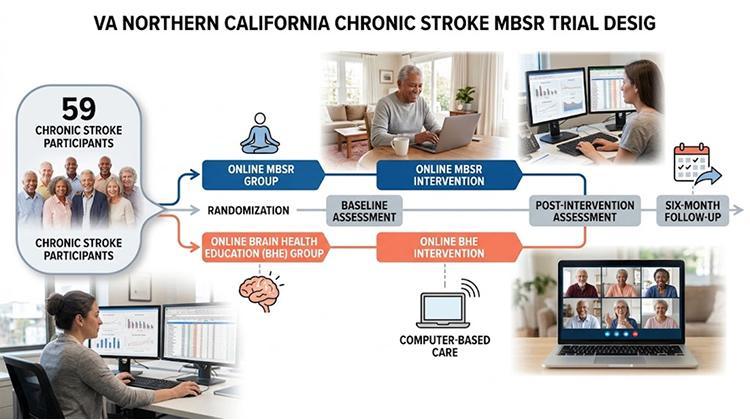
The comparison was important because simply giving participants access to an instructor, regular appointments, educational material and a structured weekly routine can itself have an effect.
If researchers had compared MBSR with no intervention at all, it would have been difficult to determine whether any improvement came from mindfulness specifically or from receiving regular attention and participating in a structured program.
By using an active comparison, the researchers created a more demanding test.
| Study Feature | Details |
|---|---|
| Researchers | Sandy J. Lwi, Jas Chok, Krista Schendel, Timothy J. Herron, Brian C. Curran and Juliana V. Baldo |
| Institution | VA Northern California Health Care System |
| Participants | 59 people with chronic stroke |
| Study design | Randomized controlled trial |
| MBSR format | Online |
| Comparison | Online Brain Health Education |
| Assessments | Baseline, post-intervention and 6-month follow-up |
| Publication | Rehabilitation Psychology, 2026 |
| DOI | 10.1037/rep0000651 |
The two interventions were matched on important logistical features, including schedule, instructor and online format. That allowed the researchers to isolate the potential contribution of the MBSR content more effectively.
The study was also registered as ClinicalTrials.gov NCT03969563, with the U.S. Department of Veterans Affairs supporting the research through its Rehabilitation Research and Development program.
What Participants Actually Learned In MBSR
This was not simply a trial in which participants were told to meditate for a few minutes each day.
The intervention was based on the standardized MBSR program developed at the University of Massachusetts and consisted of an introductory session followed by eight weeks of classes.
Because the participants had a history of stroke and the program was delivered online, the researchers modified some components to reduce fatigue and physical demands.
The traditional day-long retreat was shortened to a four-hour retreat, while movement components were adapted to include smaller movements and chair yoga rather than standard yoga practices.
Participants practiced several forms of mindfulness, including body awareness, meditation and mindful movement. They were also introduced to informal mindfulness practices that could be incorporated into activities such as eating, communicating, working and coping with difficult experiences.
That structure is significant for stroke rehabilitation.
The program was not based on the assumption that every participant could sit comfortably on the floor, perform demanding physical movements or sustain long meditation sessions.
Instead, the intervention was adapted around the realities of chronic stroke.
The researchers were effectively testing whether a recognized mindfulness program could be made accessible without losing its essential structure.
The Online Format Could Matter As Much As The Meditation
The digital delivery model is one of the study’s most practical features.
People recovering from stroke may face mobility limitations, transportation problems, fatigue or geographic barriers that make frequent in-person appointments difficult.
Online rehabilitation and wellness programs can remove some of those obstacles.
The VA Northern California Health Care System already provides telehealth services and offers whole-health programs that include meditation and mindfulness, alongside conventional rehabilitation services. Its whole-health approach includes physical, emotional and social dimensions of health rather than focusing exclusively on a diagnosis.
The new trial fits into that broader model.
Instead of requiring participants to travel to a medical center for every session, the intervention brought the program into participants’ homes.
That does not mean online treatment is automatically superior.
Digital programs require reliable internet access, appropriate technology and enough cognitive and sensory ability to participate. They may also be unsuitable for people with severe communication, visual, hearing or cognitive limitations.
But when those barriers can be addressed, online delivery could make behavioral rehabilitation easier to scale.
The Main Finding Was Not A Clear MBSR Advantage
The most important part of the study is also the easiest to misinterpret.
Researchers did not find that MBSR significantly improved anxiety symptoms over time compared with the Brain Health Education intervention.
The statistical result for anxiety was F(2,55) = 1.13, p = .321, η² = .01.
They also found no significant MBSR-specific improvement in depression, with a result of F(2,68) = 0.53, p = .588, η² = .002. Exploratory measures involving cognitive functioning, physical health and well-being likewise did not show statistically significant MBSR-specific improvements.
Those numbers matter because they place limits on what the study can legitimately claim.
The evidence does not support saying that online mindfulness reduced anxiety or depression among stroke survivors more effectively than another structured online program.
Instead, both groups showed improvements over time.
That finding raises an interesting possibility: the structure, education, regular participation and social connection involved in either program may have provided meaningful support, even when mindfulness did not emerge as the uniquely responsible component.
Why The Brain Health Comparison Is Important
An active control group can make a study harder to interpret at first glance, but it generally makes the research more informative.
Imagine a participant attending a weekly online class for eight weeks.
They have an instructor.
They interact with other people.
They receive information about their health.
They establish a regular schedule.
They are encouraged to practice skills between sessions.
Any of those factors could contribute to changes in mood or perceived well-being.
If MBSR is compared only with doing nothing, improvements could therefore be mistakenly attributed entirely to mindfulness.
The VA study avoided some of that problem by giving the comparison group its own structured Brain Health Education intervention.
Both programs were designed to be comparable in format and schedule.
This helps explain why the result is not a failure of the study.
A randomized controlled trial that finds no significant difference between two interventions can still answer an important question.
Here, it suggests that mindfulness may not provide an additional measurable advantage for anxiety or depression beyond another structured online health program, at least within this sample and study design.
What Improved For Participants
The researchers’ conclusion was not that nothing happened.
Participants with chronic stroke reported improvements after participating in either intervention.
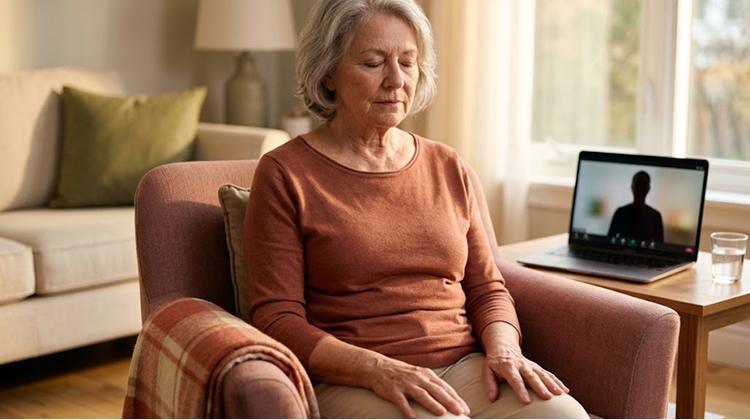
That supports the feasibility of both approaches as relatively low-cost online programs for people living with chronic stroke.
This is an important distinction between within-group improvement and between-group superiority.
If both groups improve, the appropriate scientific question is not simply whether participants improved.
It is whether one group improved significantly more than the other.
The VA researchers did not find evidence that MBSR produced a unique advantage for the primary psychological outcomes.
For healthcare systems, however, the feasibility finding may still have practical value.
A structured online program that can be delivered remotely could complement existing rehabilitation services, particularly for people who have difficulty accessing frequent in-person appointments.
Stroke Survivors May Need Flexible Stress-Management Options
The study also highlights why rehabilitation cannot be treated as a single standardized pathway.
Stroke survivors have different physical abilities, cognitive profiles, emotional needs and living situations.
One person may need intensive physical therapy.
Another may struggle primarily with fatigue and depression.
Someone else may have difficulty with attention or memory.
A flexible rehabilitation model can therefore include multiple approaches rather than assuming one intervention will work for everyone.
Mindfulness may have a place within that broader toolkit.
The current evidence, however, suggests it should be presented as a potential complementary strategy, not a replacement for established stroke care.
The VA’s rehabilitation services include physical therapy, occupational therapy, kinesiotherapy, speech and language treatment and other services intended to improve independence and quality of life. Its whole-health offerings also include meditation, mindfulness, guided imagery, yoga and tai chi.
That combination illustrates a broader trend in rehabilitation: psychological well-being and physical recovery do not have to be treated as completely separate areas.
Earlier Research Had Already Tested MBSR After Stroke
The 2026 randomized trial builds on earlier research from the same VA Northern California research program.
A pilot randomized controlled study published in Mindfulness in 2021 involved 32 participants with chronic stroke. Participants had experienced a single right- or left-hemisphere stroke at least three months earlier, and researchers tested an MBSR intervention against a comparison condition.
The earlier work helped establish the feasibility of studying MBSR in this population.
The newer study increased the sample and used an online delivery format while retaining a structured comparison intervention.
This progression matters scientifically.
Researchers rarely answer a complex rehabilitation question with one experiment.
Initial pilot work can establish whether an intervention is practical.
A larger randomized trial can then test whether measurable benefits survive a more rigorous comparison.
In this case, the newer trial provides evidence that online MBSR is feasible, while also showing that its effects should not be overstated.
What The Six-Month Follow-Up Adds
The study did not stop immediately after the intervention.
Participants were evaluated again six months after the intervention, allowing researchers to examine whether changes were maintained over a longer period.
Longer follow-up is particularly valuable in rehabilitation.
A short-term improvement can result from novelty, increased attention or the motivation that comes with joining a new program.
A benefit that remains months later would provide stronger evidence that the intervention has practical lasting value.
The VA study did not demonstrate an MBSR-specific long-term advantage in anxiety, depression or the exploratory outcomes measured.
But the six-month assessment strengthens the study design by providing information beyond the immediate end of treatment.
It also reinforces an important point: stroke recovery is a long-term process, and interventions should ideally be evaluated over time rather than judged entirely by immediate post-treatment changes.
What Researchers Should Study Next
The next stage of research could focus on identifying which stroke survivors are most likely to benefit from mindfulness-based approaches.
The current sample of 59 participants is informative, but larger studies could provide more statistical power and allow researchers to examine whether outcomes differ according to age, stroke severity, time since stroke, baseline anxiety, cognitive impairment or physical limitations.
Another question concerns the intervention itself.
MBSR is a relatively comprehensive program involving meditation, body awareness, movement and informal mindfulness practice.
A future study could examine whether a shorter or more targeted mindfulness intervention produces similar outcomes while reducing participant fatigue.
That question could be especially relevant for stroke survivors who have limited energy or difficulty sustaining lengthy sessions.
Researchers could also examine whether mindfulness works better when integrated directly into conventional rehabilitation rather than delivered as a separate online course.
For example, mindfulness techniques might be incorporated into occupational therapy, speech therapy or physical rehabilitation as strategies for managing frustration, fatigue and attention.
Such research would move the question from “Does mindfulness work?” toward the more useful question of “For whom, under what conditions and as part of which rehabilitation program does mindfulness provide additional value?”
The Evidence Supports Complementary Care, Not A Standalone Cure
The VA Northern California trial provides a useful reality check for the growing interest in mindfulness and digital health.
The study involved 59 people with chronic stroke, randomized them to online MBSR or online Brain Health Education, and followed them from baseline through post-intervention and six months later.
MBSR did not significantly outperform the active control for anxiety or depression, and the researchers did not find MBSR-specific improvements across their exploratory cognitive, physical-health and well-being measures.
At the same time, participants in both programs reported improvements, demonstrating that structured online interventions are feasible for people living with chronic stroke.
That combination of findings is more useful than a headline claiming meditation can “heal” stroke survivors.
It suggests that mindfulness deserves continued investigation as part of a broader rehabilitation strategy, particularly because it can be adapted for online delivery and modified to accommodate physical limitations.
For people recovering from stroke, the practical lesson is therefore measured rather than dramatic: mindfulness may be worth studying as one component of long-term supportive care, but current evidence from this VA Northern California randomized trial does not establish online MBSR as a superior treatment for anxiety, depression or broader recovery outcomes.