
A morning breathwork routine can sound almost too simple for people who wake with a tight chest, racing thoughts, or a sense of urgency before the day has started. The evidence does not support treating breathwork as a cure or a replacement for care, but it does suggest that brief, controlled breathing may help some people reduce short-term state anxiety. In community wellness education, that makes the first minutes after waking a useful place to study: low cost, low equipment, and easy to repeat, while still needing caution for people with medical or mental health concerns.
Why Morning Anxiety Can Feel So Immediate
Morning anxiety is not one single condition. For one person it may be tied to sleep disruption, work pressure, caregiving, trauma reminders, pain, medication timing, caffeine habits, or an anxiety disorder. For another, it may be a temporary stress response during a demanding week. Because the causes vary, a breathing practice should be viewed as a supportive skill rather than a diagnosis or treatment plan.
The practical appeal of slow breathing is that it gives attention something concrete to do before the mind begins rehearsing the day. Counting the breath, softening the shoulders, and choosing a slower pace can create a brief pause between waking and reacting. That pause is not passive; it is a form of self-observation. The person notices whether the body is tense, whether thoughts are speeding up, and whether the next action needs to be delayed, simplified, or discussed with a professional.
How A morning breathwork routine May Help
The value of a morning breathwork routine is partly behavioral. It can become an anchor: the same place, the same posture, the same two-minute structure. Repetition may reduce decision fatigue because the person is not trying to choose a calming strategy while already feeling stressed. From a community wellness perspective, a shared, simple practice can also support a calmer tone in households, classrooms, or group settings, provided no one is pressured to participate or to hold the breath beyond comfort.
A morning breathwork routine In Two Minutes
One educational model is a two-minute slow-breathing sequence using nasal breathing when comfortable, a relaxed belly or lower-rib expansion, and a steady count. The pattern most closely aligned with the reviewed A52 protocol is a 5-second inhale, a 5-second exhale, and a brief 2-second hold. That pattern is slow, structured, and easy to count without an app. It should be gentle, not forceful.
A cautious two-minute structure might look like this: sit upright or lie in a supported position; notice the first natural breath; breathe in through the nose for about five seconds if nasal breathing is comfortable; breathe out for about five seconds; pause softly for about two seconds only if that feels safe; repeat for two minutes. People who feel air hunger, dizziness, panic, chest pain, or unusual discomfort should stop and seek guidance from a qualified professional.
The breath does not need to be perfect. In fact, trying to perform it perfectly can become another source of pressure. A steadier goal is to keep the practice quiet, short, and observable. If the hold feels uncomfortable, it can be omitted in a general wellness setting. If nasal breathing is difficult because of congestion, illness, or another issue, that is a reason to ask a clinician rather than force the technique.
Why Two Minutes Can Be Enough To Study
Short sessions are not automatically weak sessions. An August 2025 narrative review on the A52 Breath Method described evidence that two-minute slow-breathing sessions, especially those using diaphragmatic activation, nasal breathing, and brief holds, may reduce state anxiety, stress, negative affect, and PTSD symptoms in both healthy and clinical populations A52 breath review. The same review described the A52 pattern as slow breathing at no more than six breaths per minute, with nasal breathing, diaphragmatic activation, and a 5-second inhale, 5-second exhale, and 2-second hold.
That is promising, but the word “may” matters. A narrative review can organize and interpret existing studies, yet it does not mean every person will respond the same way. Morning distress can come from health conditions, trauma histories, sleep problems, or medication effects that deserve direct clinical attention. A breathing routine may be one layer of support; it is not a substitute for evaluation when symptoms are frequent, severe, or disruptive.
What The Evidence Suggests
A pilot study published on April 19, 2026 studied 47 university students using one-minute cyclic sighing, box breathing, or a control condition during moments of acute anxiety. Both breathing techniques were associated with significant reductions in state anxiety five minutes after the exercise, compared with the control condition one-minute breathing study. For readers who want a related discussion of that campus-focused research, our site also reviews one-minute breathing research in more detail.
This finding is relevant to morning practice because it suggests that very brief breathing exercises can be studied in real-life anxiety moments, not only in long laboratory sessions. Still, the study was a pilot study with university students, so it should not be stretched into a claim that the same effect applies to every age group, health status, or clinical condition. Acute anxiety five minutes later is also not the same outcome as long-term recovery, sleep improvement, or reduced need for care.
Different breathing patterns may work through overlapping pathways. Cyclic sighing often emphasizes a longer exhale. Box breathing uses equal counts across inhale, hold, exhale, and hold. The A52-style pattern uses slow nasal diaphragmatic breathing with a brief hold after the exhale. Research interest across these methods points toward the same general question: can a short, repeatable breathing structure shift arousal enough to make the next few minutes more manageable?
Community Wellness Without Overstatement
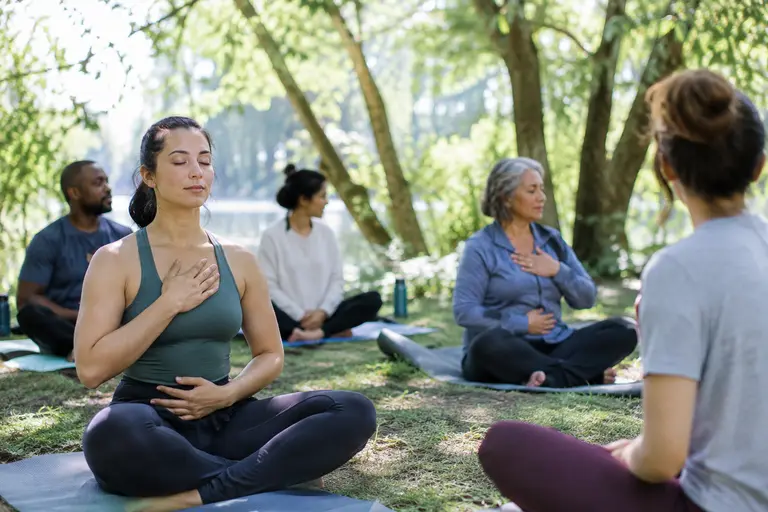
In group wellness settings, breathwork is best introduced with choice, consent, and plain language. No one should be told that a practice will fix anxiety, trauma, insomnia, or any medical concern. A facilitator can say, “Here is a brief breathing exercise some people find calming,” while leaving space for people to keep their eyes open, breathe normally, sit near an exit, or skip the practice. That approach protects autonomy and reduces pressure.
Readers interested in related health education within the same network may also find bariatric and wellness context at Trinity Bariatric Institute. Across wellness topics, the same standard applies: educational practices should be separated from medical advice, and qualified professionals should be involved when symptoms, medications, pregnancy, surgery history, or chronic conditions are part of the picture.
Keeping The Practice Gentle And Safe
Breathwork can be uncomfortable for some people, especially if it includes breath retention, very deep inhalations, fast breathing, or pressure to “push through.” A two-minute morning practice should not be treated as a test of endurance. The breath should stay smooth enough that the person can stop without strain and return to normal breathing.
People with respiratory disease, cardiovascular concerns, fainting history, panic attacks, pregnancy, recent surgery, significant trauma symptoms, or any unexplained chest discomfort should seek medical advice from a qualified professional before using breath holds or structured breathing as part of a routine. Anyone who has severe anxiety, thoughts of self-harm, or symptoms that feel unsafe should contact a licensed clinician, emergency service, or crisis support in their area.
It is also worth separating a calming tool from avoidance. If a person uses breathing only to endure an unsafe workload, delay needed care, or silence distress that requires support, the practice may hide a problem rather than clarify it. The more balanced use is to calm the body enough to make the next decision more wisely: ask for help, adjust the morning schedule, contact a clinician, or choose a slower start when possible.
A Low-Pressure Way To Track Response
For education rather than medical monitoring, a simple note can be useful: before the practice, rate tension from 0 to 10; after two minutes, rate it again; then write one word about the body, such as “tight,” “clear,” “sleepy,” or “uneasy.” This does not diagnose anything. It simply helps a person notice patterns. If ratings remain high, worsen, or interfere with daily responsibilities, that pattern is worth discussing with a qualified professional.
morning breathwork routine Safety Questions
A morning breathwork routine is most sensible when it is brief, optional, and connected to honest self-checking. The research cited above supports cautious interest in short breathing practices for acute anxiety and stress-related states, but it does not justify guarantees. Responses vary, and needs can differ by age, health history, medication use, pregnancy status, and mental health background.
- Is shortness of breath, chest discomfort, dizziness, or fainting present?
- Could morning anxiety be related to medication timing, sleep problems, caffeine, pain, or another health issue?
- Is breath holding comfortable, or would normal slow breathing be safer?
- Would a clinician, therapist, or qualified breathwork-informed professional help adapt the practice?
- Are symptoms frequent, severe, or disruptive enough to need formal assessment?
Medical advice should be sought from a qualified professional for personal concerns. A two-minute breathing practice may support a calmer start, but care, safety, and clinical guidance come first when anxiety is intense, persistent, or connected with other symptoms.