
Just-in-Time Breathing refers to very brief breathing practices used during, or immediately after, stressful moments. From a community wellness perspective, the appeal is clear: the practice is low-cost, portable, and easy to teach in workplaces, schools, clinics, and homes. The evidence, though, is still early. Pilot studies suggest possible short-term stress benefits, but they do not prove that breathing techniques work the same way for every person or every health situation.
As a holistic wellness educator, I view breathwork as a supportive skill rather than a stand-alone health solution. It may create a pause, soften acute arousal, and help people notice their stress signals sooner. It should not replace medical care, mental health treatment, medication decisions, or advice from a qualified professional.
What Just-in-Time Breathing Means
Just-in-Time Breathing And Timing
The key feature is timing. Instead of practicing only during a class or a long meditation session, the breathing cue appears close to the stressor: before a difficult conversation, after a demanding task, during a tense workday, or after a standardized stress test in a research setting. That timing makes these interventions attractive for stress education because they fit into ordinary life rather than requiring a long retreat from it.
The phrase Just-in-Time Breathing is useful, but it can also be too broad. In the research notes, the interventions varied widely: five-minute slow-paced breathing, 10-minute app-guided resonance frequency breathing, digital mindfulness breathing, box breathing, haptic-guided pacing, a three-minute device-guided cycle, and a single deep diaphragmatic breathing session after a social stress task. These are related practices, but they are not identical. Pace, posture, cueing, duration, and the person’s comfort with the practice may all influence the response.
Why Daily-Life Context Matters
Stress is not only a number on a scale. It is also a lived experience shaped by workload, sleep, family pressure, illness, financial strain, and community support. A breathing prompt delivered during a real-life moment may feel helpful to one person and irritating to another. The April 2026 daily-life slow-paced breathing study noted that stress reduction was greater when participants felt the exercise was natural, which is a reminder that acceptability may matter as much as technique choice.
This is where cautious education helps. A breathing exercise that feels grounding should still be framed as optional, adjustable, and noncompetitive. People should not be pressured to breathe in a way that feels uncomfortable, and medical advice should be sought from a qualified professional for symptoms, ongoing distress, or health-specific concerns.
What Pilot Research Has Found
Student Studies And Short-Term Stress Signals
One of the most relevant studies for real-life stress used a four-day intensive longitudinal micro-randomized design with 67 moderately stressed students. Participants were prompted three times daily to complete five minutes of guided slow-paced breathing or no exercise. The breathing condition significantly lowered self-reported perceived stress compared with control moments. Vagally mediated heart rate variability increased during and after the breathing practice compared with before the practice, although those HRV changes did not significantly differ from control times. The PubMed record for the slow-paced breathing study also reported that feeling the practice was natural was linked with greater stress reduction.
Another pilot randomized controlled study dated October 7, 2026 involved 12 postgraduate students assigned to app-guided resonance frequency breathing or control conditions. The intervention group practiced for 10 minutes daily over three weeks. In that small sample, heart rate variability measures improved at selected timepoints, including SDNN at week 2 and week 3 and RMSSD at week 3. Perceived stress decreased by a mean of 6 points in the breathing group while increasing by a mean of 4.5 points in controls by week 3, but that perceived-stress difference did not reach statistical significance. The small sample size makes these findings promising but uncertain.
Recovery After A Controlled Stressor
A separate pilot randomized controlled trial involved 44 healthy adults and tested a single deep diaphragmatic breathing technique immediately after the Trier Social Stress Test, a structured psychosocial stressor. The study reported reductions in an allostatic load index, increased respiratory abdominal amplitude, decreased breathing rate, increased heart rate variability consistent with parasympathetic activation, and reductions in cortisol and inflammatory cytokines. The full report on deep diaphragmatic breathing described this as a pilot randomized trial, so the findings should be read as early evidence rather than settled clinical guidance.
Other pilot and feasibility reports in the research notes point in a similar but mixed direction. A naturalistic app study involving 199 adults reported decreases in perceived stress and resting heart rate with increased HRV by week 4, with no adverse events reported. A trial involving 20 adults with COPD and high stress found short-term improvements in blood pressure, heart rate, dyspnea rating, and relaxation after a brief pranayama protocol, with no change in lung function. A digital breathing study among 76 resident physicians found small average stress changes at the population level, while some individuals appeared to respond more strongly. These mixed findings fit what many educators see in practice: brief breathwork may support some people, but response is not uniform.
Limits, Safety, And Community Use
Small Samples And Individual Differences
Pilot studies are designed to test feasibility, signals, and measurement approaches. They are not usually large enough to settle questions about long-term outcomes, best technique, ideal dose, or who should avoid certain practices. Several studies in the research notes had very small samples, including 12 postgraduate students and 20 adults in the COPD pilot. Even the larger feasibility work was not the same as a large blinded clinical trial.
For community wellness, Just-in-Time Breathing should be presented with humility. It may be offered as one possible stress-management skill, not as a cure, diagnostic tool, or replacement for care. A person experiencing persistent anxiety, panic-like symptoms, breathlessness, chest discomfort, faintness, trauma-related distress, or any concerning symptom should seek medical advice from a qualified professional. Needs may also vary by age, pregnancy status, medication use, respiratory conditions, cardiovascular history, and mental health history.
How To Teach Without Overpromising
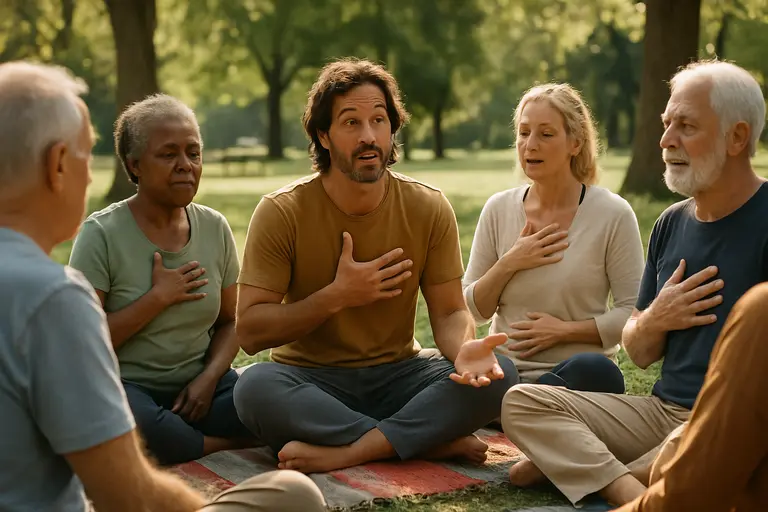
A careful teaching approach begins with choice. People can be invited to slow the breath gently, notice the exhale, or pause and observe their body’s response. They should also be told they can stop at any time. For some people, focusing closely on breathing can feel calming; for others, it can increase discomfort or body vigilance. Both responses deserve respect.
Community programs can also pair breathwork education with broader supports: rest breaks, social connection, reasonable workload expectations, access to mental health resources, and clinician referral pathways when needed. Readers who want a related educational resource can review breathwork techniques for stress, while remembering that general education is not the same as individualized care. People receiving medically supervised weight, metabolic, or surgical care may also have personal considerations; a related network resource such as Trinity Bariatric Institute is available for insights, allowing personal decisions to be guided by clinician expertise.
Just-in-Time Breathing In Practice
A Practical, Evidence-Sensitive Frame
Used carefully, Just-in-Time Breathing can be framed as a brief pause skill: notice stress, soften the pace of breathing if comfortable, and reassess. The research signals are encouraging for short-term perceived stress, and some studies report physiological changes such as HRV shifts, slower breathing rate, or stress-marker changes. Yet the same research also shows limits: small samples, mixed physiological findings, modest average effects in some groups, and meaningful individual differences.
For community wellness, the safest message is neither enthusiasm nor dismissal. Breathing practices may support stress awareness and recovery for some people, especially when they feel natural and are used voluntarily. They should sit alongside sleep, movement, social support, mental health care, and medical evaluation when symptoms call for it.
What To Ask A Clinician
Before using breathwork for health-related goals, or if stress symptoms are frequent or severe, discuss the practice with a qualified professional. Useful questions include:
- Is a brief breathing practice appropriate for my health history, medications, pregnancy status, or respiratory and cardiovascular needs?
- Are there symptoms that should prompt me to stop the practice and seek care?
- Would slow-paced breathing, box breathing, diaphragmatic breathing, or another approach be safer for my situation?
- How should I track whether the practice is helping without treating it as a substitute for care?
- Should breathwork be paired with counseling, physical activity guidance, sleep support, or medical evaluation?
Medical advice should be sought from a qualified professional, especially when stress is persistent, symptoms are new or worsening, or breathing practices cause discomfort. Breathwork can be a gentle community wellness tool, but personal health decisions deserve professional guidance.