
Researchers at the University of Florida and Florida State University are examining whether an integrative breathwork program can become a practical non-drug approach for adults living with chronic low back pain. The research, led by Steven D. Pratscher, PhD, and involving investigators including Irene M. Estores, MD, Adam W. Hanley, PhD, Kimberly T. Sibille, PhD, and Roger B. Fillingim, PhD, was published September 22, 2026, in Pain Medicine. The study evaluates an eight-week intervention called Guided Respiration Mindfulness Therapy (GRMT).
The program combines conscious connected breathing, mindfulness directed toward physical sensations and deliberate relaxation of bodily tension. Participants receive a 60-minute, one-on-one session once each week for eight weeks. The study is designed as a single-arm pilot, meaning participants receive the intervention rather than being randomly assigned to a separate comparison group. Its purpose is to examine feasibility, acceptability and early signals of potential clinical benefit before larger controlled research.
That design makes the study particularly relevant to the growing interest in breathwork routines for pain management, but it also places clear limits on what can be concluded from the findings. The research does not establish that breathwork is an effective treatment for chronic low back pain. Instead, it represents another step in developing and testing a structured breathing intervention that could eventually be evaluated in randomized trials.
Why Researchers Are Looking At Breathwork For Low Back Pain
Chronic low back pain is defined as pain lasting at least 12 weeks, and it can affect physical activity, sleep, mood and everyday functioning. A 2024 review in American Family Physician estimated that chronic low back pain occurs in approximately 13% of U.S. adults, illustrating the size of the population potentially affected by long-lasting symptoms.
Pain is also influenced by more than the physical sensation itself. Attention, emotional responses, stress, fear of movement and expectations can affect how people experience and respond to persistent pain. That broader perspective helps explain why researchers are investigating interventions that combine physical and psychological components.
The University of Florida team is approaching the problem through breathing, body awareness and relaxation rather than through medication or a physical exercise program alone.
The study’s principal intervention, GRMT, was developed as a multicomponent approach. During each session, participants practice a continuous breathing pattern while paying attention to physical sensations and deliberately releasing unnecessary muscular tension. The goal is to give participants a structured way to observe pain-related sensations without automatically responding with additional physical tension or avoidance.
This places the intervention closer to a mind-body pain-management technique than to conventional respiratory training designed primarily to improve lung function.
The distinction is important because the program is not simply asking participants to take slow breaths for a few minutes. The sessions are longer, facilitated and specifically designed around the experience of chronic pain.
The Eight-Week Program Uses 60-Minute Individual Sessions
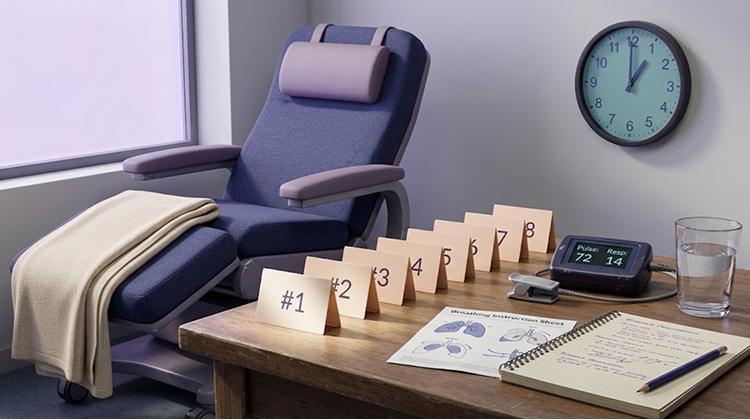
The intervention follows a consistent weekly structure. Participants receive eight 60-minute sessions over eight weeks, with each session delivered individually and in person by a trained facilitator. Participants lie in a supine position while the facilitator observes their breathing and guides them through the three central components of GRMT.
| Program Element | Description |
|---|---|
| Respiratory regulation | Conscious connected breathing without a pause between inhalation and exhalation |
| Somatic mindfulness | Attention to physical sensations with an accepting attitude |
| Physical relaxation | Deliberate release of unnecessary bodily tension |
| Frequency | One session per week |
| Duration | 60 minutes per session |
| Total program | 8 weekly sessions |
| Delivery | One-on-one, in person |
The breathing component uses a sustained connected pattern in which inhalation and exhalation flow into one another without a pause. The protocol describes breathing through either the nose or mouth, with an active inhale followed by a more passive and relaxed exhale.
The mindfulness component shifts attention toward the body’s most noticeable sensations from moment to moment. Rather than attempting to immediately eliminate an uncomfortable sensation, participants are instructed to observe it with acceptance while maintaining awareness of the breathing process.
The final component involves physical relaxation. Participants are guided to identify areas of tension and allow those areas to soften.
This combination is significant because chronic pain can create a cycle in which discomfort produces protective muscle tension, heightened attention to symptoms and concern about movement. GRMT is designed to investigate whether changing the relationship between breathing, bodily sensations and tension can influence pain-related outcomes.
The Study Was Conducted Through The University Of Florida
The research team includes investigators from several U.S. institutions. Pratscher is affiliated with the University of Florida’s Pain Research and Intervention Center of Excellence and Department of Community Dentistry and Behavioral Science, while Estores is based in the university’s Department of Physical Medicine and Rehabilitation. Hanley is affiliated with Florida State University’s Complementary Health Innovation Lab, and Sibille and Fillingim are also affiliated with the University of Florida’s pain research center. Mark A. Lumley, PhD, is affiliated with Wayne State University in Detroit.
The study’s primary U.S. research location is the University of Florida in Gainesville. The clinical research program was registered as NCT06546956 and was sponsored by the University of Florida with NIH support identified under grant K01AT012066. Registry information lists a target of 19 participants for the single-group study.
The research builds on an earlier line of work from the same investigators. In 2025, Pratscher, Lalande, Allison Davis and Hanley published a proof-of-concept study examining a single group breathwork session among adults with chronic pain.
That earlier study enrolled 11 people, with 10 completing the breathwork session. At the two-week follow-up, five of nine participants with available data had a clinically meaningful improvement in pain intensity and interference, with a mean change of −2.9 points on the PEG measure. At six weeks, six of nine participants had a clinically meaningful improvement, with a mean change of −3.5 points.
Those findings were preliminary and came from a very small uncontrolled sample. They nevertheless provided the researchers with enough evidence of feasibility to justify investigating a longer eight-week format.
What The Researchers Measure Beyond Pain
Pain intensity is only one part of chronic low back pain. The University of Florida study therefore includes a much broader set of outcomes.
The primary outcomes include treatment acceptability, adherence, participant retention, changes in pain intensity and changes in pain interference. Secondary measures examine several psychological, physical and behavioral dimensions that can influence how people live with chronic pain.
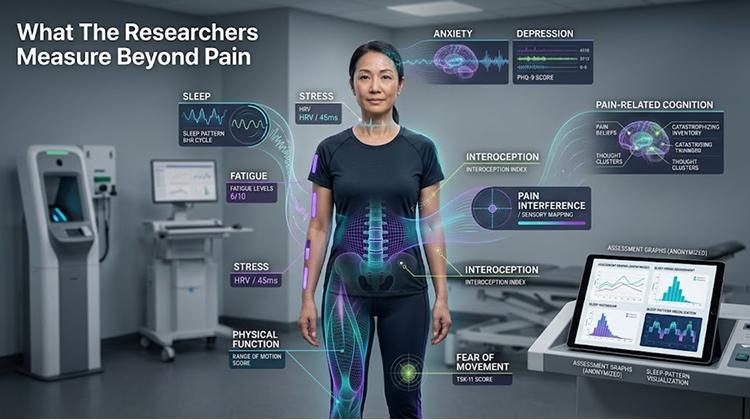
These include:
- Pain catastrophizing and pain self-efficacy.
- Fear-avoidance beliefs and physical function.
- Sleep disturbance and sleep-related impairment.
- Fatigue, stress, anxiety and depression.
- Multisensory sensitivity and interoception.
- Mindful reappraisal of pain sensations.
This broader measurement strategy reflects the biopsychosocial nature of persistent pain. A treatment could potentially influence the way someone responds to pain without completely eliminating the underlying physical source of discomfort.
The inclusion of sleep, fatigue, anxiety and depression is particularly relevant because chronic pain frequently extends beyond the painful area itself. The researchers are therefore interested in whether changes associated with the intervention appear across several dimensions of daily functioning.
The study also measures treatment credibility and psychological insight, which can help researchers determine whether participants consider the intervention plausible and whether they develop a different perspective on their pain experience.
Existing Evidence For Mind-Body Approaches Is Mixed
The Florida study is entering an area where some mind-body approaches already have evidence, but the strength of that evidence varies by intervention.
The National Center for Complementary and Integrative Health reports that several mind-body approaches, including mindfulness-based stress reduction, progressive muscle relaxation, yoga and tai chi, have shown potential benefits for chronic low-back pain. However, NCCIH also emphasizes that the quality of evidence differs between practices and that the evidence for some approaches remains limited. (NCCIH research on low-back pain)
Mindfulness-based approaches are especially relevant to GRMT because the intervention incorporates sustained attention to bodily sensations. NCCIH notes that previous research on mindfulness-based stress reduction has found short-term improvements in pain intensity and physical functioning, although it remains uncertain whether those changes are large enough to be meaningful for patients in every setting.
GRMT differs from conventional MBSR, however. MBSR is a broader structured program involving mindfulness meditation and other practices, while GRMT places conscious connected breathing at the center of the intervention and adds somatic awareness and physical relaxation.
That difference means evidence supporting MBSR cannot automatically be transferred to GRMT.
The Florida research is therefore addressing a specific gap: whether this particular combination of breathing, body awareness and relaxation can be delivered consistently and whether it produces measurable changes that justify a larger clinical trial.
The Single-Arm Design Limits What The Study Can Prove
One of the most important details about the new research is its design.
Because the study is a single-arm pilot, participants are not randomly divided between breathwork and a control condition. Everyone enrolled in the intervention receives GRMT.
That makes the study useful for assessing whether the program can be delivered and whether participants are willing to complete it, but it makes causal interpretation difficult.
If pain improves during the eight weeks, several explanations are possible. The change could be related to the breathwork itself, increased attention to physical sensations, expectations about treatment, natural fluctuations in chronic pain, increased interaction with a facilitator, changes in other behaviors, or a combination of factors.
A randomized controlled trial would provide a stronger test because researchers could compare GRMT with another condition while balancing many of these influences between groups.
The research program was developed with that progression in mind. Earlier University of Florida materials describe the eight-week development work as preparation for a future pilot randomized controlled trial comparing the intervention with usual care in adults with chronic low back pain.
That sequence matters. The current study is better understood as intervention development and early clinical testing rather than as a definitive efficacy trial.
The Earlier Proof-Of-Concept Study Provided A Starting Point
The new eight-week research did not emerge in isolation. The investigators previously tested GRMT in a much smaller single-session study conducted in Tallahassee, Florida.
The earlier trial recruited adults with chronic pain through local outreach and online advertising. Participants had no previous breathwork training. The final group was predominantly female, with an average age of 53.1 years, and chronic musculoskeletal pain—including persistent low-back, neck and knee pain—was common. Most participants had lived with chronic pain for more than five years.
The intervention was rated highly for acceptability and satisfaction. Among the participants who completed the session and follow-up assessments, the mean acceptability score was 9.3 out of 10, while satisfaction averaged 9.7 out of 10. No adverse events were reported during the intervention.
The study also reported immediate reductions in pain intensity and unpleasantness after the session, along with improvements that remained visible at the two- and six-week follow-ups.
But the researchers were careful about the study’s limitations. The sample was very small, there was no control group, and the intervention was delivered by the developer of GRMT. Those factors make it difficult to separate the specific effect of the breathing intervention from expectations, therapist effects and normal variation in chronic pain.
The eight-week pilot represents an attempt to move beyond that initial proof of concept.
Why An Eight-Week Format Matters
A single breathwork session can show whether people are willing to participate and whether they report immediate changes. An eight-week program asks a different question: can a structured intervention be delivered repeatedly enough to become a meaningful component of chronic pain care?
The longer format also gives researchers more opportunities to examine whether changes persist across treatment rather than appearing only immediately after a session.
The University of Florida protocol includes assessment at baseline, after treatment at Week 8 and again during follow-up. This allows investigators to examine changes in pain and related outcomes after the intervention has ended rather than relying exclusively on immediate post-session responses.
That distinction is important for chronic pain research. A temporary change in pain intensity can be useful, but researchers and patients also need to know whether an intervention influences everyday activity, sleep, emotional wellbeing or confidence in managing symptoms.
The study’s broad outcome list reflects that goal.
At the same time, eight weeks of one-on-one treatment requires considerably more resources than a brief self-guided breathing exercise. Each session requires a trained facilitator, a clinical setting and approximately one hour of participant time.
If future randomized studies demonstrate meaningful benefits, researchers would then have to examine whether the intervention can be delivered efficiently and whether patients can access it outside a specialized research setting.
What The Florida Research Could Add To Breathwork Science
The September 22 publication represents an important stage in the development of GRMT because it documents a specific breathwork intervention being tested for a specific chronic pain condition.
The researchers are not simply asking whether “breathing helps pain.” They are testing a defined protocol with identifiable components, a fixed eight-week schedule and measurable outcomes.
That structure makes the intervention easier to study and potentially easier to reproduce. It also allows future research teams to determine whether the results remain consistent when different trained facilitators deliver the same protocol.
The earlier proof-of-concept findings provide a preliminary rationale for continuing the work, but they do not establish effectiveness. The new pilot similarly should be viewed as an early stage of evidence development.
For people living with chronic low back pain, that distinction is important. Breathwork may eventually become one component of a broader pain-management plan, but current evidence does not justify replacing established medical evaluation or treatment with an intensive breathing practice.
NCCIH advises people considering complementary approaches for chronic low-back pain to discuss them with healthcare professionals, particularly because safety and suitability can depend on individual medical circumstances. (NCCIH guidance on chronic low-back pain)
The University of Florida research offers a more precise question for the scientific community: whether a structured combination of conscious connected breathing, somatic mindfulness and physical relaxation can produce measurable and reproducible improvements for people with persistent low back pain.
That question is now moving from an early proof-of-concept stage into a more structured eight-week investigation.