
Brief Breathwork Practices have drawn research attention because they are short, low-cost, and relatively easy to study in controlled stress situations. The main question is not whether breathing is a stand-alone solution for distress. It is whether brief, structured changes in breathing may support emotional regulation in measurable ways, such as reduced state anxiety, lower heart rate, improved heart rate variability, or less rumination after stress.
As a holistic wellness educator, I view breathwork as a community skill rather than a quick fix. Breath can offer a shared pause, a moment to soften reactivity, and a practical way to notice stress signals. Still, health needs vary by age, pregnancy status, medication use, trauma history, cardiovascular health, respiratory conditions, and mental health history. Medical advice should be sought from a qualified professional, especially before using breathwork during intense distress or as part of care for a health condition.
Brief Breathwork Practices And Emotional Regulation
Emotional regulation refers to how people notice, interpret, and respond to emotional activation. In the research notes provided, recent studies from 2025 and 2026 examined breathing during or after stress tasks, emotional images, exam stress, anxiety moments, and multi-day breath meditation. The strongest pattern was not that one technique worked for everyone. Rather, paced, slow, nasal, box, or prolonged-exhale breathing often shifted short-term markers related to arousal and mood.
How Brief Breathwork Practices May Work
Brief Breathwork Practices are best understood as attention-and-arousal practices. A person changes the rhythm of breathing, while attention is directed toward the body. In several studies summarized in the research notes, outcomes included heart rate, heart rate variability, salivary alpha-amylase, electrodermal activity, anxiety ratings, affect ratings, and rumination. These measures do not prove deep or lasting psychological change on their own, but they can show whether a brief intervention changed the body’s stress response during a specific study window.
One plausible explanation is that slower or longer-exhale breathing may reduce sympathetic activation for some people. Another is that a structured breathing cue gives attention somewhere stable to rest during emotional activation. Those ideas fit the study patterns, but they should be treated carefully. Short-term physiological shifts are not the same as diagnosis, treatment, or prevention of any condition.
What Recent Studies Suggest
Several 2026 studies in the research notes tested brief breathing under stress. In August 2026, a randomized controlled trial with 66 participants compared box breathing and prolonged exhalation with normal breathing during a virtual Trier Social Stress Test. Both active breathing conditions significantly reduced heart rate, state anxiety, and salivary alpha-amylase after the stressor compared with control. The same study did not find significant effects on heart rate variability or cognitive performance. That mixed result matters because it shows that calming one marker does not mean every stress-related function changes.
Longer Exhales And Short Stress Windows
An August 31, 2026 Washington Post science video reported that one-minute breathing techniques emphasizing a longer exhale than inhale could slow heart rate and reduce anxiety. That claim fits the broader research interest in prolonged exhalation, but it should not be stretched into a universal rule. A one-minute result may be useful for studying acute stress, yet it does not show how a practice affects long-term mental health or people with different medical backgrounds.
An ecological momentary intervention published online in April 2026 compared one-minute cyclic sighing, box breathing, and a control condition among 47 university students during acute anxiety moments. Both breathing methods reduced state anxiety versus control. Box breathing was also linked with fewer inhibition errors, especially among those with high trait anxiety, while reaction times were longer than control. That kind of tradeoff is useful: a calmer state may not always mean faster performance.
Multi-Day Breath Meditation Findings
Not all findings focused on a single minute. A study published on July 24, 2026 examined 112 participants in a 21-day breath meditation program, alone or combined with body scanning and positive reflection. The group combining breath meditation with “Three Good Things” showed the largest increases in positive affect and reductions in negative affect, suggesting a possible synergy between breathing and positive reflection in that sample, according to the breath meditation study.
The wording is worth holding steady: the study indicated a pattern within its design. It did not prove that a short breath practice will produce the same response for every person, and it did not replace clinical evaluation. Still, it points toward a practical research question for community wellness: does breathing work better when paired with reflection, supportive routines, or other low-risk educational practices?
How To Read The Signals Cautiously
The 2025 and 2026 findings in the research notes used several different stress models and populations. A March 2025 study with 27 individuals found that slow breathing reduced anxiety and arousal during uncertain threat, with EEG differences across frequency bands. A February 2026 adolescent study tested expansive posture, nasal breathing, both combined, and a control condition under stress. The active interventions reduced anxiety more than control, while nasal breathing alone showed more stable electrodermal activity patterns.
These signals are promising, but they are not identical. A reduced anxiety rating, a lower heart rate, a shift in electrodermal activity, and a change in EEG power each tell a different part of the story. They do not automatically combine into one simple claim. For careful public education, the better statement is that brief breathing may support short-term regulation for some people in some settings.
Sample size also matters. A study with 27 participants can be valuable for early signals, but it cannot answer every question about safety, age differences, cultural setting, respiratory health, medication use, or long-term effects. A trial with 66 participants offers stronger comparison than a single-group observation, but it still leaves questions. Even a larger exam-stress study with about 240 medical students reflects a specific population under a specific stressor.
Safety, Access, And Community Practice
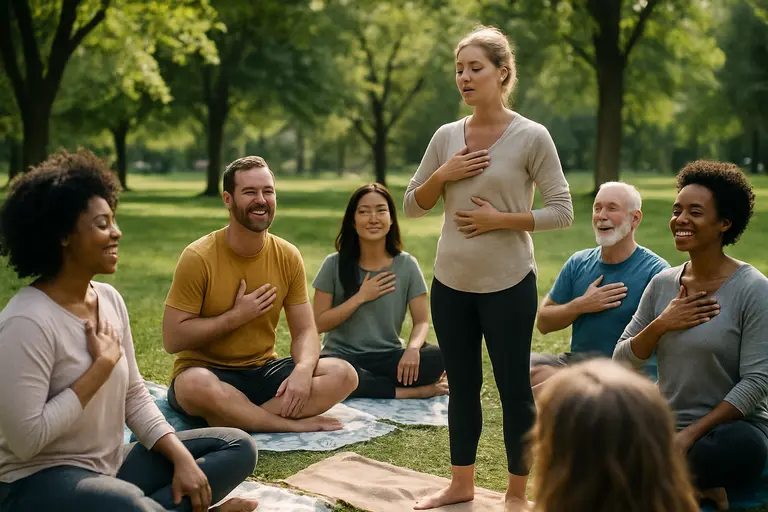
In community wellness settings, breathwork is often presented as gentle. Many practices are gentle for many people, but that does not make every method appropriate for everyone. Techniques involving breath retention, fast breathing, intense emotional activation, or pressure to push through discomfort may not be suitable for people with certain health histories. People with respiratory, cardiovascular, neurological, pregnancy-related, panic-related, trauma-related, or other medical concerns should seek medical advice from a qualified professional before using breathwork in a structured way.
A cautious community approach favors choice, consent, and low intensity. Educators can describe the evidence without promising outcomes. Participants can be invited to stop, return to normal breathing, open their eyes, or use grounding through the senses. No one should be pressured to disclose personal health information in a group. Breathwork education works best when it respects privacy and does not replace mental health care, medical care, medication guidance, or emergency support.
For readers who want related educational context, this site has a source-sensitive discussion of breathwork for emotional regulation. Additionally, those interested in comparing educational resources might appreciate the content at Petraclass, another insightful site within the same network. Any resource, including this one, should be read as education rather than personal health direction.
Brief Breathwork Practices In Community Wellness
In community wellness, Brief Breathwork Practices may be most useful as a shared pause before discussion, study, caregiving, conflict repair, or group reflection. The research notes suggest that short practices can influence some markers of state anxiety, heart rate, affect, rumination, and autonomic regulation. The evidence is strongest when phrased modestly: brief breathing may support short-term emotional regulation, but the size and durability of the effect can vary.
For educators, the practical task is to keep the message honest. Breathwork should not be promoted as a cure, a substitute for therapy, or a replacement for medical care. It can be framed as one stress-management skill among many: sleep routines, social support, movement within ability, professional care, and safer environments also matter. A calm breath can be meaningful, but it does not carry the whole weight of wellness.
Before using breathwork for ongoing anxiety, panic symptoms, trauma reactions, dizziness, faintness, chest discomfort, shortness of breath, or other concerning symptoms, discuss it with a qualified clinician. Useful questions include: Is this style of breathing appropriate for my health history? Are there techniques I should avoid? How should I respond if symptoms intensify? Could breathwork fit safely with my existing care plan? Those questions keep the practice grounded, respectful, and safer for the whole community.