A prenatal mindfulness program may influence how an infant’s body responds to stress months after birth, according to research from the University of California, San Francisco (UCSF) that has returned to public attention in August 2026.
UCSF highlighted the findings on August 29, 2026, reporting that infants whose mothers participated in an eight-week mindfulness-based program during pregnancy showed healthier patterns of stress response and recovery at six months of age. The researchers studied 135 mother-infant pairs from a racially and ethnically diverse, low-income population experiencing high levels of stress.
The underlying peer-reviewed study, however, is not a new 2026 clinical trial. It was published in Psychosomatic Medicine in 2022 by Amanda N. Noroña-Zhou, Michael Coccia, Elissa Epel, Cassandra Vieten, Nancy E. Adler, Barbara Laraia, Karen Jones-Mason, Abbey Alkon and Nicole R. Bush. The current UCSF report brings those findings back into focus because researchers are increasingly interested in interventions that may benefit both parents and children.
That distinction does not make the research less relevant. Instead, it makes the study an interesting example of how prenatal stress research is shifting from documenting potential risks toward asking whether practical interventions can change biological outcomes for the next generation.
What The UCSF Researchers Actually Found
The study followed mother-infant pairs whose mothers had participated in a prenatal intervention trial. Women were assigned either to an eight-week mindfulness-based intervention or to treatment as usual.

The intervention was designed to address stress and depression during pregnancy while encouraging healthier behaviors. It included mindfulness-based stress reduction practices involving mindful eating, breathing and movement, delivered in group sessions. Participants also received additional support, including telephone sessions and a postpartum booster session.
At approximately six months of age, the infants were brought into a laboratory setting where researchers could examine their physiological and behavioral responses to a controlled social stressor.
The question was not whether the babies were “calm” in a general sense.
Researchers wanted to know whether their developing autonomic nervous systems responded to stress in a pattern associated with effective regulation.
| Study Detail | What Researchers Reported |
|---|---|
| Mother-infant pairs | 135 |
| Population | Low-income, racially and ethnically diverse mothers experiencing high stress |
| Prenatal intervention | Eight-week mindfulness-based program |
| Infant assessment | Approximately 6 months |
| Stress paradigm | Still Face Paradigm |
| Physiological systems | Sympathetic and parasympathetic activity |
| Behavioral measure | Self-regulatory behavior |
The findings were notable because infants whose mothers received the intervention showed faster cardiovascular recovery after the stressful interaction and more observable self-soothing behaviors than infants in the comparison group.
For readers interested in mindfulness during pregnancy, the research provides an important distinction: the intervention was aimed at the mother’s stress and well-being during pregnancy, while the biological measurements were later taken from the infants.
Why Researchers Looked At The Infant Nervous System
Pregnancy is a period of major biological development, and researchers have long investigated whether maternal stress is associated with differences in children’s later health and behavior.
The challenge is determining how those associations develop.
Maternal stress can involve psychological, social and physiological factors. Financial strain, depression, anxiety, health problems, discrimination and other forms of adversity can affect the mother’s daily environment. Researchers therefore cannot assume that a single biological pathway explains every relationship between prenatal stress and child development.
The UCSF research approaches the question differently.
Rather than simply asking mothers whether their babies appeared less fussy or more relaxed, researchers used physiological measurements that could capture how the infant’s autonomic nervous system responded during a controlled stress experience. UCSF researchers emphasized that this approach provides an objective marker that is less dependent on parental perception.
The autonomic nervous system regulates many involuntary functions, including heart activity, breathing and cardiovascular responses.
It is commonly divided into sympathetic and parasympathetic components.
The sympathetic system helps mobilize the body during demanding or threatening situations, while the parasympathetic system contributes to recovery and regulation.
A healthy stress response does not necessarily mean having no reaction.
Instead, the body needs to recognize a challenge, respond appropriately and then return toward baseline when the challenge ends.
That ability to recover is central to what the researchers observed.
The Still Face Experiment Created A Controlled Stressor
To measure the infants’ responses, the research team used the still face paradigm, a widely studied laboratory procedure for examining infant social and emotional regulation.
During the procedure, mothers initially interacted normally with their babies.
The mother then adopted a neutral facial expression and stopped responding to the infant’s attempts to engage with her.
After the brief period of nonresponsiveness, normal interaction resumed.
From an infant’s perspective, the sudden disappearance of normal social feedback can be stressful.
The researchers recorded autonomic nervous system activity using electrodes while trained observers independently coded the infants’ behavior. The observers were unaware of which treatment group the mothers had been assigned to, reducing the possibility that expectations about the intervention would influence behavioral ratings.
The result was not simply that babies in the mindfulness group showed less stress.
In fact, the researchers found something more nuanced.
Infants whose mothers participated in the intervention had a more acute sympathetic response during the stressful portion of the interaction, followed by a faster recovery after the stressor ended.
That pattern may sound counterintuitive.
But researchers argue that an effective stress system should respond when a genuine challenge occurs and then deactivate when the challenge is over.
A Stronger Reaction Can Sometimes Be A Healthier One
The UCSF findings challenge the simplistic idea that successful stress regulation means producing the smallest possible physiological reaction.
Nicole Bush, PhD, a UCSF professor of psychiatry and pediatrics and senior author of the research, explained that a strong response followed by rapid recovery can represent a healthier pattern than a delayed or prolonged response.
Imagine two different responses to the same stressful event.
In one case, the body recognizes the disruption quickly, activates its stress system and then begins returning toward normal as soon as the disruption ends.
In another, the body reacts slowly and remains activated after the stressful event has passed.
The second pattern may be more concerning because the physiological system is not responding as efficiently to the changing environment.
The UCSF researchers observed differences consistent with these two patterns.
Babies whose mothers did not receive the intervention showed a more delayed sympathetic response and slower recovery, while the intervention group displayed a sharper response during the stressor and quicker recovery afterward.
This is one reason the study should not be summarized simply as “meditation makes babies calmer.”
The physiological finding is more specific: prenatal mindfulness was associated with a different pattern of autonomic reactivity and regulation in infants.
The Babies Also Showed More Self-Soothing Behavior
The physiological measurements were accompanied by observable behavioral differences.
Infants in the intervention group engaged in higher proportions of self-regulatory behavior during the still face procedure. Researchers observed behaviors such as sucking their thumbs and looking at their hands.
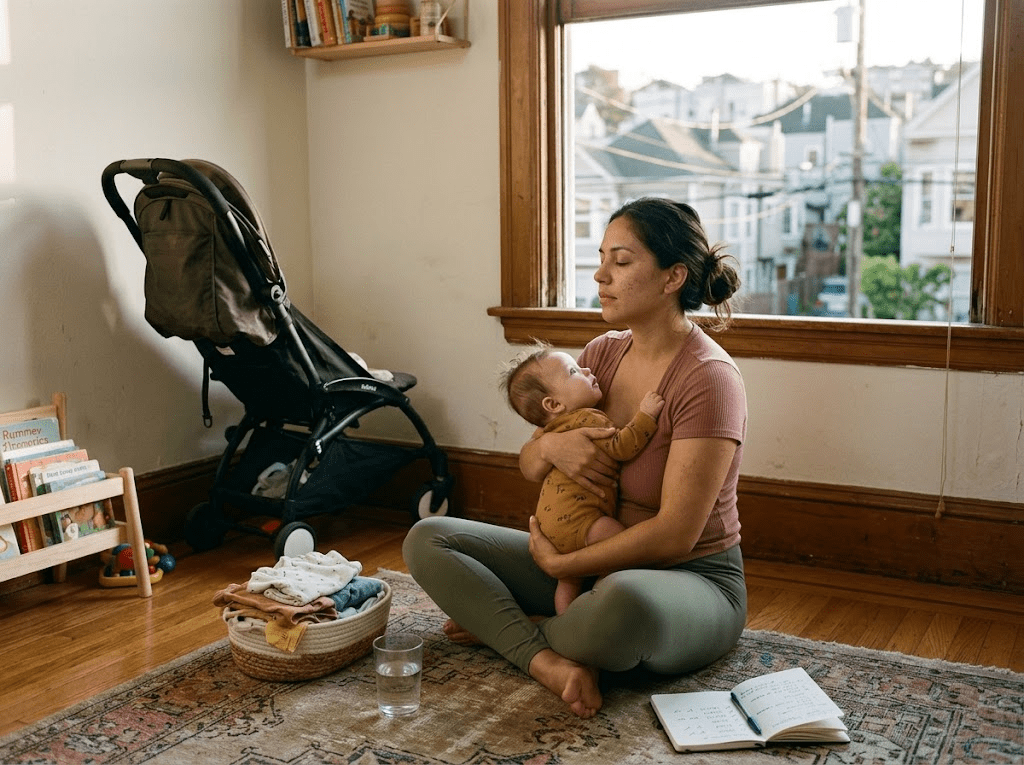
Self-soothing is one way infants attempt to regulate arousal when normal social interaction is interrupted.
It does not mean that a baby has learned mindfulness or consciously understands how to manage stress.
Instead, these behaviors are part of early regulatory development.
The combination of physiological and behavioral observations makes the study more interesting than research based solely on parental questionnaires.
The researchers could observe what the infants did while simultaneously measuring aspects of their autonomic nervous system.
That creates two complementary perspectives on regulation.
The Study Did Not Find Changes In Every Measure
The findings also contain important limitations that are easy to lose when the headline is reduced to a simple claim about mindfulness and babies.
The researchers measured both sympathetic and parasympathetic activity.
They found differences in sympathetic reactivity and recovery, but did not find a significant intervention effect on the infants’ parasympathetic response during the still face paradigm. They also found no significant intervention effect on observed behavioral negativity.
That means the intervention did not broadly alter every component of the infant stress system.
Instead, the strongest evidence involved particular aspects of autonomic regulation and self-regulatory behavior.
This matters because it prevents the findings from being overstated.
The nervous system is not a single mechanism, and a change in one measurement cannot automatically be interpreted as a global improvement in infant health.
The Mothers Were Experiencing High Levels Of Stress
Another important feature of the study was the population that researchers recruited.
The sample consisted of low-income, racially and ethnically diverse mothers experiencing high stress. Researchers intentionally focused on women who could potentially benefit from an intervention addressing stress and depression during pregnancy.
This is significant because many behavioral intervention studies have historically relied heavily on relatively advantaged populations.
A program that produces benefits only under highly controlled circumstances among people with abundant resources may have limited practical impact.
The UCSF team instead studied an intervention delivered in a population facing substantial social and economic pressures.
That makes the research relevant to a broader question: can relatively inexpensive group-based programs become part of strategies designed to support maternal and infant health?
The researchers believe that possibility deserves additional investigation.
The Intervention Was More Than Sitting Quietly
The phrase “prenatal mindfulness” can create the impression that participants simply sat still and concentrated on their breathing.
The actual intervention was broader.
The eight-week program incorporated mindfulness-based stress reduction exercises, mindful eating, breathing and movement. Sessions were conducted in groups, with participants receiving structured lessons and activities.
This makes it difficult to attribute the infant findings to meditation alone.
The intervention could have influenced mothers through several pathways.
It may have reduced perceived stress.
It may have affected depressive symptoms.
It may have changed physical activity or other health behaviors.
It may have changed how participants responded to stressful situations.
It may also have provided social connection through the group format.
The study therefore supports the idea of a prenatal mindfulness-based intervention, not necessarily meditation as an isolated ingredient.
That distinction is particularly important for future research.
Earlier Results Showed Benefits For Mothers
The infant findings were connected to an earlier trial involving the same intervention.
A 2019 study reported that the prenatal mindfulness program reduced maternal stress and depression and was associated with improvements in glucose tolerance and physical activity. UCSF researchers subsequently followed the children of women who had participated in that trial to investigate whether there could be effects extending into the next generation.
That two-generation design is one of the most interesting features of the research program.
Instead of evaluating maternal outcomes and infant outcomes as completely separate questions, the researchers asked whether an intervention delivered to pregnant women could potentially influence both.
The broader idea is sometimes described as a two-generation approach.
Rather than treating maternal and infant well-being as independent targets, researchers examine whether supporting the mother can also improve developmental conditions for the child.
Recent UCSF work continues to explore this broader framework. The university has also reported research examining prenatal wellness programs, maternal depression and longer-term outcomes for mothers.
Why Recovery From Stress Matters
The ability to recover from stress is increasingly viewed as an important part of health research.
Stress itself is not inherently harmful.
Humans need stress systems to react to threats, adapt to challenges and maintain physiological balance.
The concern arises when stress responses become poorly regulated or remain activated after a challenge has ended.
Researchers have therefore become increasingly interested in reactivity and recovery rather than simply asking whether an individual experiences stress.
The UCSF findings fit into that broader scientific model.
The intervention-group infants did not simply appear less reactive.
Their physiological response appeared to be more appropriately timed, with stronger activation during the social stressor and faster recovery afterward.
That distinction could become important in future studies examining whether early differences in autonomic regulation relate to later emotional or physical health.
However, the current evidence cannot establish that connection.
What The Study Does Not Prove
The research does not prove that prenatal mindfulness permanently changes a baby’s nervous system.
It does not establish that mindfulness prevents anxiety, depression, obesity, hypertension or other diseases later in life.
It also does not show that every pregnant woman who practices mindfulness will produce a child with a faster stress recovery response.
The study was based on a specific intervention, a specific population and measurements taken at approximately six months of age.
The researchers themselves have emphasized the need for longer follow-up.
UCSF’s current report notes that while autonomic stress regulation is relevant to later health, the evidence is not strong enough to claim that an infant physiological signal can predict an individual’s cardiovascular health decades later.
That caution is essential.
The findings are best understood as evidence of an early biological association, not proof of a lifelong outcome.
For additional background on prenatal health and evidence-based care, readers can consult the American College of Obstetricians and Gynecologists, which provides broader guidance on stress and health during pregnancy.
Why This Research Is Returning To The Spotlight
The timing of the renewed attention is significant.
UCSF published its new report on August 29, 2026, describing the study as evidence that a prenatal social intervention may influence offspring health through measurable autonomic responses.
The renewed attention comes as researchers increasingly investigate interventions that could address maternal health while also supporting child development.
The university has simultaneously highlighted research on prenatal wellness, digital treatment for insomnia during pregnancy and other interventions aimed at reducing maternal psychological stress.
This creates a broader scientific shift.
For years, much of the discussion around prenatal stress focused on documenting associations between maternal stress and potential negative outcomes.
The newer question is more intervention-oriented:
If prenatal stress can influence development, can supporting mothers during pregnancy alter some of the biological pathways involved?
The UCSF mindfulness research does not answer that question completely.
But it provides one of the more concrete pieces of evidence that an intervention delivered during pregnancy can be followed by measurable differences in infant stress regulation.
What Researchers Need To Study Next
The next step is not simply to repeat the same eight-week intervention.
Researchers need to determine whether the observed differences persist as children grow.
A six-month-old infant is still undergoing enormous developmental changes. A physiological pattern observed at that age may change substantially during toddlerhood, childhood and adolescence.
Long-term follow-up could determine whether early differences in stress reactivity are associated with later measures of emotional regulation, behavior, sleep, physical health or mental health.
Larger trials would also help determine how broadly the findings apply.
Future research could examine whether similar results occur across different socioeconomic groups, cultural backgrounds and levels of prenatal stress.
Another important question is which component of the intervention matters most.
Was the effect driven primarily by mindfulness?
Was it reduced maternal depression?
Was it physical activity?
Was it social support?
Or did the combination produce the outcome?
Answering those questions could make prenatal interventions more precise and potentially easier to implement.
A Potential Two-Generation Approach To Mindfulness
The most important implication of the UCSF research is not that pregnant women should meditate to change their babies.
That interpretation goes beyond the evidence.
The more defensible takeaway is that supporting maternal well-being during pregnancy may have consequences that extend beyond the mother, and mindfulness-based programs are one potential intervention worth continuing to study.
The original study’s 135 mother-infant pairs provide evidence that an eight-week prenatal program was associated with differences in infant autonomic regulation and self-soothing behavior at six months.
The findings are particularly notable because the researchers did not define success as making infants less reactive.
Instead, the pattern suggested a potentially more adaptive sequence: respond to the stressor, then recover when it ends.
That idea changes how prenatal mindfulness can be discussed.
Rather than presenting meditation as a way to create a permanently calm child, the research points toward a more nuanced possibility: helping mothers regulate their own stress during pregnancy may be associated with healthier early patterns of stress regulation in their children.
Whether those early differences persist, and whether they translate into meaningful long-term health benefits, remains an open scientific question.
For now, the evidence supports a narrower but important claim: a prenatal mindfulness-based intervention was associated with measurable differences in infant autonomic and behavioral regulation at six months, giving researchers a new reason to study maternal stress interventions as potential two-generation health strategies.