
A new study involving researchers from the University of California, Merced, offers a closer look at how people develop mindfulness skills when they begin meditating. Published in the October 2026 issue of Stress and Health, the research examined whether an eight-week program using the Headspace meditation app helped novice meditators strengthen two core skills: attention and acceptance.
The study, led by Mercedes Peña, alongside Matthew J. Zawadzki, Larisa Gavrilova and Martin S. Hagger, found that participants assigned to Headspace reported improvements in both skills during the program. Changes were evident as early as the second week, with improvements continuing through the eight-week intervention. The researchers also found that participants’ initial mindfulness and perceived stress levels were associated with how much their skills changed.
The findings provide a more detailed look at the learning process behind meditation. Rather than asking only whether people feel less stressed after completing a program, the team examined how mindfulness skills developed during ordinary daily life. The full study is available in Stress and Health.
Why Researchers Studied Meditation Beginners
Mindfulness programs are often evaluated by comparing participants’ symptoms or questionnaire scores before and after an intervention. Those comparisons can show whether outcomes changed, but they provide less information about when particular skills begin to develop.
For beginners, that distinction matters. Meditation involves more than sitting quietly or trying to empty the mind. Practitioners learn to notice where their attention goes, return to the present when their thoughts wander, and respond to thoughts and feelings without immediately judging or reacting to them.
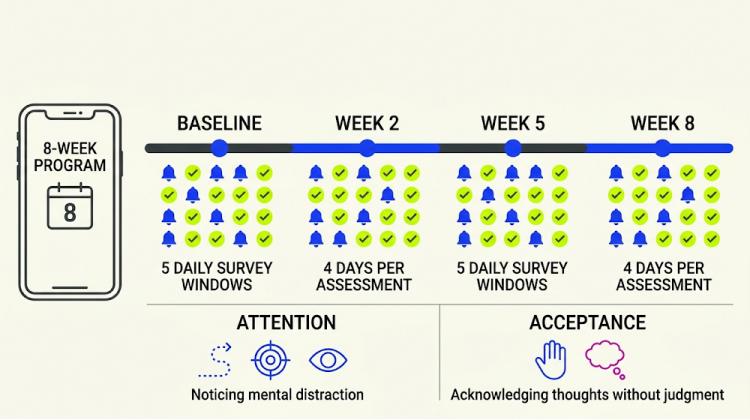
The UC Merced research focused on two skills central to this process. Attention refers to monitoring and directing awareness toward the present moment. Acceptance involves allowing thoughts, feelings and experiences to occur without automatically judging them or attempting to push them away.
These skills can operate together, but they are not identical. A person may become better at noticing that their mind has wandered while still finding it difficult to accept uncomfortable thoughts. Measuring them separately can help researchers identify how different aspects of mindfulness develop.
The study, titled Testing How Mindfulness Skills Change for Novice Meditators Using Headspace: Examining Trait Mindfulness and Perceived Stress as Moderators, was published in the journal’s October 2026 issue. It sought to establish whether a digital meditation program was associated with changes in attention and acceptance and whether participants’ starting characteristics helped explain differences in progress.
How The Eight-Week Headspace Study Worked
The researchers recruited non-faculty employees at a public university in California’s Central Valley. Participants had to be at least 18 years old, speak English, have a smartphone and reliable internet access, and be new to regular sitting meditation.
The study excluded people who had meditated for at least 10 minutes more than twice a week during the preceding three months. This restriction helped the researchers focus on people learning mindfulness skills rather than those with an established meditation routine.
Of the participants who were eligible and consented, 143 were randomized, and five withdrew after randomization. The final analysis included 138 participants. Researchers assigned participants to either the Headspace intervention or a waitlist control group using a two-to-one allocation, meaning more people entered the meditation group than the control group.
Participants assigned to Headspace were instructed to meditate for 10 minutes each day for eight weeks. They began with the app’s Basics program, which introduces foundational mindfulness practices, and then progressed to its Stress program. Participants in the waitlist group were asked not to undertake meditation exercises during the study and were offered access to the app after four months.
The study did not rely exclusively on participants’ recollections at the end of the program. Instead, the researchers used ecological momentary assessment, a method that collects reports close to the time experiences occur.
Participants completed brief surveys five times daily across four consecutive days at four assessment points: baseline, week two, week five and week eight. This approach allowed the team to examine changes in mindfulness skills during everyday activities instead of relying only on a single retrospective evaluation.
The full methods and participant details are described in the published research paper.
Attention And Acceptance Improved During The Program
The main finding was that participants in the Headspace group reported significantly higher attention and acceptance skills at week eight than at baseline. The waitlist control group did not show the same significant improvement over that period.

The researchers also detected changes in both skills by week two among participants assigned to Headspace. This suggests that measurable changes in how beginners reported their mindfulness skills can emerge relatively early in a structured meditation program.
That does not mean every participant experienced the same progress or that two weeks of meditation guarantees a noticeable benefit. The results describe group-level patterns in the study’s measurements, and individual responses can differ.
The distinction between attention and acceptance is also important. Attention helps a practitioner recognize what is happening in the present moment, including when thoughts have drifted away from a task. Acceptance concerns how the person relates to those thoughts and feelings after noticing them.
For example, someone meditating before a difficult work meeting might recognize that their mind is repeatedly rehearsing possible problems. Attention allows them to notice that mental activity. Acceptance involves acknowledging the worry without automatically treating it as a problem that must be eliminated immediately.
The study assessed these skills as reported by participants; it did not establish that the intervention improved every aspect of mental health or that participants became more productive in their jobs. Its contribution is more specific: the findings indicate that two key mindfulness skills changed during an eight-week app-based program.
Why A Person’s Starting Point May Matter
The research also examined whether baseline trait mindfulness and perceived stress influenced the development of attention and acceptance.
Trait mindfulness refers to a person’s usual tendency to notice present-moment experiences in daily life. It differs from the skills someone may develop through a specific meditation intervention. Perceived stress, meanwhile, reflects how stressful people judge their circumstances and experiences to be.
The results showed different patterns for these two characteristics.
Participants with lower baseline trait mindfulness showed greater increases in attention during the intervention. However, initial trait mindfulness did not moderate changes in acceptance in the same way.
Perceived stress showed another pattern. Participants who reported lower perceived stress at the beginning of the study showed greater increases in both attention and acceptance during the Headspace program.
These results suggest that starting characteristics may be relevant to how people acquire mindfulness skills. However, they do not establish that people with higher stress cannot benefit from meditation. The study found differences in the size of changes, not evidence that one group was incapable of learning.
The findings also point to an important research question: should mindfulness programs adapt their instructions, pacing or practice options to account for participants’ starting needs? The authors discuss the potential value of matching intervention content to individual characteristics, while recognizing that more research is needed to determine how personalization should work.
How Researchers Tracked Changes In Daily Life
A notable feature of the study was the frequency of its assessments. At each measurement point, participants received surveys at different times throughout the day rather than completing one questionnaire and moving on.
The researchers used the LifeData mobile assessment app to deliver these surveys during five daily time windows. The repeated assessments provided observations of mindfulness skills across everyday situations, helping the team examine changes over time.
This method can offer a different perspective from a standard pre- and post-intervention design. A participant’s answer at the end of an eight-week program may reflect their overall impression of the experience. Repeated reports collected throughout the day provide more opportunities to observe how self-reported attention and acceptance vary during normal routines.
The method also comes with demands. Participants must regularly respond to notifications and complete surveys, which can become burdensome over several weeks. In this study, participants received compensation for each completed assessment period, with additional compensation available for meeting a high survey-completion rate.
The researchers’ approach is particularly relevant to digital mindfulness research because apps can be used outside a laboratory or scheduled class. Studying meditation in everyday settings can help researchers examine how skills develop in the environments where people are expected to use them.
What The Findings Mean For People New To Meditation
For beginners, the study supports a practical point: meditation can be approached as a skill that develops through repeated practice, rather than as an ability that someone either has or lacks.
The Headspace intervention used in the study involved a relatively short daily commitment of 10 minutes. Participants were guided through a structured sequence, beginning with foundational mindfulness practices and later moving into sessions focused on stress.
A beginner interested in following a similar routine can start by setting aside a consistent period each day, focusing on the breath or another present-moment sensation, and noticing when attention wanders. Rather than treating distraction as a failure, the practitioner can gently return attention to the chosen focus. When thoughts or feelings arise, they can be acknowledged without automatically judging them.
These suggestions reflect general mindfulness practice; the study did not compare every possible meditation routine or establish that its exact app sequence is the best choice for all beginners.
Readers exploring practical approaches can also visit our guide to mindfulness routines, which covers ways to incorporate brief awareness practices into everyday life.
The results offer no reason to assume that a person who begins with low mindfulness must progress faster in every respect, or that someone experiencing high stress should avoid meditation. Instead, the findings suggest that different starting characteristics may relate to changes in different skills, making patience and realistic expectations important parts of a beginner’s practice.
Important Limitations Of The Research
The study provides useful evidence, but several limitations shape what can be concluded.
First, participants were non-faculty employees recruited from a single university in California’s Central Valley. The findings may not apply in the same way to teenagers, older adults, clinical populations, experienced meditators or people with limited access to smartphones and reliable internet.
Second, the final analysis included 138 participants, fewer than the 143 randomized. The researchers had initially screened 291 people, and some eligible participants withdrew before randomization. Attrition is a common challenge in digital intervention research because sustained participation can be difficult.
Third, attention and acceptance were assessed through participants’ reports in brief daily surveys. These reports offer valuable information about perceived experiences but are not direct measurements of brain activity or independent demonstrations of behavior change.
The comparison group was also a waitlist rather than an active intervention. As a result, the study cannot fully separate the effects of meditation content from factors such as expectations, engagement with a new routine or receiving access to an app.
Finally, the research focused on the development of mindfulness skills. Although such skills may be relevant to stress management, the results should not be interpreted as proof that every participant experienced reduced anxiety, improved sleep or another clinical benefit from this particular analysis.
The authors also identify the need for further work on how best to measure trait mindfulness and address attrition in mindfulness intervention studies. More research could test whether personalized program recommendations improve skill development across people with different baseline characteristics.
A Closer Look At How Mindfulness Skills Develop
The UC Merced study adds detail to research on app-based meditation by showing that attention and acceptance can change on different timelines and that participants’ initial characteristics may help explain those differences. In this sample, changes were evident by week two and remained apparent at the end of the eight-week program.
The results do not establish a universal timeline for learning meditation, nor do they show that one app will work equally well for every person. They do, however, support studying mindfulness as a set of learnable skills that can be measured during everyday life.
Future studies can build on this work by examining whether the patterns hold in more diverse populations, whether active comparison programs produce similar changes, and whether adjusting meditation content to a person’s starting needs improves outcomes.
For now, the clearest takeaway is that beginners do not need to judge their progress solely by whether they feel calm after a session. The ability to notice attention drifting and respond to thoughts with greater acceptance are themselves meaningful skills to study—and, for people practicing mindfulness, useful areas to observe over time.