
A new meta-analysis led by researchers at the University of Connecticut and Brown University School of Public Health found that Mindfulness-Based Stress Reduction (MBSR) was associated with lower cortisol levels across a large body of intervention research. Published September 3, 2026, in Health Psychology, the systematic review and meta-analysis examined 39 MBSR intervention studies involving 2,059 participants. The researchers found a statistically significant reduction in cortisol when MBSR was compared with control conditions, although the size of the effect varied considerably between studies. (pubmed.ncbi.nlm.nih.gov)
The study is significant because it focuses on a physiological measure rather than relying exclusively on participants’ descriptions of how stressed they feel. Cortisol is widely used as a biological marker related to the body’s stress response, although it is influenced by factors beyond psychological stress. By bringing together studies that measured cortisol before and after MBSR while accounting for the timing of cortisol collection, the researchers attempted to address an important methodological problem in earlier mindfulness research.
The results do not mean that meditation simply “turns off” cortisol or that MBSR produces the same biological response for everyone. Instead, they provide evidence that structured mindfulness-based stress reduction programs can be associated with measurable changes in cortisol, while also showing why study design, comparison groups, and biological measurement matter.
Why Cortisol Matters In Stress Research
Cortisol is a hormone produced by the adrenal glands and is closely involved in the body’s response to stress. It also follows a daily rhythm, meaning that concentrations naturally vary depending on the time of day. That pattern creates an important challenge for researchers studying whether an intervention changes cortisol.
A cortisol measurement taken in the morning cannot automatically be compared with one taken later in the afternoon without accounting for those differences. The new meta-analysis specifically required eligible studies to report pre- and post-intervention cortisol measurements and control for the timing of cortisol collection.
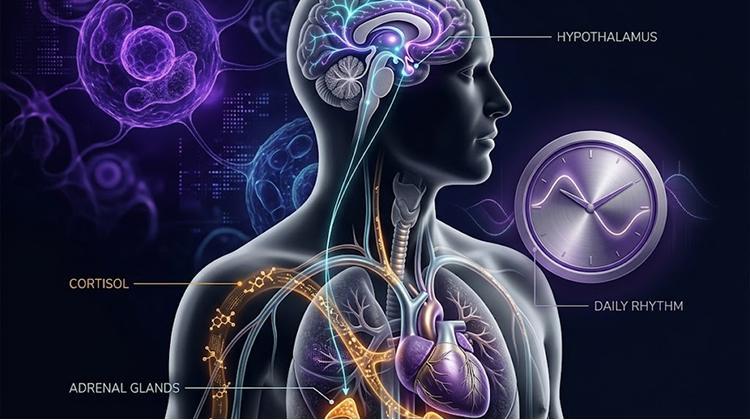
That methodological requirement makes the new analysis more focused than a simple review of studies that happened to measure cortisol.
The National Center for Complementary and Integrative Health also describes chronic stress as a prolonged physical and emotional response that can affect multiple body systems. NCCIH notes that relaxation techniques, including mindfulness and breathing practices, have been investigated as approaches for managing stress and its physiological effects.
For researchers, cortisol provides one possible window into those physiological processes. It does not capture the entire stress response, but it offers an objective biological measure that can be examined alongside psychological outcomes.
The Review Was Led By Researchers At UConn And Brown
The research team included Blair T. Johnson, Taryn J. Simon, Chen Li, Emersyn K. Rokos, Lisset Martinez-Berman, Matthew B. Jané, Sarah S. Tsai, and Eric B. Loucks.
The authors were affiliated with the Department of Psychological Sciences and Department of Allied Health Sciences at the University of Connecticut, along with the Department of Epidemiology at Brown University School of Public Health. The paper was published in Health Psychology, the official journal of the Division of Health Psychology of the American Psychological Association. (pubmed.ncbi.nlm.nih.gov)
The analysis addressed a gap in the existing literature. MBSR has been studied extensively for psychological outcomes such as perceived stress, anxiety, depression, and quality of life, but the researchers noted that its specific relationship with cortisol had not previously been subjected to this type of meta-analysis.
The authors therefore focused on intervention studies that met their predefined eligibility requirements rather than combining every available mindfulness study.
| Study Characteristic | Finding |
|---|---|
| MBSR studies meeting criteria | 39 |
| Participants | 2,059 |
| Within-group analyses | 53 |
| Randomized controlled trials in within-group analysis | 26 |
| Between-group analyses | 34 |
| Publication date | September 3, 2026 |
The distinction between the number of studies and the number of analyses is important. The 39 eligible intervention studies formed the evidence base, while different statistical analyses incorporated subsets of those studies depending on whether they provided the necessary comparison data.
What Mindfulness-Based Stress Reduction Actually Involves
MBSR is more structured than simply sitting quietly for a few minutes.
The program was developed more than four decades ago by Jon Kabat-Zinn at the University of Massachusetts Medical School’s Stress Reduction Clinic. Contemporary descriptions of MBSR generally include formal mindfulness meditation, body awareness, mindful movement, and practices designed to bring greater awareness to everyday experiences.
A typical traditional MBSR course is delivered over approximately eight weeks, although specific program formats can vary. Participants commonly receive instruction during weekly sessions and are asked to practice outside the sessions.
The University of Massachusetts describes MBSR as an eight-week program incorporating meditation, mindful movement, and awareness practices designed to help people respond differently to pain and stress. (umassmed.edu)
This structure matters because the new meta-analysis did not examine a single standardized meditation exercise. The included studies represented MBSR interventions conducted under different research conditions.
That variation helps explain why the researchers found an overall effect while also reporting substantial differences among studies.
The Overall Cortisol Reduction Was Statistically Significant
The main between-group analysis included 34 studies and found that MBSR was significantly more effective than control conditions in reducing cortisol.
The standardized effect was g = −0.38, with a 95% confidence interval from −0.56 to −0.21.
In practical terms, the negative effect indicates that cortisol levels tended to be lower in the MBSR groups relative to the comparison conditions.
The magnitude is more important than the sign. An effect of this size is generally considered modest rather than dramatic. The result suggests a measurable difference across the combined evidence, but it does not indicate that MBSR produces a large cortisol reduction in every individual.
The researchers also found a statistically significant within-group reduction across the eligible studies. Across 53 analyses, the standardized effect was g = −0.26, with a 95% confidence interval from −0.38 to −0.14.

However, the within-group result is less informative by itself than the comparison with control conditions because cortisol can change over time for reasons unrelated to an intervention.
That is why the between-group finding is particularly relevant.
Randomized Trials Produced A Stronger Signal
The researchers conducted additional analyses focused on randomized controlled trials.
Among 26 randomized controlled trials, the within-group reduction in cortisol was g = −0.37, with a 95% confidence interval of −0.53 to −0.20. In contrast, the within-group analysis of uncontrolled studies did not show a statistically significant reduction, with an effect of g = −0.06 and a 95% confidence interval from −0.19 to 0.07.
That contrast strengthens the interpretation because uncontrolled studies cannot easily separate intervention effects from natural changes, expectations, regression to the mean, or other influences.
The randomized studies provide a clearer comparison between people receiving MBSR and people assigned to another condition.
The result does not eliminate every possible source of bias, but it gives greater weight to the possibility that MBSR itself contributed to the observed cortisol differences.
The NCCIH overview of meditation and mindfulness research similarly emphasizes that evidence for mindfulness varies depending on the specific intervention, outcome, comparison group, and study quality. That broader context is useful when interpreting any new meta-analysis.
MBSR Performed Differently Against Active And Inactive Controls
One of the most informative findings came from the comparison between inactive and active control groups.
When MBSR was compared with inactive controls, the pooled effect was g = −0.42, with a 95% confidence interval from −0.63 to −0.20.
When MBSR was compared with active controls, the effect was smaller at g = −0.29, with a 95% confidence interval from −0.54 to −0.04. Both results were statistically significant.
This difference is important because an inactive control may involve little or no comparable behavioral intervention. An active control, by contrast, may require participants to attend sessions, receive attention from instructors, practice another activity, or engage in another structured program.
If MBSR produces a larger difference against an inactive comparison than against an active intervention, that suggests some of the observed effect may be related to factors shared by structured health programs.
The researchers therefore did not treat all control conditions as interchangeable.
That analytical approach makes the findings more informative than a simple statement that “mindfulness lowers cortisol.” The size of the observed difference depends partly on what MBSR is being compared against.
The Results Varied Across Studies
The researchers reported significant unexplained heterogeneity across the evidence base.
Heterogeneity means that the individual studies did not all produce the same size of effect. Some showed larger cortisol reductions, others smaller changes, and the statistical model could not account for all of those differences.
This is one of the most important limitations of the analysis.
A pooled effect can summarize a broad research literature, but it does not mean every study produced the same result. Differences in participant characteristics, MBSR delivery, duration, cortisol sampling methods, control groups, adherence, and study setting can all influence the findings.
The researchers specifically noted that substantial heterogeneity remained unexplained.
That means the most accurate interpretation is that MBSR was associated with a modest overall reduction in cortisol across the pooled evidence, while the magnitude of the effect varied between studies.
The result should not be translated into a guaranteed biological response for an individual person.
Cortisol Is Useful But Does Not Tell The Whole Stress Story
Cortisol is an important physiological measure, but it is not a complete stress score.
People can experience psychological stress without showing the same cortisol pattern, and cortisol levels naturally fluctuate throughout the day. Sleep, physical activity, illness, medication, food intake, timing, and other biological factors can also influence cortisol.
That is why the researchers required studies to control for collection timing.
The NCCIH stress research overview notes that stress involves coordinated changes in heart rate, breathing, blood pressure, muscle tension, sweating, and hormone release. Cortisol is therefore one component of a larger physiological response rather than a standalone measure of someone’s mental state.
This distinction also explains why the new meta-analysis should not be interpreted as evidence that lowering cortisol is automatically equivalent to improving overall health.
The study answers a narrower question: whether MBSR interventions are associated with changes in cortisol under controlled research conditions.
That question matters, but it is different from asking whether MBSR prevents chronic disease or produces broad medical benefits.
The Findings Add Biological Evidence To Existing MBSR Research
MBSR has been studied for decades, with research examining psychological, behavioral, and physical outcomes.
The new meta-analysis adds a different layer because it focuses specifically on a biological stress marker.
NCCIH notes that mindfulness and meditation research has investigated stress, anxiety, depression, sleep, pain, and other outcomes. The agency also notes that evidence quality varies across conditions and that different mindfulness programs cannot always be treated as identical interventions.
That context is important for understanding where the new cortisol analysis fits.
It does not replace research on perceived stress or mental health. Instead, it addresses whether a commonly studied physiological marker changes alongside MBSR participation.
The fact that the pooled cortisol effect was statistically significant in randomized comparisons provides evidence that the biological response deserves further study.
At the same time, the unexplained heterogeneity suggests that researchers still need to identify which types of participants, program formats, practice patterns, and intervention conditions are associated with larger or smaller effects.
What The Meta-Analysis Does Not Prove
Several conclusions would go beyond the evidence.
The analysis does not prove that MBSR will lower cortisol for every person who participates. It also does not establish that a specific number of meditation minutes produces a predictable cortisol change.
It does not show that cortisol reduction is responsible for all psychological benefits associated with mindfulness.
And it does not establish that MBSR is superior to every other approach for managing stress.
The active-control analysis is especially relevant here. The effect was smaller when MBSR was compared with other active interventions than when it was compared with inactive controls. That suggests the broader experience of participating in a structured intervention may matter alongside the specific mindfulness components.
There is also no basis for treating cortisol as something that should simply be driven as low as possible. Cortisol has essential biological functions, including roles in metabolism, immune regulation, blood pressure, and the body’s response to challenges.
The relevant research question is therefore about regulation and physiological response, not about eliminating cortisol.
Why The Findings Matter For Stress-Management Research
The new analysis provides a useful bridge between subjective and biological measures of stress.
Many mindfulness studies ask participants whether they feel calmer, less anxious, or less stressed. Those outcomes remain important because people’s lived experience is central to evaluating a stress-management intervention.
But biological measurements can provide another perspective.
By analyzing cortisol across 39 studies and more than 2,000 participants, the UConn and Brown researchers found evidence that MBSR’s effects may extend beyond how participants describe their own stress. The biological signal was statistically significant, particularly in comparisons with control conditions.
The next research challenge is determining why the effect differs from one study to another.
Future trials could benefit from more consistent cortisol collection protocols, clearer descriptions of MBSR adherence, longer follow-up periods, better characterization of participants, and direct comparisons with other established stress-management interventions.
Researchers may also be able to examine whether changes in cortisol correspond with changes in sleep, anxiety, perceived stress, cardiovascular measures, or other outcomes within the same participants.
That would help move the field beyond the question of whether MBSR changes cortisol toward a more detailed question: when does that biological change occur, for whom, and how does it relate to meaningful changes in daily life?
A More Precise View Of Mindfulness And Stress Biology
The September 2026 meta-analysis provides a relatively clear signal within a complicated research area.
Across 39 MBSR intervention studies involving 2,059 participants, the pooled evidence showed statistically significant reductions in cortisol. The between-group effect was g = −0.38, with larger effects against inactive controls and smaller effects against active controls. Randomized controlled trials also showed significant cortisol reductions, while uncontrolled studies did not show a statistically significant effect.
At the same time, significant unexplained variation remained between studies.
For mindfulness research, that combination is useful. It suggests that MBSR can be associated with measurable changes in stress-related biology, while making clear that the response is not uniform and that cortisol represents only one part of a much larger physiological system.
The findings give researchers another reason to investigate how structured mindfulness practice interacts with the body’s stress-regulation systems. They also reinforce the value of evaluating meditation through multiple measures rather than relying on a single definition of whether a practice “works.”
For people interested in stress management techniques, the research offers a more measured takeaway: MBSR has now been linked to a modest pooled reduction in cortisol across a substantial evidence base, but the biological response varies and should be understood alongside psychological and behavioral outcomes rather than treated as a standalone measure of health.