
Older adults often report better emotional well-being than younger adults, even though aging can bring health challenges, losses, caregiving responsibilities and other stressful life events. This apparent contradiction has become known among researchers as the well-being paradox.
A new U.S. study published September 5, 2026, in Scientific Reports suggests that mindfulness may be one piece of that puzzle. Researchers from Fairfield University and the University of Connecticut examined whether dispositional mindfulness and personality traits could help explain why emotional well-being differs across adulthood.
The study included 129 adults divided into young, middle-aged and older groups. The researchers found that older age was associated with greater positive emotional well-being and lower negative emotional well-being. Lower neuroticism partly explained those age-related differences, while greater dispositional mindfulness statistically mediated the relationship between age and negative, but not positive, emotional well-being.
The findings do not show that meditation causes people to become happier as they age. The study was based on survey data and examined naturally occurring differences in mindfulness and personality. But it does provide new evidence about how the ability to remain attentive and present may relate to emotional experiences across the adult lifespan.
Why Older Adults Can Report Better Emotional Well-Being
The starting point for the research is a pattern that has appeared repeatedly in aging research: emotional well-being does not necessarily decline as people get older.
That might seem surprising because older adulthood can involve experiences that would reasonably be expected to increase emotional strain. People may encounter chronic health conditions, changes in employment, the death of loved ones, reduced mobility or increased caregiving responsibilities.
Yet older adults frequently report relatively favorable emotional outcomes compared with younger adults. The new study describes this as the well-being paradox, a phenomenon that has prompted researchers to look beyond the number of stressful events people experience and examine how they respond to those experiences.
One explanation comes from socioemotional selectivity theory, which proposes that people’s goals and priorities can shift as they perceive their remaining time differently. Present-focused goals and emotionally meaningful experiences may become more important with age.
Mindfulness offers another possible explanation because it emphasizes present-moment awareness and a less judgmental relationship with thoughts and feelings.
The researchers behind the new study wanted to determine whether mindfulness could statistically account for some of the age-related differences in emotional well-being while also considering personality.
That distinction is important. If mindfulness and personality are both related to emotional health, looking at either factor alone could make its contribution appear larger than it actually is.
How The U.S. Study Examined Mindfulness And Age
The research team included Merrisa Lin of Fairfield University’s Department of Psychological and Brain Sciences, Nairán Ramírez-Esparza of the University of Connecticut’s Department of Psychological Sciences, and Natalie J. Shook of the University of Connecticut’s Elisabeth DeLuca School of Nursing.
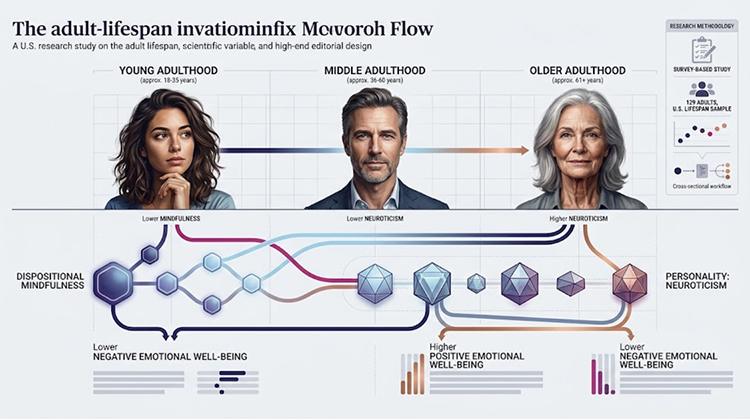
The researchers analyzed survey data from 129 adults:
| Age Group | Participants |
|---|---|
| Young adults | 40 |
| Middle-aged adults | 42 |
| Older adults | 47 |
| Total | 129 |
The sample had a mean age of 51.3 years. According to reporting on the study, approximately 67% of participants were women, 81% were White, and 95% had post-secondary education, characteristics that are important when considering how broadly the findings can be generalized.
The study focused on dispositional mindfulness, meaning a person’s tendency to be attentive and aware of present experiences in everyday life. This differs from testing whether participants completed a particular meditation program.
In other words, the researchers were not asking participants to meditate for eight weeks and then comparing their results with a control group. Instead, they were examining whether people who naturally reported different levels of mindfulness also showed different emotional well-being patterns across age.
That makes the research particularly relevant to mindfulness practice, but it should not be interpreted as a clinical trial demonstrating that starting meditation will produce the same age-related differences. The National Center for Complementary and Integrative Health notes that meditation and mindfulness research covers a wide range of practices and health outcomes, with results varying depending on the intervention and population studied.
What Emotional Well-Being Meant In The Study
The researchers did not treat emotional well-being as a single feeling.
Instead, they examined both positive and negative dimensions of emotional functioning.
Positive emotional well-being included:
- Subjective happiness
- Positive affect
- Satisfaction with life
Negative emotional well-being included:
- Negative affect
- Anxiety symptoms
- Depressive symptoms
This distinction became central to the findings.
Older age was associated with better outcomes on both sides of the equation: more positive emotional well-being and less negative emotional well-being. But mindfulness did not appear to explain both patterns equally.
The researchers found that greater dispositional mindfulness mediated the inverse association between age and negative emotional well-being. It did not significantly mediate the relationship between age and positive emotional well-being.
That is a much narrower finding than saying mindfulness makes older people happier.
Instead, the evidence points more specifically toward a possible relationship between mindfulness and lower levels of negative emotional experiences associated with aging.
Neuroticism Played An Even Broader Role
Mindfulness was not the only psychological factor examined.
The researchers also analyzed the Big Five personality traits, including neuroticism, extraversion, agreeableness, conscientiousness and openness.
Neuroticism became particularly important.
Higher neuroticism was associated with worse negative emotional well-being and lower positive emotional well-being. Older age was associated with lower neuroticism, and lower neuroticism partly explained the relationship between age and emotional well-being.
This means the study points to two different psychological pathways.
One involves personality, particularly lower neuroticism with increasing age. The other involves greater dispositional mindfulness and its statistical relationship with lower negative emotional well-being.
The findings therefore suggest that the emotional advantages sometimes observed among older adults cannot be reduced to mindfulness alone.
Personality appears to matter substantially.
Mindfulness And Personality May Overlap Without Being The Same Thing
This distinction is important because mindfulness and personality can appear closely related.
A person who tends to notice experiences without immediately reacting to them may also report lower emotional reactivity. Someone who frequently worries or anticipates negative outcomes may find present-moment attention more difficult.
The researchers specifically examined mindfulness alongside personality to determine whether mindfulness could account for unique differences beyond the Big Five traits. Their analysis suggests that it can contribute a distinct statistical pathway, particularly for negative emotional well-being.
That makes the study more informative than a simple correlation between mindfulness and happiness.
The research asks a more specific question: does mindfulness help explain why emotional well-being differs by age after personality is considered?
The answer from this sample is partly yes—but primarily for negative emotional well-being.
Mindfulness Was More Closely Connected To Negative Emotional Well-Being
The distinction between positive and negative emotional well-being is one of the most important details in the study.
When researchers say mindfulness mediated the relationship between age and negative emotional well-being, they are describing a statistical pathway. Older age was associated with greater dispositional mindfulness, and greater mindfulness was associated with lower negative emotional well-being.

This does not prove that aging increases mindfulness, or that mindfulness directly causes lower anxiety or depressive symptoms.
The study was observational and based on survey measurements collected from adults at different stages of life. Because of that design, several explanations remain possible.
People who naturally experience less negative emotion may find it easier to remain attentive and accepting. People with greater mindfulness may respond differently to difficult experiences. Age-related changes in personality, social priorities, health, relationships or coping strategies may influence both.
The statistical analysis can identify patterns consistent with mindfulness playing a role, but it cannot establish a direct cause-and-effect pathway.
What The Findings Could Mean For Everyday Mindfulness
The study does not establish a specific meditation routine that people should follow.
There was no assigned breathing schedule, no eight-week mindfulness course and no required daily meditation period.
Instead, the findings suggest that the qualities associated with mindfulness may become increasingly relevant when researchers examine emotional well-being across adulthood.
For someone practicing mindfulness, those qualities can include paying attention to what is happening now, recognizing thoughts as mental events rather than automatically treating them as facts, and responding to uncomfortable experiences without immediately escalating them.
These skills are especially relevant to the management of everyday emotional reactions.
Consider a stressful interaction at work. A person may immediately interpret a colleague’s comment as criticism, replay the conversation repeatedly and anticipate another conflict. A more mindful response might involve noticing the emotional reaction, identifying the thought attached to it and allowing some distance before deciding how to respond.
That example is consistent with the psychological concept being studied, but it should not be confused with evidence from this particular research that mindfulness training would produce such a response.
The study measured dispositional mindfulness rather than assigning participants a mindfulness intervention.
The Results Fit With Earlier Research On Aging And Mindfulness
The September 2026 study builds on earlier research examining whether mindfulness is related to emotional well-being later in life.
For example, previous work has found that present-moment attention and nonjudgmental acceptance can be associated with better affective well-being among middle-aged and older adults. One experience-sampling study followed 157 adults aged 53 to 86, collecting smartphone assessments four times a day for 10 days. Researchers found that present-moment attention and nonjudgmental acceptance were associated with greater affective well-being, while acceptance appeared to buffer emotional reactions to daily hassles.
Other research has also examined mindfulness alongside neuroticism in older adults. A secondary analysis of a randomized controlled trial involving community-dwelling older adults found that mindfulness was associated with fewer depressive symptoms and less negative affect, particularly among people with average or higher neuroticism. However, the analysis did not find that mindfulness-based stress reduction produced different outcomes according to neuroticism levels.
These earlier findings provide useful context, but they also show why the new study should be viewed as part of an evolving research area rather than a final explanation of emotional aging.
Why The Study Cannot Prove That Mindfulness Causes Better Aging
The strongest limitation is the study design.
The researchers used survey data from 129 adults rather than following the same people over many years. This means the study can identify relationships among age, mindfulness, personality and emotional well-being, but it cannot determine which factor came first.
A longitudinal study following participants from young adulthood into later life could provide stronger evidence about whether increases in mindfulness precede improvements in emotional well-being.
An intervention study could go further by randomly assigning people to mindfulness training or an appropriate comparison condition and tracking whether emotional outcomes change.
The current research does neither.
The sample also has demographic limitations. With 81% of participants identifying as White and 95% having post-secondary education, the results may not represent the experiences of the broader U.S. population. The relatively small overall sample of 129 people also limits the precision with which the findings can be generalized.
The researchers themselves describe the work as examining statistical contributions to the well-being paradox rather than establishing a causal mechanism. The study was funded by a $100,000 National Institute on Aging award from the National Institutes of Health, with NIH providing 100% of the direct costs.
What The Study Adds To Mindfulness Research
The most useful contribution of the new research is its broader view of mindfulness.
Much mindfulness research focuses on whether an intervention reduces stress, anxiety or depressive symptoms after several weeks of practice. This study asks a different question: why might mindfulness be connected with emotional differences that appear across the adult lifespan?
That shift matters.
If older adults tend to report better emotional well-being despite experiencing potentially difficult life events, researchers need to examine the psychological processes that may help explain that pattern.
Mindfulness appears to be one candidate.
Personality, particularly neuroticism, appears to be another.
The new findings suggest that these factors may work through different pathways rather than representing a single explanation for why emotional well-being can improve with age.
Mindfulness May Be One Piece Of A Larger Aging Process
The September 5, 2026, study from Fairfield University and the University of Connecticut does not show that mindfulness makes people age better, nor does it establish that meditation can reproduce the emotional profile observed among older adults.
What it does show is more specific.
In a U.S. sample of 129 adults, older age was associated with greater positive emotional well-being and lower negative emotional well-being. Lower neuroticism partly explained the age-related differences, while greater dispositional mindfulness statistically mediated the relationship between age and lower negative emotional well-being. The mindfulness pathway did not explain the age difference in positive emotional well-being.
That distinction gives the findings their value.
Mindfulness may be relevant to how people experience and respond to negative emotional states as they move through adulthood, but it is unlikely to be the only factor shaping emotional well-being. Personality, social priorities, life circumstances, health, relationships and coping strategies all remain part of the picture.
For mindfulness research, the next step is therefore not simply to ask whether older people are more mindful. It is to determine how mindfulness develops, whether it can be deliberately strengthened across adulthood, and whether changing it produces measurable improvements in emotional well-being.
Those questions require longitudinal and intervention research. The new study provides evidence for why those studies are worth pursuing.