
A brief mindfulness routine may influence more than how calm a person feels. New research from San José State University suggests that just two short mindfulness sessions can alter several components of the body’s autonomic nervous system, including measures related to heart regulation, skin conductance and blood pressure.
The study, published in Physiology & Behavior on August 1, 2026, examined 91 young adults randomly assigned to either a brief mindfulness-based intervention or an attention-control condition involving audiobook listening. The mindfulness group completed two sessions combining breathing meditation, meditation focused on working with difficulties and a short body scan, totaling 15 minutes per session.
The researchers, Li Shen Chong of San José State University, Rachel C. Bucher, Edward Merritt and Elana B. Gordis, measured three related but distinct aspects of autonomic functioning: respiratory sinus arrhythmia (RSA), skin conductance level (SCL) and blood pressure. They also exposed participants to a standardized psychosocial stress test to see whether any differences extended beyond the meditation period itself.
The results are interesting because the researchers did not rely on a single measurement. Instead, they examined how several physiological systems worked together.
That approach could help explain why previous studies of brief mindfulness have sometimes produced mixed findings.
What The San José State Study Actually Tested
The research was designed around a question that has become increasingly important in mindfulness science: Can a very short intervention produce measurable changes in the body’s stress-regulation systems?
Traditional mindfulness programs can last several weeks or longer. That creates a practical problem for universities, workplaces and other organizations looking for inexpensive interventions that can be delivered without major time commitments.
Brief mindfulness-based interventions, often called bMBIs, are intended to address that problem.
The San José State researchers specifically wanted to determine whether two sessions could influence the autonomic nervous system (ANS) and, more importantly, whether different parts of that system responded in a coordinated way.
| Study Feature | Details |
|---|---|
| Participants | 91 young adults |
| Mindfulness group | 44 participants |
| Control group | 47 participants |
| Mindfulness sessions | 2 |
| Duration | 15 minutes per session |
| Control activity | Audiobook listening |
| Main physiological measures | RSA, SCL and blood pressure |
| Stress challenge | Trier Social Stress Test |
The researchers reported that the mindfulness group had greater RSA augmentation, lower skin conductance and greater declines in blood pressure during or following the mindfulness condition compared with controls.
The findings therefore do not simply suggest that participants “felt relaxed.”
They indicate measurable changes in several physiological systems.
For readers interested in mindfulness techniques, the study is especially relevant because the intervention was short enough to resemble the kind of practice that could realistically fit into a busy daily routine.
The 15-Minute Routine Combined Three Practices
The intervention was not simply 15 minutes of sitting quietly.
Participants in the mindfulness group listened to three guided components taken from the UCLA Mindful Awareness Research Center.
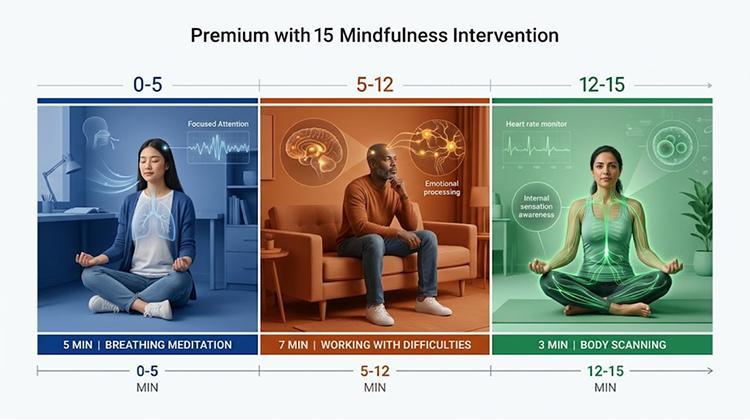
The first was a five-minute breathing meditation. The second was a seven-minute meditation focused on working with difficulties. The final component was a three-minute body scan. Together, they lasted exactly 15 minutes.
This structure is important because it exposed participants to several core elements of mindfulness within a relatively small amount of time.
Breath awareness directed attention toward respiration.
The meditation focused on difficulties asked participants to work with challenging internal experiences.
The body scan shifted attention toward physical sensations.
The researchers were therefore testing a compact package rather than one isolated mindfulness exercise.
That distinction also limits what can be concluded. If the study found a physiological effect, researchers cannot determine whether it came primarily from breathing, body awareness, acceptance of difficult experiences or the combination.
Still, the short duration is noteworthy.
The authors point out that brief mindfulness interventions commonly range from approximately 5 to 20 minutes per day, while some programs use longer weekly sessions.
The San José State experiment therefore fits within a growing effort to determine how little practice might be needed to produce measurable effects.
What Respiratory Sinus Arrhythmia Reveals
One of the study’s most important measurements was respiratory sinus arrhythmia, or RSA.
RSA refers to changes in heart rate associated with breathing and is commonly used as an indicator of parasympathetic nervous system activity, particularly vagal influence on the heart.
The autonomic nervous system has two major branches that are often described in relation to stress and recovery: the sympathetic and parasympathetic systems.
The sympathetic system is involved in mobilizing the body during demanding situations, while the parasympathetic system contributes to regulation and recovery.
RSA gives researchers one window into how the parasympathetic system is functioning.
The San José State study found greater RSA augmentation during the brief mindfulness intervention compared with the audiobook control condition.
That does not mean that a higher RSA measurement is automatically healthier in every situation.
The autonomic nervous system needs to adapt to changing circumstances.
In fact, the researchers were interested not simply in whether one system became more active, but in how multiple systems coordinated with one another.
That is a more sophisticated question than asking whether mindfulness “activates the parasympathetic nervous system.”
Skin Conductance Provided A Different Signal
The study also measured skin conductance level, or SCL.
Skin conductance reflects changes in the electrical properties of the skin associated largely with sweat gland activity. Because sweat gland activity is influenced by sympathetic nervous system activity, SCL can provide researchers with another physiological measure of arousal.
The mindfulness group showed lower SCL during the mindfulness condition than the attention-control group.
The significance of this finding becomes clearer when considered alongside RSA.
The mindfulness group showed increased RSA while simultaneously showing reduced SCL.
In simple terms, the two physiological measures moved in different directions.
That pattern is one reason the researchers describe the response as reciprocal coordination between autonomic subsystems.
The control group did not show the same pattern.
This matters because stress is not controlled by a single biological switch.
The body continuously coordinates cardiovascular, respiratory and electrodermal responses.
The research therefore provides a more detailed picture of what might happen during a brief mindfulness exercise.
Blood Pressure Fell After The Mindfulness Sessions
The most immediately recognizable measurement in the study was blood pressure.
Researchers measured both systolic blood pressure (SBP) and diastolic blood pressure (DBP) at several points during the experiment.
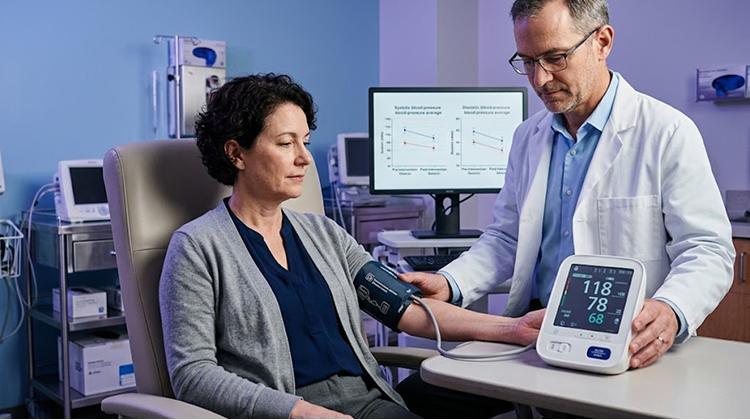
Systolic pressure represents pressure in the arteries when the heart contracts, while diastolic pressure represents pressure between heartbeats.
The mindfulness group showed greater declines in blood pressure after the mindfulness condition compared with the control group.
The results became particularly interesting after participants completed the psychosocial stress test.
Immediately following the stress challenge, participants in the mindfulness group had lower diastolic blood pressure than participants in the control group.
The researchers reported a statistically significant difference, with F(1,91) = 5.56, p < .05, Cohen’s d = 0.50, indicating a medium-sized group difference.
However, the study should not be interpreted as evidence that two meditation sessions can treat hypertension.
The researchers measured short-term changes in blood pressure under controlled laboratory conditions.
They did not test people with hypertension over months or years.
That distinction is essential.
The Stress Test Was Designed To Make Participants Uncomfortable
To determine whether the effects extended beyond meditation itself, researchers used the Trier Social Stress Test, commonly abbreviated as TSST.
The test is designed to create a controlled social-evaluative stress experience.
Participants prepared and delivered a speech about why they were the best candidate for an ideal job. They then completed a demanding verbal arithmetic task while research assistants observed them without providing normal social feedback.
The arithmetic task required participants to count backward from 2023 in increments of 17.
If someone stopped before the allotted time, the researchers instructed them to continue.
This type of standardized stressor allows researchers to compare physiological reactions across participants under similar circumstances.
It also creates a useful test of whether an intervention has effects that persist when a person encounters an entirely different challenge.
The San José State researchers found that the mindfulness group had lower post-stressor diastolic blood pressure.
However, RSA and SCL responses to the stress test themselves did not differ significantly between groups.
That qualification is important.
The intervention did not uniformly change every physiological measure during the stressful task.
The Most Interesting Finding Was Coordination Between Systems
The central contribution of the research may be the way it combines multiple physiological measures.
Earlier mindfulness studies have often examined one biological marker at a time.
One study might measure heart-rate variability.
Another might examine blood pressure.
Another could measure skin conductance.
The problem is that these systems interact.
A person can show a change in one physiological measurement without necessarily showing the same change in another.
The San José State researchers therefore examined coordination between RSA and SCL.
During the psychosocial stress test, the mindfulness group showed an inverse relationship between RSA and SCL, described by the researchers as reciprocal coordination.
The control group showed a positive association between the two systems instead.
This suggests that brief mindfulness may influence not only individual physiological signals but also the way those systems work together during stress.
That possibility could help explain why previous mindfulness studies have produced inconsistent results.
Two people can have similar changes in one biomarker while displaying very different patterns when multiple systems are considered simultaneously.
Why Two Sessions Are Scientifically Interesting
The intervention lasted only two sessions.
That is a surprisingly small amount of training compared with many established mindfulness programs.
The researchers deliberately used two sessions because they wanted to examine early physiological adaptations, rather than changes that emerge after weeks or months of practice.
This makes the study useful for a different question.
Instead of asking whether meditation can transform the body after extensive training, the researchers asked whether the body’s stress-regulation systems can respond almost immediately.
The answer appears to be yes for some measures.
But “immediately” does not mean “permanently.”
The study does not establish how long the observed physiological changes lasted.
The measurements were made during the laboratory visits and immediately after the stress challenge.
There is no evidence from this experiment that two sessions would produce lasting blood-pressure changes days, weeks or months later.
The Participants Were Young Adults
The study included 44 participants in the mindfulness group and 47 in the control group.
The average age was approximately 18.6 years in the mindfulness group and 19.0 years in the control group.
That demographic detail matters.
Young adults may respond differently to mindfulness interventions than older adults or people with chronic cardiovascular conditions.
The study therefore should not be generalized to everyone.
It provides evidence about an early-stage physiological response in a relatively young population.
Future studies could test whether similar effects occur in older adults, people experiencing chronic stress or people with elevated blood pressure.
That would help determine whether the findings have practical clinical relevance.
What The Study Does Not Prove
The headline “mindfulness lowers blood pressure” is tempting, but it goes further than the evidence allows.
The study found short-term reductions in blood pressure following the mindfulness condition and lower post-stressor diastolic blood pressure, not a sustained reduction in hypertension.
There are several other limitations.
First, the sample was relatively small.
Second, the intervention contained three mindfulness components, so researchers cannot identify which exercise produced the physiological response.
Third, participants completed only two sessions.
Fourth, some stress-response measures did not differ significantly between groups.
Finally, the experiment was conducted in a controlled laboratory environment.
These factors make the findings promising rather than definitive.
For people with high blood pressure or cardiovascular disease, mindfulness should not be treated as a replacement for medical evaluation or prescribed treatment.
Organizations such as the American Heart Association continue to emphasize established approaches to blood-pressure management, including appropriate medical care and lifestyle changes.
Why The Results Still Matter
The importance of this research lies partly in its practicality.
A 15-minute intervention is much easier to implement than a lengthy mindfulness course.
Universities could potentially incorporate short guided practices into student wellness programs.
Employers could experiment with short sessions during workdays.
Researchers could use similarly brief interventions to investigate the biological mechanisms of mindfulness without requiring participants to complete months of training.
The study’s results also suggest that researchers should stop thinking about stress as a single physiological measurement.
The human stress response is a network.
Heart regulation, skin conductance and cardiovascular pressure provide different windows into what the autonomic nervous system is doing.
A person can experience stress while these systems change at different rates and in different directions.
Understanding those relationships may ultimately be more informative than focusing on any single number.
The San José State University research record identifies the study as a faculty publication from the university’s Psychology Department, providing an additional institutional source for the research and its authors.
Could A 15-Minute Practice Become A Useful Stress Tool?
The findings raise a practical possibility without establishing a medical prescription.
If two 15-minute mindfulness sessions can produce measurable changes in autonomic activity, short mindfulness exercises may deserve more attention as tools for acute stress regulation.
That does not mean people need to meditate for exactly 15 minutes.
The study was designed around a specific combination of exercises, and different durations or techniques may produce different effects.
The larger lesson is that mindfulness does not necessarily require a long training period before researchers can detect physiological changes.
The body appears capable of responding quickly to changes in attention, breathing and awareness.
The more difficult question is whether those short-term responses can accumulate into meaningful long-term changes.
That remains unanswered.
What Researchers Should Test Next
The next generation of studies could extend this research in several directions.
Researchers could recruit larger samples, include people from a wider range of ages and health backgrounds, and test whether repeated short sessions produce cumulative effects.
They could also compare different types of mindfulness.
A breathing-only intervention could be compared with a body scan, compassion meditation or an attention-focused exercise.
That would help determine whether the physiological response comes from mindfulness broadly or from specific practices.
Longer follow-up would be equally important.
If participants practiced for several weeks, researchers could measure whether changes in blood pressure and autonomic coordination persist outside the laboratory.
They could also investigate whether physiological changes correspond with improvements in perceived stress, sleep, anxiety or daily functioning.
That would connect the laboratory measurements to outcomes that people actually experience.
A Short Practice With A Bigger Research Question
The San José State study does not establish that mindfulness is a treatment for high blood pressure.
What it does provide is more specific and scientifically useful evidence.
After only two 15-minute mindfulness sessions, young adults in the intervention group showed greater RSA augmentation, lower skin conductance and greater reductions in blood pressure compared with an audiobook control condition. Following a standardized psychosocial stress test, the mindfulness group also had lower diastolic blood pressure and showed a different pattern of coordination between autonomic systems.
The results suggest that brief mindfulness may influence the body’s stress response at several levels simultaneously.
They also reinforce why multisystem research matters.
Stress is not experienced by the brain alone, nor is it reflected by a single number on a blood-pressure monitor.
The cardiovascular system, autonomic nervous system and physiological arousal mechanisms constantly interact.
A short mindfulness practice may affect some of those interactions within minutes.
Whether that response can become stronger, longer-lasting or clinically meaningful with regular practice is the question researchers now need to answer.
For people looking for a practical takeaway, the study offers a measured one: short mindfulness sessions are scientifically worth investigating as tools for regulating acute stress, but the evidence is not yet strong enough to treat them as a substitute for medical care or as a proven long-term blood-pressure intervention.
That distinction keeps the finding in perspective while highlighting what makes the research compelling: the possibility that a 15-minute practice can produce measurable changes across multiple systems involved in how the body responds to stress.