
The University of Southern California is launching a clinical research project that will examine whether mindfulness training can help extend the effects of psilocybin-assisted therapy for depression. Supported by up to $4 million from the Advanced Research Projects Agency for Health (ARPA-H), the project brings together researchers from USC’s Keck School of Medicine and Brain and Creativity Institute to investigate how psychedelic treatment and sustained mindfulness practice may work together.
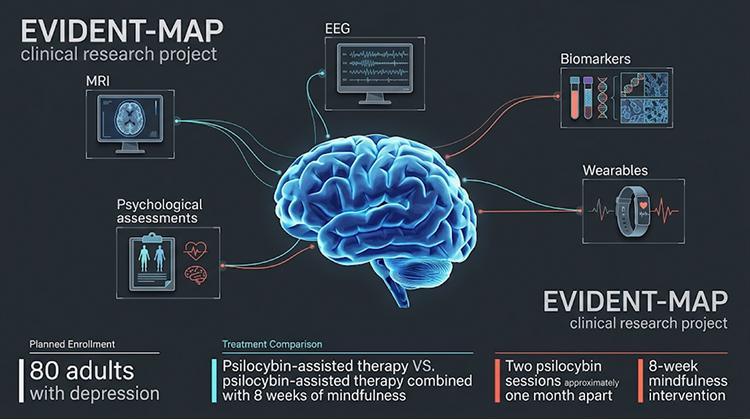
The planned study will enroll 80 adults with depression and compare psilocybin-assisted therapy alone with psilocybin treatment followed by eight weeks of mindfulness training. Researchers will use brain imaging, biological samples, psychological assessments, and wearable-device information to examine changes over time.
The project is particularly relevant to meditation research because it asks a question that goes beyond whether a psychedelic experience can produce short-term changes in mood: can structured mindfulness practice help people maintain psychological improvements after treatment?
This is an ongoing research project, not a completed clinical trial. Its findings have not yet established that combining psilocybin and mindfulness is more effective than psilocybin therapy alone.
The project, called EVIDENT-MAP, is more than a comparison of two depression treatments. It will also investigate whether changes in brain activity, biological signals, and psychological responses can help explain why some people maintain improvements after treatment.
Inside The EVIDENT-MAP Research Project
The initiative is led by researchers at the University of Southern California (USC), with funding from the Advanced Research Projects Agency for Health (ARPA-H).
According to ARPA-H’s award information, the project received funding of up to $4 million, with an award start date of May 14, 2026. The October announcement from USC introduced the clinical trial’s focus on depression and the combination of psychedelic-assisted therapy with mindfulness training. Keck School of Medicine of USC+1
The project expands on an earlier USC investigation involving healthy adults. The new phase will focus on people experiencing depression, allowing researchers to examine whether the combined approach has potential applications in a clinical population.
The project has three principal investigators:
- Rael Cahn, MD, PhD: Clinical associate professor of psychiatry and the behavioral sciences at USC’s Keck School of Medicine and director of the USC Center for Mindfulness Science.
- Assal Habibi, PhD: Associate professor of psychology at the USC Brain and Creativity Institute, with research interests in music, brain function, and emotional processes.
- Shrikanth (Shri) Narayanan, PhD: USC University Professor and Niki and Max Nikias Chair in Engineering, contributing expertise in engineering, computing, and behavioral signal analysis.
Their combined expertise allows the research to examine psychological outcomes alongside measurable changes in brain activity and biological processes. Keck School of Medicine of USC+1
How The 80-Participant Clinical Trial Will Work
The research team plans to recruit 80 adults living in Los Angeles who have depression. Participants will not have previous experience with psychedelic substances or meditation practice.
The researchers will divide participants into two groups. Both will receive supervised psilocybin-assisted therapy, but only one group will also complete the structured mindfulness program.
| Research group | Treatment approach |
|---|---|
| Comparison group | Psilocybin-assisted therapy |
| Combined intervention group | Psilocybin-assisted therapy plus eight weeks of mindfulness training |
This design will help researchers investigate whether adding structured mindfulness practice produces different outcomes from psychedelic-assisted therapy alone.
Each participant will complete two psilocybin sessions approximately one month apart. The treatment process also includes several psychotherapy appointments intended to prepare participants and help them process their experiences.
Before the first psychedelic session, participants will attend six hours of preparatory psychotherapy. Three integration sessions will take place between the two psilocybin sessions, followed by another three after treatment is complete.
These appointments are an important part of the research protocol. The investigators are examining the therapeutic process as a structured program rather than treating psilocybin exposure as an isolated event. Keck School of Medicine of USC
Why Researchers Are Combining Psilocybin With Mindfulness
Psilocybin is a naturally occurring psychedelic compound found in certain mushroom species. It can temporarily alter perception, emotional experiences, and patterns of thinking.
Researchers studying psychedelic-assisted therapy are interested in whether these temporary changes can help people reconsider persistent thought patterns associated with depression.
However, an important question remains: what happens after the psychedelic experience ends?
Rael Cahn and his colleagues hypothesize that mindfulness training could help participants work with insights gained during treatment and maintain a more flexible approach to thoughts, emotions, and personal experiences.
Assal Habibi has described the challenge as helping people maintain the new perspectives that may emerge during psychedelic treatment. Mindfulness could provide tools for continued self-exploration after the supervised sessions.
The approach also builds on previous research involving experienced meditators, in which investigators examined relationships between meditation experience and responses to psychedelic substances.
EVIDENT-MAP will investigate this concept in adults with depression rather than assuming that results from experienced meditators automatically apply to people receiving mental health treatment. Keck School of Medicine of USC+1
What The Eight-Week Mindfulness Program Includes
Participants assigned to the combined intervention will complete an eight-week program focused on mindful awareness, loving-kindness, and compassion.
The program incorporates structured meditation instruction alongside daily home practice. Its purpose is to help participants develop skills that can be used outside the clinical treatment environment.
The timing of the intervention is also significant. The first psilocybin session will take place between the second and third weeks of mindfulness training.
This arrangement gives participants an opportunity to begin practicing mindfulness before their first psychedelic session. They will then continue developing those skills while completing the remaining treatment and integration appointments.
Three areas receive particular attention:
Mindful awareness: Participants practice paying attention to present-moment experiences, including thoughts, emotions, and physical sensations. The goal is to develop awareness without automatically reacting to every experience.
Loving-kindness: These practices encourage attitudes of kindness and goodwill toward oneself and others. Researchers will examine whether this aspect of meditation contributes to psychological changes during treatment.
Compassion: Participants will work with practices intended to encourage a more accepting and compassionate relationship with difficult experiences.
The intervention is more structured than simply recommending that participants meditate occasionally. Its eight-week duration allows researchers to examine whether repeated practice contributes to changes beyond the supervised psychedelic sessions.
For readers interested in the foundations of these practices, Spiritual Endeavors also covers meditation techniques that support attention, awareness, and emotional well-being. Keck School of Medicine of USC
Brain Scans, Blood Samples, And Wearable Technology Will Track Changes
One of the most distinctive elements of EVIDENT-MAP is the amount of information researchers plan to collect.
Rather than evaluating the intervention exclusively through depression questionnaires, the USC team will combine psychological assessments with brain imaging, biological sampling, and wearable-device measurements.
The research includes:
- MRI and EEG recordings: Brain imaging and electrical activity measurements will help researchers examine changes in brain function.
- Blood and saliva samples: These will provide biological information that may help identify changes associated with treatment.
- Stool samples: Researchers will investigate biological signals that could contribute to a broader picture of participants’ responses.
- Psychological and cognitive assessments: These will help measure changes in symptoms, thinking patterns, and psychological well-being.
- Wearable-device information: Additional measurements will help researchers follow participants outside scheduled clinical appointments.
This multimodal approach is central to ARPA-H’s EVIDENT initiative, which aims to improve behavioral health research through detailed clinical information and real-time measurements.
The information collected through participating projects will be de-identified and contributed to a secure national research repository. This could help researchers identify patterns associated with treatment responses and improve future approaches to mental health care. ARPA-H+1
Music Will Also Play A Role In The Therapeutic Environment
Another interesting component involves the music selected for the psilocybin sessions.
Previous psychedelic research has suggested that the therapeutic environment, including music, can influence participants’ experiences. USC researchers are incorporating this consideration into the treatment protocol.
Habibi worked with clinicians and music therapists to develop a playlist intended to accompany different stages of the psychedelic experience.
The selections are instrumental or lyric-free and draw from multiple musical traditions. Their timing is structured around the progression of psilocybin’s effects, including a particularly emotional composition during the period of peak intensity.
The researchers also plan to use the same music during subsequent MRI sessions.
This will allow them to investigate whether listening to the playlist after treatment produces measurable brain activity associated with the therapeutic experience.
The longer-term research question is particularly interesting: could music eventually have some therapeutic value on its own, even without psychedelic treatment?
The team has not established that possibility. Instead, the music component provides another way to investigate the relationship between emotional experience, brain activity, and psychological change. Keck School of Medicine of USC
What This Study Could Mean For Depression Treatment
Depression can involve persistent changes in mood, motivation, concentration, and the way people interpret their experiences. Treatments do not produce identical outcomes for everyone, which is one reason researchers continue exploring different therapeutic approaches.
The USC study addresses a specific limitation in psychedelic-assisted therapy research: understanding how to support psychological changes beyond the treatment sessions.
If mindfulness training contributes to longer-lasting improvements, it could help researchers develop treatment protocols that combine supervised clinical interventions with ongoing skills practice.
However, several questions remain unanswered.
Will participants who practice mindfulness experience greater reductions in depressive symptoms? Will improvements last longer than those associated with psilocybin therapy alone? Can brain measurements help identify people who are more likely to benefit from the combined intervention?
EVIDENT-MAP is structured to investigate these questions, but the answers will depend on the results collected during the trial.
The earlier USC research involving healthy adults offers background for the project, but those preliminary observations cannot establish effectiveness in people with depression. The new trial is intended to investigate that distinction directly. Keck School of Medicine of USC+1
Important Questions About Safety And Research Limitations
Psilocybin-assisted therapy is an experimental clinical approach, and the USC announcement should not be interpreted as a recommendation for unsupervised psychedelic use.

The compound can produce substantial changes in perception and emotional experience. Its effects may vary between individuals, and clinical research requires screening, supervision, preparation, and appropriate follow-up.
The USC protocol incorporates preparatory psychotherapy, supervised treatment sessions, and integration appointments. These safeguards are part of the research setting and cannot be replicated simply by taking a psychedelic substance independently.
The planned sample of 80 participants is also relatively small. Although the trial can provide valuable information, its findings will need to be interpreted in light of its participant population, treatment design, and duration of follow-up.
Researchers must also distinguish between improvements associated with the combined intervention and changes that may result from psilocybin therapy itself. The comparison group is essential for examining that question.
Until the study produces its findings, it is not possible to conclude that mindfulness extends the antidepressant effects of psilocybin or that the combined approach is superior to existing depression treatments.
The project nevertheless represents an important effort to investigate how meditation practices, psychedelic-assisted therapy, and measurable biological changes may interact.
For Spiritual Endeavors, its central question is particularly relevant: Can mindfulness help people maintain psychological changes after an intensive therapeutic experience?
The USC team is now using an eight-week meditation program, advanced brain measurements, and biological monitoring to investigate that possibility.