
City of Hope Medical Center in Duarte, California, is preparing a randomized clinical trial to examine whether scheduled meditation can help patients recover after pancreatectomy, a major operation used to remove part or all of the pancreas. The study is designed to examine postoperative anxiety, pain, insomnia, stress and mobility while also determining whether patients can consistently follow a structured meditation program through a smartphone app.
The trial, registered as NCT07608458, is expected to enroll 70 adults undergoing pancreatectomy. City of Hope surgical oncologist Bradford J. Kim, M.D., M.H.S. is listed as the principal investigator, with the National Cancer Institute serving as a collaborator. The study’s official title is Scheduled Meditation for Perioperative Optimization: A Randomized Controlled Trial on Postoperative Outcomes, Pain, Anxiety, Insomnia, Stress, and Mobility in Pancreatectomy Patients.
The registry currently identifies the study as an interventional, randomized trial with a supportive-care purpose. While several trial-tracking services list an October 1, 2026 start date, the latest official ClinicalTrials.gov record available still lists the study as not yet recruiting and retains an earlier estimated start date of June 25, 2026. That distinction matters because the study has no published clinical results yet.
Why Meditation Is Being Studied After Pancreatic Surgery
Pancreatectomy is a substantial abdominal operation, and recovery can extend well beyond discharge from the hospital. City of Hope’s patient information states that typical hospital stays can range from about five to nine days after a distal pancreatectomy, six to 12 days after a Whipple procedure and five to seven days after a total pancreatectomy. Full recovery can take several weeks to several months depending on complications, overall health and treatment response.
The American Cancer Society similarly describes pancreatic cancer surgery as complex and notes that complete recovery can take weeks or months. Depending on tumor location, patients may undergo procedures such as a Whipple procedure, distal pancreatectomy or, less commonly, total pancreatectomy.
That recovery period creates several targets for supportive care. Pain, fatigue, sleep disruption, anxiety and reduced physical activity can overlap during the weeks following surgery. Earlier research has also documented substantial short-term changes in quality of life after pancreatic resection. One randomized-trial analysis found that more than 75% of participants experienced clinically important worsening in fatigue, pain or role functioning during the early postoperative period.
City of Hope’s new study is therefore focused on a specific question: can a structured meditation routine become a practical part of the perioperative pathway for people undergoing pancreatic surgery?
The researchers are not testing meditation as a replacement for surgery, pain medication or cancer treatment. Instead, meditation is being evaluated as an additional behavioral intervention alongside standard medical care.
How The City Of Hope Meditation Trial Is Designed
The trial uses a randomized parallel-group design and is expected to include 70 participants aged 18 and older who are scheduled to undergo pancreatectomy. Participants must be willing to use a smartphone and wear a Garmin activity tracker during the study. The study excludes people with previous formal meditation or mindfulness training and those who already maintain a structured meditation practice.
The experimental group receives access to the Headspace application and follows scheduled mindfulness meditation. The study description specifies practices involving focused breathing, awareness of thought patterns and management of mind-wandering.
The intervention is unusual because the researchers are testing meditation across two distinct stages of the surgical experience rather than introducing it only after the operation.
According to the registered study protocol, participants in the intervention arm are scheduled to complete 10 minutes of meditation once a day for three weeks before surgery, followed by two sessions per day for one month after surgery. The comparison group receives access to Headspace at hospital discharge and is informed about the platform’s basic meditation content.
That structure allows researchers to examine whether establishing a meditation habit before an operation makes postoperative participation more practical. It also separates a scheduled perioperative program from simply giving patients access to a meditation library after surgery.
What Researchers Will Measure
The primary focus is feasibility. Before asking whether meditation improves recovery, investigators need to determine whether patients can actually complete the intervention during a demanding period of medical care.
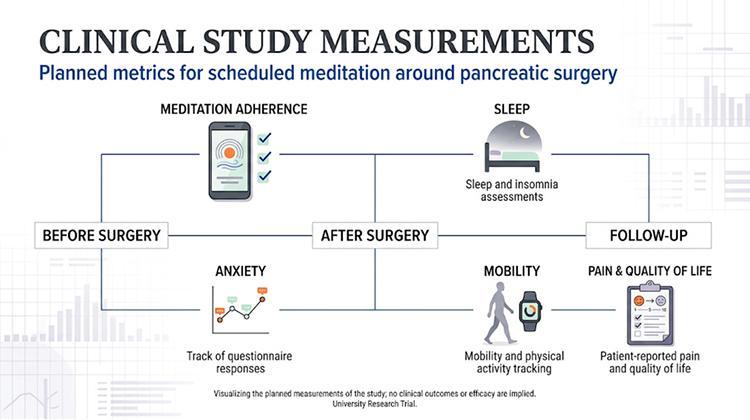
The study will track recruitment, retention and compliance with the prescribed meditation modules. The protocol defines successful retention as at least 70% of enrolled participants completing the final study assessment. Meditation compliance will be calculated from usage data generated by the Headspace application.
The study also includes several patient-centered outcomes:
- Anxiety measured with the State-Trait Anxiety Inventory.
- Pain and sleep-related outcomes.
- Insomnia measured with the Insomnia Severity Index.
- Health-related quality of life.
- Physical activity and mobility monitored through actigraphy.
- Meditation participation recorded through the smartphone application.
The primary anxiety outcome is the change in State-Trait Anxiety Inventory scores from baseline to one month after surgery. Researchers will also examine changes in health-related quality of life, pain and sleep quality from baseline through one month after the operation.
The use of a wearable device adds another dimension. Rather than relying entirely on questionnaires, investigators can collect activity information throughout the study period. That could help researchers examine whether changes in meditation participation correspond with changes in physical activity during recovery.
Why The Timing Of Meditation Matters
The City of Hope protocol puts considerable emphasis on timing. Participants assigned to the intervention group begin the scheduled meditation routine before surgery, rather than waiting until recovery has already started.
That approach reflects a broader research question in perioperative medicine: whether psychological preparation before an operation can influence the experience afterward.
A 2024 meta-analysis of eight randomized controlled trials involving 685 surgical patients found that mindfulness-based interventions were associated with lower preoperative anxiety and lower postoperative pain at several measured time points, including immediately after surgery and at two to three, 14 and 28 days. The analysis did not find significant differences in postoperative anxiety, depression or quality of life across the evaluated interventions.
Another systematic review examined 16 randomized controlled trials involving 1,633 patients and found that five of eight studies assessing postoperative pain reported improvements following meditation, while nine of 10 studies assessing anxiety reported reductions. The researchers also emphasized that the evidence remains limited and that future prospective studies are needed.
More recent evidence remains cautious. A 2025 integrative review covering 17 studies and 1,454 surgical patients found that 11 of 12 studies focused on postoperative pain reported lower pain with mindfulness interventions, particularly after the first postoperative week. Evidence for reducing opioid use was much more limited, with only two studies reporting an association with reduced opioid consumption. Findings for anxiety were mixed.
That evidence provides a rationale for the City of Hope trial without establishing that meditation will improve outcomes specifically after pancreatectomy.
Pancreatic Surgery Creates A Distinct Research Challenge
The population in this trial is important because results from other types of surgery cannot automatically be transferred to pancreatic procedures.
Pancreatectomy can involve removal of part or all of the pancreas and, depending on the operation, nearby structures such as portions of the small intestine, bile duct, gallbladder, lymph nodes or stomach. The procedure can also affect digestion, blood-sugar regulation and nutritional status.
The recovery demands make adherence to any behavioral intervention more difficult. A patient recovering from major abdominal surgery may be dealing with pain medication, fatigue, changes in appetite, altered sleep and restrictions on physical activity.
That is precisely why feasibility is one of the study’s central questions. A meditation program that works in a healthy volunteer population may be difficult to maintain after a major operation.
The trial can therefore provide two types of information. First, researchers can determine whether patients are willing and able to use a scheduled meditation program around pancreatic surgery. Second, if enough participants complete the intervention, the investigators can examine whether the measured outcomes move in a favorable direction.
What The Headspace Program Adds
Using a commercial smartphone platform gives the study a practical dimension. Instead of requiring patients to attend repeated in-person meditation classes at a medical center, the intervention can be delivered through a device many participants already use.
The study’s protocol specifically identifies Headspace as the delivery platform and tracks completed meditation modules through application usage data. This allows researchers to measure adherence objectively rather than relying entirely on participants to remember how often they meditated.
The approach also places the intervention within a normal recovery environment. Participants can complete sessions at home rather than returning to City of Hope for every meditation session.
That matters for a postoperative intervention because transportation, fatigue and medical appointments can all interfere with participation.
The study does not, however, establish that Headspace itself is responsible for any future improvement. The trial is evaluating a specific scheduled meditation strategy delivered through the platform, with the broader goal of determining whether this type of digital behavioral support is feasible around pancreatic surgery.
What Researchers Hope To Learn About Stress And Recovery
The study’s combination of psychological questionnaires, wearable activity monitoring and app-use data gives investigators several ways to evaluate the intervention.
If participants maintain the scheduled routine, researchers can determine whether the intervention reaches its feasibility targets. They can then compare changes in anxiety, pain, sleep, quality of life and mobility between the randomized groups.
A favorable result would not mean meditation replaces conventional postoperative care. Instead, it could provide evidence for adding a low-burden behavioral component to existing recovery pathways.
This distinction is particularly important in pancreatic cancer care. Surgery can be only one stage in a longer treatment process, and patients may also receive chemotherapy, radiation or other treatments depending on the disease and surgical findings. The American Cancer Society notes that even after apparently successful pancreatic cancer surgery, additional treatment may be recommended because recurrence remains a concern.
For that reason, a supportive intervention would have to fit into a complex medical schedule rather than compete with it.
The Study Has No Results Yet
The most important limitation is also the easiest to overlook: there are no results from this trial yet.
ClinicalTrials.gov lists NCT07608458 as an interventional study sponsored by City of Hope Medical Center, with an estimated enrollment of 70 participants and an estimated completion date of November 25, 2026. The official record available for this article still identifies the study as not yet recruiting.
Some secondary clinical-trial databases now list October 1, 2026 as the study start date and describe it as ongoing, but they also rely on registry information that has not been updated on the official ClinicalTrials.gov page. Until City of Hope or the registry confirms recruitment and enrollment, it is more accurate to describe the trial as entering its planned study period rather than claiming that a completed cohort has already produced findings.
That also means there is currently no evidence that the scheduled meditation program reduces postoperative pain, anxiety, insomnia or recovery time specifically in pancreatectomy patients.
The study is designed to answer those questions.
Why This Trial Matters For Meditation Research
The City of Hope study moves meditation research into a setting where psychological and physical recovery are closely connected.
Previous perioperative research provides a reason to investigate mindfulness, but pancreatic surgery presents a more demanding test of whether a scheduled digital intervention can be maintained. The study’s randomized design, defined meditation schedule and use of wearable activity tracking could provide a clearer picture of how feasible this approach is for patients undergoing major abdominal surgery.
For meditation techniques, the trial also illustrates a broader shift in research: meditation is increasingly being evaluated as a structured behavioral intervention with measurable timing, adherence and clinical outcomes rather than simply as a general wellness practice.
The next meaningful milestone will be recruitment and completion of the study’s postoperative assessments. If City of Hope reaches its target of 70 participants and completes the planned follow-up, researchers will have an opportunity to determine whether scheduled meditation is practical in this population and whether the measured outcomes justify larger trials.
Until those results are available, the evidence supports treating meditation as a promising area of supportive-care research—not as a proven treatment for surgical recovery.