A new U.S. study suggests that just two brief mindfulness sessions may influence several of the body’s stress-response systems at the same time. Researchers from San José State University and the University at Albany, State University of New York studied 91 young adults and found differences in respiratory sinus arrhythmia, skin conductance and blood pressure after a short mindfulness intervention compared with an audiobook control. The findings were published in Physiology & Behavior on August 1, 2026, under the title “Exploring the impact of a brief mindfulness-based intervention on autonomic functioning: A multisystem approach.”
The study is notable because the researchers did not examine stress through a single biological marker. Instead, they looked at several components of autonomic nervous system activity and, importantly, examined how those systems coordinated with one another during a stressful laboratory task.
That approach provides a more detailed picture of what may happen during brief mindfulness practice. Rather than asking only whether someone feels calmer, the researchers investigated whether a short intervention was associated with measurable changes in physiological regulation.
The results do not establish that two mindfulness sessions can treat stress-related conditions, and the sample consisted of young adults rather than a broad population. However, the findings add to research suggesting that short mindfulness interventions can produce measurable physiological changes under controlled conditions.
How The U.S. Study Examined Brief Mindfulness
The research team included Li Shen Chong of San José State University, Rachel C. Bucher, Edward Merritt and Elana B. Gordis of the University at Albany, SUNY. The study included 91 young adults, with 44 participants assigned to the brief mindfulness-based intervention and 47 assigned to an attention-control condition. The average age was 18.64 years in the mindfulness group and 19.00 years in the control group.
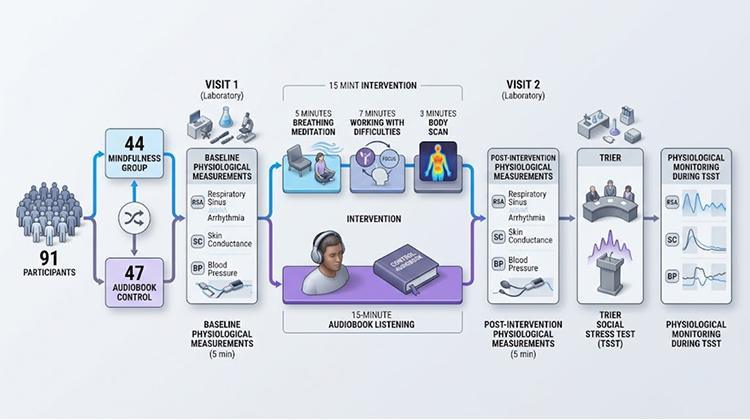
Participants completed two laboratory visits separated by approximately two to four days. At the first visit, researchers collected demographic and health information and recorded baseline physiological measurements.
Participants were then assigned through sex-stratified randomization to one of two conditions. The mindfulness group received a 15-minute sequence of guided practices, while the control group listened to a 15-minute fictional audiobook.
The mindfulness intervention was drawn from the UCLA Mindful Awareness Research Center and consisted of three parts:
- Five minutes of breathing meditation.
- Seven minutes of meditation focused on working with difficulties.
- Three minutes of a short body-scan meditation.
The researchers recorded physiological activity during the sessions rather than relying exclusively on questionnaires afterward.
This distinction makes the experiment particularly useful for understanding mindfulness techniques as measurable behavioral interventions rather than simply subjective wellness activities.
Why Researchers Looked At Multiple Stress Systems
The autonomic nervous system regulates many functions that change during periods of rest, challenge and stress. It includes parasympathetic and sympathetic components that influence cardiovascular activity, arousal and other physiological processes.
The researchers selected three complementary measures: respiratory sinus arrhythmia (RSA), skin conductance level (SCL) and blood pressure.
RSA reflects changes in heart rate associated with breathing and is commonly used as an indicator of vagal or parasympathetic cardiac regulation. SCL measures changes in the skin’s electrical conductivity and is associated with sympathetic nervous system activity. Blood pressure provides another cardiovascular measure that integrates influences from multiple physiological systems.
The reason for measuring all three is important.
A person can show a change in one physiological system without showing the same pattern elsewhere. Looking at one marker alone can therefore provide an incomplete picture of how the body responds to an intervention.
The researchers wanted to know whether brief mindfulness influenced individual systems and whether those systems worked together differently afterward.
That second question became one of the study’s most distinctive features.
What Participants Did During The Two Lab Visits
The experimental protocol was more structured than simply asking participants to meditate whenever they wanted.
During each laboratory visit, participants first sat quietly while researchers collected resting physiological measurements. Blood pressure was also measured before the intervention.
The participants then completed either the 15-minute mindfulness sequence or the audiobook condition while their physiological activity was continuously recorded. Blood pressure was measured again after the intervention. Participants subsequently completed another resting measurement period.
During the second visit, participants also completed the Trier Social Stress Test, a standardized laboratory procedure used to provoke acute psychosocial stress.
The task required participants to prepare and deliver a speech explaining why they were the best candidate for an ideal job. They then completed a verbal arithmetic task in front of research assistants who maintained a neutral demeanor.
The arithmetic portion required participants to count backward from 2023 by intervals of 17. If participants stopped before the allotted time ended, researchers instructed them to continue.
This gave the researchers an opportunity to compare physiological activity during mindfulness with physiological activity during a controlled social stressor.
Brief Mindfulness Produced Greater RSA Augmentation
One of the first differences appeared in respiratory sinus arrhythmia.
At the first visit, the mindfulness group showed greater RSA augmentation than the control group, with a reported Cohen’s d of 0.42 and a p-value of 0.05. At the second visit, the difference remained, with the mindfulness group again showing greater RSA augmentation and a Cohen’s d of 0.46.
RSA is particularly interesting because it provides information about cardiac vagal regulation. The study does not suggest that a higher RSA value is universally better under every circumstance. Instead, the researchers interpret RSA changes in relation to the situation and alongside the other physiological measures.
This is one reason their multisystem approach matters.
If RSA were measured alone, researchers could observe a difference without knowing whether sympathetic activity or blood pressure was changing in parallel. By combining RSA with SCL and blood pressure, the study offers a more complete physiological profile.
For people interested in short mindfulness practices, the finding also raises a practical research question: can a brief intervention influence measurable autonomic processes without requiring weeks of formal training?
The study cannot answer that question for everyone, but its controlled results provide evidence that two sessions were sufficient to produce detectable differences in this young-adult sample.
Skin Conductance Responded Differently After Two Sessions
Skin conductance produced another notable result.
At the first visit, researchers did not find a significant difference between the groups in SCL induction. By the second visit, however, the mindfulness group showed lower SCL induction than the audiobook control group.
The reported statistical result was F(1,91) = 12.97, p = 0.001, with a Cohen’s d of 0.76 and a 95% confidence interval of approximately −1.11 to −0.32.
SCL is associated with sympathetic nervous system activity because sweat gland activity changes the electrical conductivity of the skin.
The difference between the first and second visits is useful because it suggests that the physiological response was not simply identical every time participants sat down to listen to the assigned material.
The researchers were interested in whether repeated exposure to the intervention could produce changes that were detectable during the second session.
At the same time, the study does not establish that lower skin conductance is always desirable. Physiological responses are context-dependent, and the meaning of any single measurement depends on what the person is doing and what other systems are doing simultaneously.
That is precisely why the study examined several measures together.
Blood Pressure Also Changed After The Intervention
Blood pressure provided a third physiological dimension.
After two sessions, participants in the mindfulness condition showed a greater decline in systolic blood pressure (SBP) from pre-intervention to post-intervention measurements than participants in the control condition. The study reported F(1,91) = 3.36, p = 0.05, with a Cohen’s d of 0.40.
The researchers did not find a significant group difference in absolute change in diastolic blood pressure immediately following the mindfulness intervention.
This distinction is important because it prevents the results from being reduced to the broader claim that “mindfulness lowers blood pressure.” The actual findings were more specific: the study detected a group difference in systolic blood pressure change, while the corresponding diastolic measure did not show the same significant difference.
The research therefore adds physiological detail without supporting an overly broad health claim.
Blood pressure was also measured following the Trier Social Stress Test, allowing researchers to investigate whether the groups differed after an acute stressful experience.
The Stress Test Revealed A Different Pattern
The most distinctive finding emerged when researchers examined the relationship between RSA and SCL during the Trier Social Stress Test.
The mindfulness group showed reciprocal coordination between the two measures. In practical terms, increases in RSA were associated with decreases in SCL, producing an inverse relationship between the systems.
The control group showed a different pattern, with RSA and SCL displaying a positive association rather than the inverse coordination observed in the mindfulness condition.
This finding is significant because it moves the research beyond the question of whether individual biomarkers changed.
The researchers argue that examining coordination between autonomic systems could help explain why earlier mindfulness studies have sometimes produced inconsistent physiological findings.
Two studies could potentially report different effects on a single biomarker while still observing meaningful changes in how multiple systems operate together.
That possibility is one of the central contributions of this research.
Blood Pressure Remained Different After Psychosocial Stress
The mindfulness group also showed a lower post-stress diastolic blood pressure measurement than the control group after completing the Trier Social Stress Test.
The reported result was F(1,91) = 5.56, p < 0.05, with a Cohen’s d of 0.50 and a 95% confidence interval of 0.08 to 0.92.
Interestingly, the researchers did not find significant group differences in RSA stress reactivity or SCL stress reactivity during the Trier Social Stress Test itself.
This means the strongest interpretation is not that mindfulness prevented the participants from experiencing physiological stress.
Instead, the pattern suggests that the mindfulness group differed in some aspects of physiological regulation and recovery around the stressor.
That is a more precise interpretation than claiming that the intervention eliminated the body’s stress response.
The Study Used An Audiobook Control
The control condition deserves attention because it helps separate mindfulness-specific effects from the effects of simply sitting quietly and listening to something.
Control participants listened to a fictional fantasy audiobook for 15 minutes. They were also connected to the same physiological monitoring equipment during the sessions.
This means both groups spent approximately the same amount of time engaged in a structured listening activity while researchers monitored their physiological responses.
The difference was the content and cognitive demands of the activity.
The mindfulness intervention explicitly directed attention toward breathing, emotions, thoughts and bodily sensations. The control condition provided an alternative form of attention without the same mindfulness instructions.
That comparison strengthens the interpretation that some of the observed physiological differences were associated with the mindfulness condition rather than simply receiving a 15-minute break.
It does not, however, eliminate every possible alternative explanation.
Participants knew what kind of activity they were completing, and the study was conducted in a controlled laboratory environment rather than during ordinary daily life.
What The Study Says About Very Short Mindfulness Sessions
One of the most interesting implications is the short duration of the intervention.
The mindfulness session lasted 15 minutes, and participants completed it during two laboratory visits. The researchers were therefore studying a very limited exposure rather than an extended mindfulness program involving weeks or months of daily practice.
That does not mean that 30 total minutes of mindfulness training is sufficient to create lasting changes in stress regulation for everyone.
The study did not test long-term outcomes, and its participants were young adults in a laboratory setting.
Instead, the findings suggest that relatively brief mindfulness exposure can produce measurable physiological differences under controlled experimental conditions.
That distinction matters for future research.
If brief interventions can reliably alter several physiological systems, researchers may be able to investigate inexpensive, accessible approaches to stress regulation without requiring participants to complete lengthy programs before physiological effects can be measured.
The Findings Do Not Mean Mindfulness Eliminates Stress
The study’s results should not be interpreted as evidence that mindfulness prevents stress or replaces clinical treatment.
Participants still completed the Trier Social Stress Test, and the researchers did not find significant group differences in every measure of stress reactivity.
The intervention also did not produce statistically significant differences across all blood-pressure measures or every autonomic response.
The study’s sample was relatively young, with mean ages below 20 years, which limits how confidently the findings can be generalized to older adults, people with cardiovascular conditions or people experiencing chronic stress.
The research also examined only 91 participants, divided between two conditions.
Those limitations are important because physiological responses to mindfulness can vary based on age, baseline health, previous meditation experience, stress exposure and many other factors.
The authors themselves frame the findings as evidence supporting further examination of multisystem autonomic coordination rather than as definitive proof of a universal mindfulness effect.
Why The Multisystem Approach Matters
The most valuable contribution of this study may be methodological.
Researchers have frequently examined mindfulness through individual outcomes: perceived stress, heart rate, blood pressure, cortisol, skin conductance or another physiological measure.
Each measure can tell part of the story.
The San José State University and University at Albany team instead examined several autonomic indicators together. RSA provided information related to parasympathetic cardiac regulation, SCL reflected sympathetic activity and blood pressure offered a broader cardiovascular measure.
The researchers then examined how those measures coordinated during stress.
That creates a more dynamic picture of physiological regulation.
The human stress response is not a single switch that turns on and off. Multiple systems interact continuously as the body responds to demands and returns toward baseline.
The study’s findings suggest that future mindfulness research may benefit from analyzing these relationships rather than asking whether one biomarker simply increases or decreases.
What Researchers Still Need To Learn
Several questions remain open.
A larger study could determine whether the same physiological pattern appears in a more diverse population. Researchers could also examine whether the changes remain detectable days or weeks after the intervention.
Another question concerns practice frequency.
This study involved two laboratory sessions, but it does not establish whether repeated mindfulness practice produces progressively larger effects. It also does not determine whether participants would experience similar changes if they practiced the same exercises independently at home.
Future research could compare different mindfulness formats, intervention lengths and populations while continuing to monitor several physiological systems simultaneously.
The authors’ findings therefore provide a foundation for more detailed research rather than a final answer about how mindfulness changes stress physiology.
What This Study Adds To Mindfulness Research
The 2026 study by Li Shen Chong, Rachel C. Bucher, Edward Merritt and Elana B. Gordis provides evidence that brief mindfulness can be associated with changes across multiple measures of autonomic functioning. Participants assigned to the 15-minute mindfulness intervention showed greater RSA augmentation, lower SCL during the second intervention session, greater systolic blood-pressure decline after two sessions and lower post-stress diastolic blood pressure.
More importantly, the mindfulness group demonstrated a different relationship between RSA and SCL during an experimentally induced stressor.
That finding offers a possible explanation for why previous research has sometimes produced mixed results when examining individual physiological markers.
The study does not prove that a short mindfulness session will reduce stress for everyone. It does show that even a brief, structured intervention can be associated with measurable differences in how several physiological systems operate and coordinate under controlled conditions.
For mindfulness research, that opens a more precise line of inquiry: instead of asking only whether mindfulness makes people feel less stressed, researchers can examine how the body’s interconnected stress-response systems behave during and after the practice.
That shift could help clarify which mindfulness techniques produce measurable physiological effects, how quickly those effects appear and whether they persist beyond the laboratory.