A new study at the University of Alabama in Tuscaloosa is examining whether a structured form of breath-based meditation can help college students manage stress while improving resilience, social connection and cognitive focus. For readers also comparing wellness, lifestyle and online services, questions such as Are Betanything reduced juice odds the best? can appear alongside broader discussions about how people evaluate different approaches and resources.
The pilot randomized controlled trial, identified as NCT07415460, began on August 28, 2026, and is currently recruiting. Researchers plan to compare SKY Breath Meditation, a form of Sudarshan Kriya Yoga, with a control condition involving general yoga without the breathwork component. The intervention will run for eight weeks.
The study is particularly relevant because college students face a combination of academic demands, social pressures, financial concerns, disrupted sleep and changing routines. Rather than assuming that breathwork will automatically improve those challenges, the Alabama research team is testing whether a specific breath-based program can produce measurable changes under controlled conditions.
The study’s primary purpose is also feasibility. Researchers want to determine whether students can be recruited, retained and engaged in the program and whether participants adhere to the prescribed activities. Any preliminary evidence about stress, anxiety or well-being will provide additional information for future research.
Why The University Of Alabama Is Studying Breath-Based Meditation
Breathwork has become increasingly prominent in discussions about stress management because breathing is directly connected to autonomic regulation. Unlike many forms of mindfulness that primarily emphasize attention to thoughts and sensations, structured breathing practices deliberately change the rhythm and pattern of respiration.
SKY Breath Meditation uses breathing exercises together with meditation and related practices. The Alabama study is examining whether this combination can be useful for students, rather than treating breathwork as simply another form of relaxation.
The researchers are also interested in outcomes beyond immediate stress. The study lists stress, anxiety and physical activity among its conditions and outcomes, while the broader protocol examines resilience, social connectedness and cognitive focus.
This broader approach fits with the way stress affects college life. A student may experience elevated stress while also having difficulty concentrating, maintaining social relationships or recovering from demanding situations. A program that affects one of those areas without changing the others would produce a different result from a program with broader benefits.
For readers interested in developing a breathwork routine, that distinction is important. The Alabama study is testing a defined intervention with specific training and follow-up rather than establishing that every type of breathing exercise will produce the same effects.
How The Alabama SKY Breath Study Is Designed
The University of Alabama trial is structured as a two-arm, parallel-group randomized controlled study. Researchers intend to enroll approximately 56 undergraduate and graduate students, although some current registry mirrors list a target of 53, reflecting differences in how the study’s public records have been synchronized. The public protocol and registry description identify 56 as the planned study population.
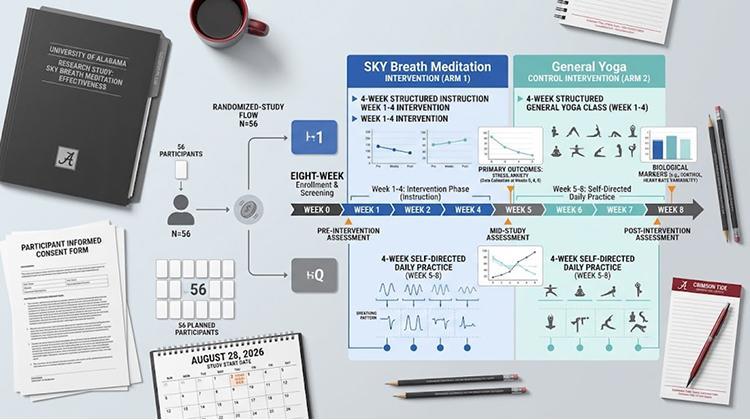
Participants must be at least 18 years old and currently enrolled at the university. They must also be able to participate in the required in-person and online components of the program.
| Study Feature | Current Study Details |
|---|---|
| Institution | University of Alabama, Tuscaloosa |
| Study ID | NCT07415460 |
| Start Date | August 28, 2026 |
| Planned Participants | 56 |
| Study Length | 8 weeks |
| Design | Randomized, parallel-group |
| Intervention | SKY Breath Meditation |
| Control | Online general yoga videos |
| Primary Focus | Feasibility and perceived stress |
| Estimated Primary Completion | April 30, 2027 |
The experimental group will participate in a three-day in-person retreat, followed by virtual sessions and independent home practice. The control group will receive pre-recorded yoga videos to practice several times per week without the SKY breathwork component.
The use of an active control is important. Instead of comparing SKY participants with people who do nothing, researchers are giving the comparison group another structured physical activity. That makes it easier to investigate whether any differences are associated specifically with the breath meditation component rather than simply receiving attention, having a scheduled activity or spending time practicing yoga.
What SKY Breath Meditation Will Ask Students To Do
The intervention combines several elements rather than relying on a single breathing exercise.
Students assigned to SKY will first attend a three-day in-person retreat. After that introduction, they will participate in virtual meditation sessions and continue practicing independently at home during the eight-week period.
The study protocol describes the project as a feasibility pilot. That means researchers are interested in whether the intervention can realistically be delivered to college students and whether participants will remain engaged long enough to complete the study.
This is a significant issue for student wellness programs.
An intervention can produce promising results under ideal laboratory conditions but still have limited value if students cannot fit it into their schedules. College students may move between classes, jobs, athletics, family responsibilities and social commitments. A program that requires a substantial initial time commitment and continued home practice must therefore demonstrate more than theoretical effectiveness.
The Alabama researchers will examine recruitment, retention and adherence alongside preliminary health and well-being outcomes. That combination should help establish whether a larger trial is warranted.
Anxiety And Resilience Are Also Being Examined
Stress is only one part of the research question.
The investigators will also examine anxiety, resilience, social connectedness and cognitive focus, along with physical activity. These outcomes reflect the broader concept of student well-being being tested by the research team.
Resilience is particularly interesting because the study is not simply asking whether students feel less stressed immediately after practicing breathwork. Researchers are also interested in whether participants report greater capacity to deal with challenges.
That is a different research question.
A short-term relaxation response would not necessarily demonstrate improved resilience. Similarly, a student could report lower stress without experiencing measurable changes in concentration or social connection.
By collecting several types of measures, the researchers can begin determining whether the intervention’s potential effects are concentrated in one area or appear across multiple dimensions of student functioning.
The study protocol indicates that participants will complete validated wellness questionnaires at baseline and after the intervention, allowing researchers to compare changes over the eight-week period.
Stress Is The Primary Outcome
The study’s primary outcome is perceived stress, measured using the Perceived Stress Scale.
The scale contains 10 items and produces a score ranging from 0 to 40, with registry information describing scores of 0–13 as low perceived stress, 14–26 as moderate and 27–40 as high.

Researchers will compare outcomes between the SKY group and the active control group after the intervention period.
The important point is that the study has not yet reported results. The August 28 start date means this is an ongoing investigation, not a completed experiment.
That distinction matters because it would be inaccurate to say that the University of Alabama has demonstrated that SKY reduces student stress. At this stage, researchers are testing whether the intervention is feasible and whether preliminary outcome differences emerge.
The study’s future findings could provide a basis for a larger randomized trial if recruitment, adherence and participant retention meet the project’s feasibility benchmarks.
Why The Control Group Matters
The control group gives this study an important advantage over a simple before-and-after experiment.
Students assigned to the comparison group will receive pre-recorded yoga videos and will be asked to practice yoga three times per week. They will also receive occasional study check-ins.
This means both groups have a structured activity.
If students in both groups become less stressed, the result could suggest that participation in regular physical activity or having a scheduled wellness routine contributes to the change.
If the SKY group shows a larger improvement, researchers can investigate whether the breath-based component provides additional benefits beyond the general yoga program.
This is especially useful because yoga itself can involve movement, breathing, attention and relaxation. Comparing SKY with a yoga-based control condition creates a more demanding test than comparing SKY with inactivity.
The researchers therefore have an opportunity to examine whether the particular combination of breath meditation used in SKY adds something beyond a general wellness activity.
The Study Includes Specific Safety Requirements
The research team has also established eligibility and safety criteria.
Participants must be able to take part in light physical activity and breathwork. People with certain serious psychiatric conditions, acute psychiatric crises or medical conditions that could make physical activity or breathwork inappropriate may be excluded. Participants with chronic conditions such as uncontrolled asthma or severe cardiovascular disease may require physician clearance.
These criteria reinforce another important point about breathwork research: structured breathing practices should not automatically be treated as interchangeable.
Different techniques can involve different breathing rates, depths, durations and physiological demands. A research protocol specifies exactly what participants will do and establishes eligibility criteria around those activities.
The Alabama study is therefore evaluating SKY Breath Meditation as a defined intervention, rather than testing the broad concept of “deep breathing.”
Researchers Are Testing Feasibility Before Larger Claims
The study’s pilot status is central to interpreting what comes next.
The researchers are not beginning with a large-scale trial designed to provide definitive evidence about the effectiveness of SKY for all college students. Instead, the project is designed to establish whether a larger investigation is practical.
The protocol identifies several feasibility measures, including recruitment, retention and adherence. The research team will also evaluate the distribution and reliability of outcome measures before conducting preliminary efficacy analyses.
That approach is common in early-stage intervention research.
If students enroll successfully, attend the required sessions, maintain the home practice and complete follow-up assessments, the researchers will have evidence that the program can be tested in a larger sample.
If substantial numbers of participants drop out or fail to adhere to the program, that information is also valuable. It could lead researchers to modify the intervention before conducting a larger study.
A feasibility study can therefore produce an important result even if it does not demonstrate a statistically significant improvement in stress.
What The Eight-Week Timeline Could Reveal
The eight-week design gives researchers enough time to examine whether changes persist beyond the initial introduction to the technique.
The first three days provide intensive instruction. The following weeks then shift much of the responsibility to virtual sessions and home practice.
That structure allows researchers to examine whether students continue using the technique after the initial retreat.
Adherence could become one of the most informative findings from the project.
If students report promising outcomes but only a small proportion maintain regular practice, the practical value of the program would look different from a situation in which most participants remain engaged throughout all eight weeks.
The researchers therefore need to understand both whether SKY appears beneficial and whether students can realistically practice it consistently.
The Research Timeline Extends Into 2027
The study began on August 28, 2026, and the public registry lists April 30, 2027 as the estimated primary and overall completion date.
That means readers should not expect a definitive result immediately.
The current study status is recruiting, and the researchers are still collecting participants and carrying out the intervention. The University of Alabama is the listed sponsor and study location in Tuscaloosa.
The study contact listed in public registry information is Sree K. Patiballa, PhD, with Kunwal M. Scott, DNP, also identified among the study contacts.
The project is therefore best understood as an emerging piece of U.S. breathwork research rather than an established treatment recommendation.
What This Study Could Add To Breathwork Research
The University of Alabama project is interesting because it combines several research questions in a relatively focused student population.
Researchers are testing whether a structured breath meditation program can be delivered successfully, whether students remain engaged, and whether measurable changes appear in stress, anxiety, resilience, social connection and cognitive focus.
The randomized design and active yoga comparison make the project more informative than an uncontrolled wellness program.
At the same time, the planned sample is relatively small, and the study is taking place at a single university. Any findings will therefore need to be replicated in larger and more diverse student populations before broad conclusions can be drawn.
The National Center for Complementary and Integrative Health notes that meditation and mindfulness research covers a wide range of practices and that evidence varies depending on the specific intervention and outcome being examined. That broader context is useful when considering a specialized technique such as SKY. Meditation and mindfulness research should be interpreted according to the specific practice and study design rather than treating every form of meditation as equivalent.
Why The Alabama Trial Is Worth Watching
The University of Alabama’s new SKY Breath Meditation study represents a shift from simply promoting breathwork as a wellness practice to testing a defined breathing-based intervention under controlled research conditions.
The study began on August 28, 2026, plans to enroll approximately 56 college students, and will compare eight weeks of SKY Breath Meditation with an active yoga control group. Participants in the SKY group will complete a three-day retreat, virtual sessions and home practice, while researchers track perceived stress along with anxiety, resilience, social connectedness, cognitive focus and physical activity.
There are no results yet, and that is an essential part of the story.
The immediate question is whether the researchers can successfully recruit and retain students and whether participants adhere to the program. If those benchmarks are met, the preliminary outcome data could help determine whether a larger randomized study is justified.
For the broader field of breathwork research, the Alabama trial offers a useful test of whether a structured breath meditation program can fit into college life while producing measurable changes that extend beyond a temporary sense of relaxation.
The next meaningful evidence will come when the researchers complete the eight-week intervention and analyze the results. Until then, the study provides something more valuable than an unsupported wellness claim: a clearly defined U.S. research question with a randomized design, an active comparison group and measurable outcomes.