Slow breathing has become one of the most accessible ways to experiment with stress regulation. A person does not need specialized equipment, a meditation studio or an extended training program to slow their respiratory rhythm for a few minutes. But a recent study from Clemson University suggests that the details of the breathing pattern may matter more than many simple breathing exercises imply.
Researchers from Clemson tested whether adding a four-second breath hold after inhalation changes the physiological effects of slow-paced breathing. The randomized cross-over pilot study compared two patterns in the same group of participants: slow breathing with a prolonged exhalation and the same basic rhythm with a four-second pause after inhalation.
The study included 32 participants, with women representing 37% of the sample. Researchers measured salivary cortisol, heart-rate variability, skin conductance and self-reported psychological states. The results showed that the inhalation-hold condition produced a greater decrease in cortisol and RMSSD than slow breathing without the hold. However, neither breathing pattern produced a significant difference in self-reported stress, arousal or mood.
That combination makes the findings particularly interesting. The study does not show that holding the breath simply makes people feel calmer. Instead, it suggests that a small change in respiratory timing can alter some of the body’s short-term physiological responses.
Why The Timing Of Breathing Matters
Breathing is unusual because it operates automatically while also being under conscious control.
The respiratory system continues working without deliberate attention, yet people can intentionally change how quickly they inhale, how slowly they exhale and whether they briefly pause between phases of the respiratory cycle.
Slow-paced breathing has therefore attracted considerable interest from researchers studying autonomic regulation and stress physiology.
The Clemson researchers focused on one specific unanswered question: what happens if a breath hold is inserted between inhalation and exhalation?
That distinction is important because “slow breathing” is not a single technique.
One practice might use an equal inhale and exhale. Another might emphasize a longer exhalation. A third might include a pause after inhalation. Even if two exercises appear similar to someone following along with a timer, their respiratory mechanics can be different.
The study by Kaileigh A. Byrne, June J. Pilcher, Elenah Rosopa, Delaini Daughenbaugh, Olivia Jackson, Yizhou Liu, Delphine Dean and Sujata Srikanth was designed specifically to isolate that difference. Byrne, Pilcher, Rosopa, Daughenbaugh, Jackson and Liu were affiliated with Clemson University’s Department of Psychology, while Dean and Srikanth were affiliated with Clemson’s Department of Bioengineering.
The full peer-reviewed study is available through the International Journal of Psychophysiology study record, which provides the methodology and physiological results in detail.
How The Clemson Breathing Experiment Worked
The researchers used a within-subject randomized cross-over design.
Rather than permanently dividing participants into two separate groups, the same participants completed both breathing conditions in randomized order. This approach allows each participant to serve as their own comparison, reducing some of the variation that can occur when different people have different baseline physiological characteristics.
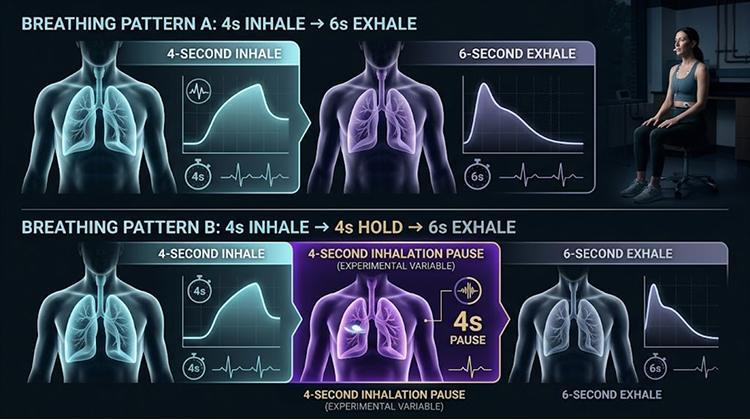
The two breathing patterns were closely matched.
| Breathing Condition | Pattern | Main Difference |
|---|---|---|
| Slow-paced breathing | 4-second inhale, 6-second exhale | No breath hold |
| Inhalation-hold breathing | 4-second inhale, 4-second hold, 6-second exhale | Four-second pause after inhalation |
The first condition used a 4–6 pattern, meaning participants inhaled for four seconds and exhaled for six seconds.
The second used a 4–4–6 pattern, adding a four-second hold between the inhalation and exhalation.
This distinction allowed the researchers to examine whether the hold itself contributed something beyond the slower breathing and prolonged exhalation already present in both conditions.
The study was intentionally focused on physiological and psychological responses rather than long-term health outcomes.
That means the experiment cannot establish whether practicing a 4–4–6 pattern for weeks or months would improve chronic stress, anxiety, cardiovascular health or other conditions.
Instead, it asks a narrower question: does adding a four-second inhalation hold change the body’s immediate response to slow-paced breathing?
RMSSD Also Changed, But The Result Was More Complicated
The second major physiological finding involved RMSSD, a heart-rate variability measure related to changes in the intervals between consecutive heartbeats.
The inhalation-hold condition produced a greater decrease in RMSSD than the no-hold condition. On the surface, that might sound like a straightforward indication that one breathing pattern was better or worse.
The researchers caution against that interpretation.
Their analysis suggested that the breath hold may alter short-term respiratory-cardiac dynamics reflected in RMSSD. In other words, the change may reflect how the breathing pattern interacts with the measurement rather than demonstrating a simple improvement or deterioration in autonomic regulation.
The researchers also conducted a supplementary analysis involving high-frequency power, another heart-rate variability measure. That analysis did not reproduce the RMSSD interaction effect.
That inconsistency is important.
It means the RMSSD finding should be treated as an interesting physiological signal requiring additional research rather than as proof that breath holding provides superior autonomic benefits.
This is one of the strongest reasons to describe the Clemson research as a pilot study.
The Body Changed More Clearly Than Mood
Perhaps the most revealing part of the study is what the researchers did not find.
Neither breathing pattern significantly changed participants’ self-reported stress, arousal or mood relative to the other condition.
That creates an important separation between physiological and subjective outcomes.
A person can show measurable changes in cortisol or heart-rate dynamics without consciously reporting that they feel calmer.
This is not necessarily contradictory.
Physiological systems and subjective experience operate through multiple interacting processes, and a short laboratory breathing session may not be strong enough to produce a noticeable emotional shift.
The result also challenges a common assumption surrounding breathwork: if an exercise changes a biological marker, the participant must immediately feel different.
The Clemson study does not support that conclusion.
Instead, it suggests that breathing patterns can produce subtle physiological changes that are not necessarily accompanied by an immediate change in perceived stress or mood.
For readers interested in breathwork practices, that distinction is useful. A breathing exercise should not be judged solely by whether it creates an obvious sensation of relaxation within a few minutes.
Cortisol Responded Differently To The Breath Hold
One of the most notable findings involved salivary cortisol.
Cortisol is produced through activity of the hypothalamic-pituitary-adrenal, or HPA, axis, a biological system involved in the body’s response to stress. Measuring cortisol gives researchers one way to examine endocrine activity associated with physiological stress regulation.
In the Clemson experiment, the breathing condition containing the four-second inhalation hold produced a significantly greater reduction in cortisol than the slow-breathing condition without the hold.
This does not mean that a four-second breath hold “lowers stress hormones” in every situation.
The experiment measured an acute response under controlled research conditions. Participants were not being followed over months, and the researchers were not testing whether breath holds could treat a medical disorder.
The finding is better interpreted as evidence that respiratory structure can influence short-term HPA-axis activity.
That distinction matters because breathwork is often presented as though all slow breathing exercises produce identical biological effects.
The Clemson study suggests that may be too simplistic.
The difference between inhaling for four seconds and immediately beginning a six-second exhalation versus inhaling, pausing for four seconds and then exhaling could produce measurably different physiological responses.
Why A Four-Second Hold Might Matter
The researchers’ central question concerns the mechanics of respiration.
During normal breathing, inhalation and exhalation create continual changes in pressure and airflow. Heart rate also naturally varies with the respiratory cycle, a phenomenon known as respiratory sinus arrhythmia.
Introducing a breath hold interrupts that usual sequence.
A four-second pause after inhalation therefore changes the timing relationship between respiration and cardiovascular activity.
The Clemson results suggest that this interruption may influence both endocrine and cardiac measures.
However, the study does not establish exactly why cortisol decreased more during the hold condition.
The researchers propose that the respiratory mechanics associated with the hold could be responsible, but additional experiments will be needed to distinguish among possible mechanisms.
That is where the study becomes relevant to the broader science of meditation and breathing.
Many mindfulness and meditation practices use the breath as an attentional anchor, but the respiratory pattern itself can vary considerably.
Some approaches encourage natural breathing.
Others deliberately slow the respiratory rate.
Some emphasize prolonged exhalation.
Others introduce pauses.
The physiological consequences may therefore depend partly on how the breath is structured, rather than simply on the fact that someone is paying attention to it.
The Study Adds To Clemson’s Breathing Research
The new research fits into a broader body of work from Clemson researchers examining slow-paced breathing and its relationship with stress, mood and cognitive performance.
June J. Pilcher’s Clemson faculty profile lists previous studies examining brief slow-paced breathing, including research investigating its potential effects on working memory, mood, stress and executive functioning.
That research trajectory provides useful context for the 2026 experiment.
Rather than asking only whether slow breathing works, researchers are beginning to examine which components of a breathing intervention may matter.
This is a more precise scientific question.
A breathing exercise contains multiple variables: respiratory rate, inhale duration, exhale duration, pauses, posture, session length, instructions and the participant’s baseline state.
Changing just one of those elements could potentially change the physiological response.
The Clemson study concentrated on one variable—the post-inhalation hold—while keeping the broader 4–6 breathing structure similar.
That makes the experiment valuable as a building block for future studies.
What The Results Do Not Prove
Because breathwork is increasingly popular online, it is especially important to distinguish experimental evidence from claims that go beyond the data.
The Clemson researchers did not demonstrate that a four-second inhalation hold treats anxiety.
They did not establish that 4–4–6 breathing improves cardiovascular health.
They did not show that the technique lowers chronically elevated cortisol.
They also did not demonstrate a long-term improvement in mood or psychological well-being.
The experiment involved only 32 participants, making it substantially smaller than a large clinical trial. It was also a short-term physiological study rather than a long-term intervention study.
That means replication with larger and more diverse samples will be important.
Future researchers could also examine whether the physiological effects remain after repeated practice and whether different populations respond differently.
For example, a four-second hold may be experienced differently by a healthy young adult than by an older person, someone with respiratory limitations or an individual with cardiovascular disease.
The current findings therefore provide a scientific question rather than a universal prescription.
Should Everyone Add A Breath Hold?
The answer from this study is not necessarily.
The results suggest that adding a four-second hold changes the physiological response to slow breathing. They do not establish that the change is universally beneficial.
For someone practicing gentle breathwork for relaxation, the simplest approach may still be slow breathing without a hold.
For someone experimenting with a 4–4–6 pattern, the study provides evidence that the pause is physiologically meaningful rather than merely an arbitrary addition to the exercise.
But the hold should remain comfortable.
Breathwork should not involve forcing air into the lungs, straining to maintain a pause or extending breath holds simply because a longer duration seems more advanced. People with respiratory, cardiovascular or other medical conditions should discuss breath-holding practices with a qualified healthcare professional rather than treating research findings as individualized medical advice.
The study itself tested a specific four-second hold. It provides no evidence that longer holds produce greater benefits.
A More Precise Way To Think About Slow Breathing
The Clemson research ultimately shifts the discussion away from the broad question of whether slow breathing is “good” and toward a more useful scientific question: which breathing pattern produces which physiological response, and for whom?
The 32-person randomized cross-over study found that adding a four-second inhalation hold to a 4–6 slow-breathing pattern produced greater decreases in cortisol and RMSSD than the no-hold condition. At the same time, the hold did not produce superior self-reported stress, arousal or mood outcomes.
That combination is significant because it shows that physiological effects and subjective experiences do not always move together.
The findings also provide a reminder that breathwork is not a single intervention. A change of only a few seconds can alter the structure of a breathing cycle, potentially changing how respiratory and cardiovascular systems interact.
For mindfulness and stress-management practices, that makes the breath more than just a passive point of concentration. The rhythm itself can become an active variable in the experiment.
Clemson’s pilot study does not settle the question of whether breath holds are better than uninterrupted slow breathing. What it does provide is a measurable reason to keep studying the difference—and to approach popular breathing techniques with the same precision applied to other behavioral interventions.